Failed Experiments · Chemistry
The Chemist Who Failed to Make Diamonds — and Got the World's Favorite Fake One Named After Him
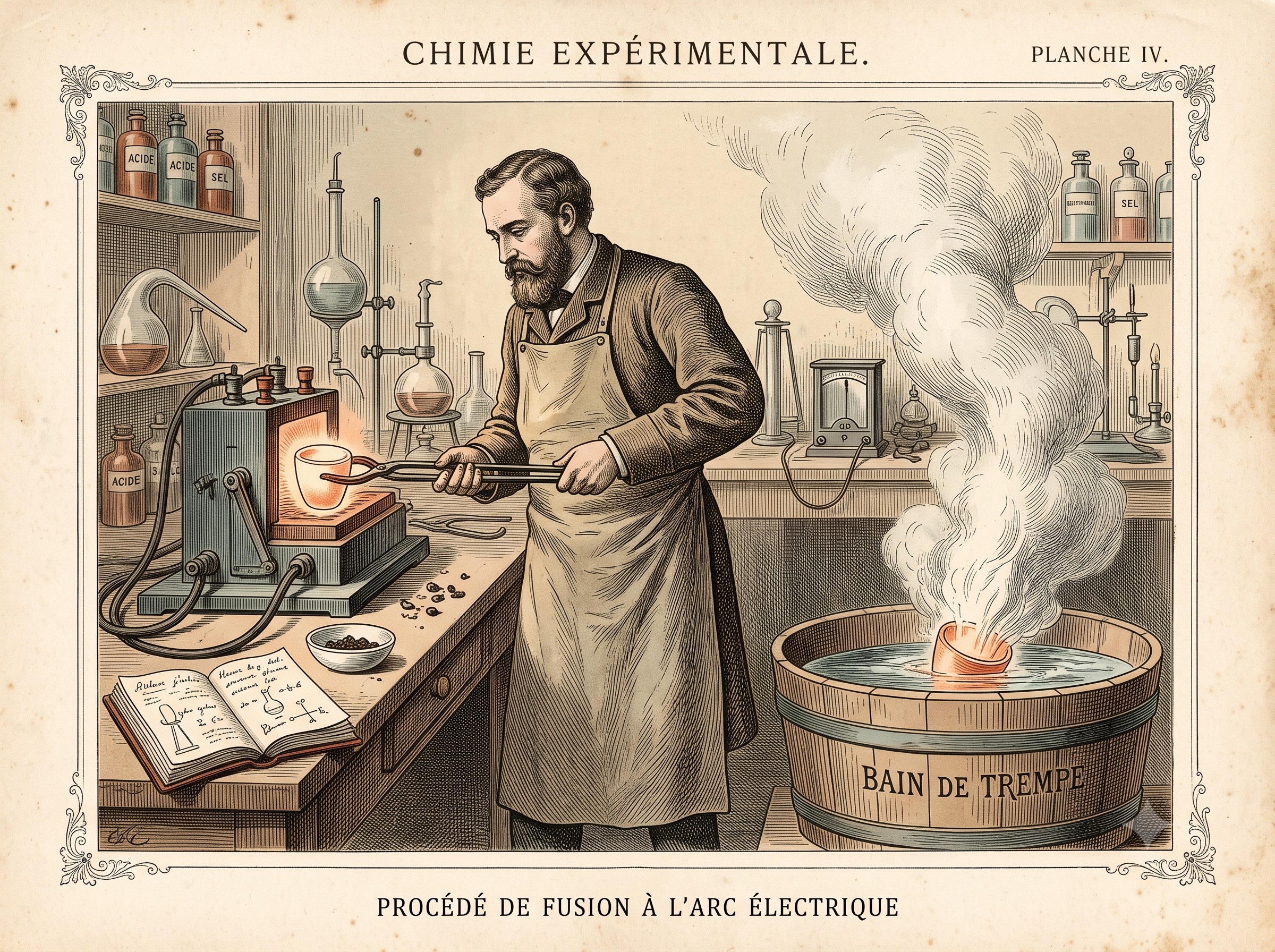
Paris, 1893. A crucible of molten cast iron glowing at around 3,000°C is hauled from an electric furnace and plunged into cold water. Days of acid baths later, Henri Moissan tips the residue into his palm: dark grit, the largest grain three-quarters of a millimeter across. He tells the French Academy of Sciences he has made diamonds, and he will believe it until he dies fourteen years later. He is wrong — and the leading theory about *why* he kept getting positive results is that somebody in his lab was being kind to him.
By the Curiosities Desk · · 5 read · Filed under Chemistry · Today’s round
What happened?
Moissan was not a crank. Seven years earlier he had isolated fluorine, the most reactive element on the periodic table — a substance that had poisoned, injured, and in some cases killed the chemists who tried before him. In 1892 he built the tool that would define the rest of his career: an electric arc furnace that could hold temperatures above 3,000°C, hotter than anything a chemist had reliably had before.
Then he went looking for something to melt, and diamonds were the obvious prize. Moissan studied where they turned up in nature, and one site stood out: the Canyon Diablo meteorite in Arizona, where two small diamonds had been found sitting inside a mass of iron. Carbon dissolves readily in molten iron, and iron kept showing up wherever diamonds did. “Nature,” Moissan wrote, “seems to have been caught in the act.”
His plan was elegant. Dissolve sugar charcoal — a very pure amorphous carbon made by burning sugar — into molten cast iron, then quench the crucible in water. Cast iron does something unusual as it changes state: it expands as it solidifies, then contracts as it cools. Quench it from outside and you get a hardening, shrinking shell clamped around an interior still trying to expand. That squeeze, Moissan reasoned, would be the pressure that turns carbon into diamond.
He ran it, dissolved the iron away in acid, and got crystals. Density: close to 3, the right neighborhood for diamond. Hardness: harder than ruby. Combustibility: they burned in oxygen, which mattered most to him, because pure carbon burns and hard mineral impostors mostly do not. In February 1893 he reported to the Academy, and newspapers ran with it.
There was one loose thread. His crystals did not burn completely; they left an ochre-colored ash. Moissan explained it away as a low-grade diamond and moved on.
Others tried to repeat the work. The German chemist Otto Ruff and the British engineer Sir Charles Parsons — inventor of the steam turbine — each believed for a while that they had, and each retracted. Parsons spent decades on it and found the tell: the more contaminated his iron was with silicon, aluminum, magnesium, or chromium, the more “diamonds” he got. With genuinely pure iron, almost none. That is backwards for diamond synthesis and exactly right for carbides and spinels, hard dense crystals that are not carbon at all. By 1928, when the metallurgist C. H. Desch reviewed the affair in Nature, the verdict was in.
Moissan never heard it. He won the 1906 Nobel Prize in Chemistry, for isolating fluorine and for the electric furnace, and died in February 1907, still convinced.
The explanation everyone repeats reaches us second-hand: Moissan’s widow is said to have told Parsons she believed one of her husband’s assistants had been slipping fragments of natural diamond into the experiments — in her reported phrase, to please the old man. It deserves an honest label. No assistant was ever named, no confession was ever recorded, and the case against Moissan’s diamonds rests not on that story but on decades of failed replication.
Why was it strange?
The strange part is not that a scientist was wrong. It is that this scientist, in a world-class lab with the best furnace on Earth, produced a result the field took sixty years to settle — and that his underlying model was actually correct. Diamonds really do form from carbon dissolved in metal under high pressure and high temperature. He had the heat, the metal solvent, and the right intuition about the meteorite. He was missing only pressure, and had convinced himself the thermal quirks of cast iron supplied it. The tests that fooled him were reasonable ones, too: density, hardness, and combustibility all fit silicon carbide, a substance almost nobody was thinking about in 1893.
The same thread — Replication — continues in Cold Fusion: The Breakthrough That Wasn’t.
What did scientists learn?
Diamond and graphite are both pure carbon. They are allotropes — the same element arranged into different crystal structures — and which one carbon adopts depends on pressure and temperature.
Calculations eventually showed diamond becomes the thermodynamically preferred form somewhere above roughly 15,000 atmospheres. But “preferred” is not “achievable.” In 1947 the Harvard physicist Percy Bridgman demonstrated the gap brutally: at room temperature, even 400,000 atmospheres would not turn graphite into diamond, because the bonds will not rearrange without heat to loosen them. The recipe needs all three at once — crushing pressure, extreme heat, and a molten metal solvent so carbon atoms can migrate and re-stack. Moissan had two. Nobody in 1893 could build a vessel that held the third.
The other lesson is methodological: an experiment whose product can only be identified by proxy measurements can fool a genius, and the only defense is patient replication.
Another experiment that taught more by not working: Smell-O-Vision: The Movie That Hissed Perfume at Its Audience and Left Them Sniffing.
How does it affect us today?
The problem Moissan opened was closed in the 1950s. Erik Lundblad and the Swedish firm ASEA got there first, in February 1953, and told almost no one. Then on 16 December 1954, at General Electric’s lab in Schenectady, New York, the chemist H. Tracy Hall squeezed graphite and iron sulfide in a “belt press” of his own design and made diamonds GE could reproduce on demand. GE announced it on 15 February 1955, and that is the announcement the world heard.
Synthetic diamond stopped being a parlor trick and became infrastructure: the grit on grinding wheels, the teeth of drill bits, the polish on semiconductor wafers, the anvils of high-pressure physics. Lab-grown gems — chemically identical to mined ones — have since taken a major share of the jewelry market, which is roughly the outcome Moissan was accused of faking. And his furnace outlived his failure: a descendant of the electric arc furnace he built as a means to an end is how much of the world’s steel is recycled today.
Another ambitious failure: The 12-Foot Weed Thomas Edison Bred to Make Car Tires.
Fun fact
While sifting fragments of the Canyon Diablo meteorite — the very rock that gave him the diamond idea — Moissan found grains of a hard, brilliant mineral he first took for diamond. It was silicon carbide, and it was named moissanite in his honor.
Silicon carbide is precisely the kind of compound later chemists suspected his “diamonds” of being. And cut and polished, moissanite is now the world’s most popular diamond substitute. The chemist who spent fourteen years failing to make a real diamond has his name on the most successful fake one ever sold.
Sources
- Henri Moissan, The Electric Furnace (English translation, 1904) — Moissan’s own account of the furnace and the diamond experiments. archive.org/details/electricfurnace00moisrich
- C. H. Desch, “The Problem of Artificial Production of Diamond,” Nature 121, 799–800 (1928). nature.com/articles/121799a0
- Kathleen Lonsdale, “Further Comments on Attempts by H. Moissan, J. B. Hannay and Sir Charles Parsons to Make Diamonds in the Laboratory,” Nature 196, 104–106 (1962). nature.com/articles/196104a0
- “The Early History of Synthetic Diamond,” The Australian Gemmologist, Gemmological Association of Australia. gem.org.au/ag-article/the-early-history-of-synthetic-diamond
- “Henri Moissan – Biographical,” NobelPrize.org. nobelprize.org/prizes/chemistry/1906/moissan/biographical