The Geese That Supposedly Grew on Driftwood — So Some Clergy Ate Them on Fast Days
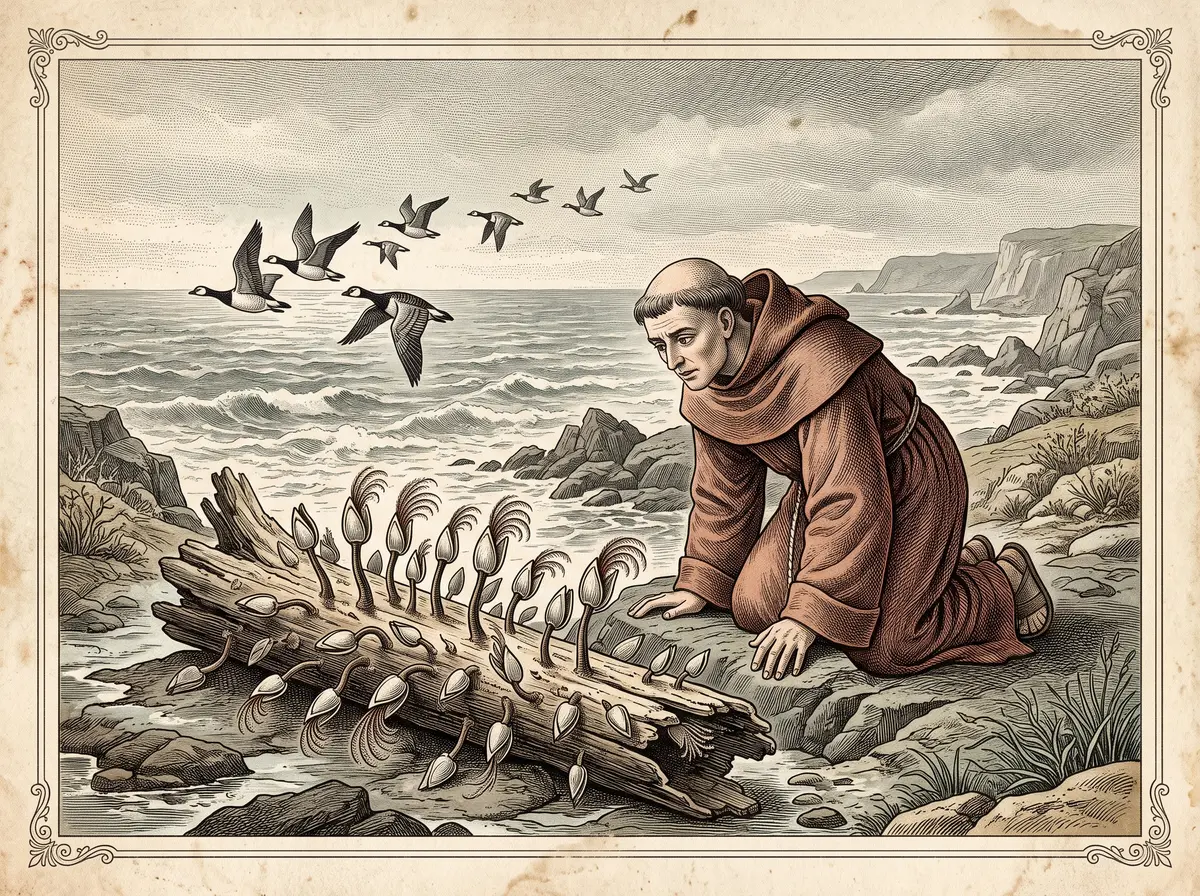
Sometime around 1188, the churchman Gerald of Wales walked a beach in Ireland and found a log covered in small shells. Inside, he wrote, were tiny birds, hanging from the wood by their beaks, waiting to drop into the sea and fly away. He counted more than a thousand on one piece of timber. And he reported that some local bishops had found a practical use for this miracle: since these geese were never born of flesh, they ate them on days when meat was forbidden.
By the Curiosities Desk · · 5 min read · Filed under Biology · Today’s round
Part of The Version Everyone Remembers
What happened: The Barnacle Goose Myth
The bird in question is the barnacle goose, a small black-and-white goose that arrives on the coasts of Ireland, Scotland, and northern Europe every autumn. For centuries, nobody in those places ever saw one nest, lay an egg, or raise a chick. The geese simply appeared in the cold months and vanished in spring.
Medieval writers filled that gap with a story. In his Topographia Hibernica (“Topography of Ireland”), written around 1187–1188, Gerald described the geese as growing from “gummy” lumps on floating fir timber, enclosed in shells, until they were big enough to fall into the water and swim off. He insisted this was no rumor: “I have often seen with my own eyes,” he wrote, more than a thousand of the tiny bodies hanging from a single piece of wood on the shore.
He then reported, with clear disapproval, that in parts of Ireland “bishops and men of religion make no scruple of eating these birds on fasting days,” on the grounds that a bird not born of flesh was not meat. Gerald thought this was bad reasoning. If someone ate the thigh of “our first parent,” he argued (meaning Adam, who was made rather than born), they would still have eaten flesh.
Others repeated the loophole. Within a generation, the English scholar Alexander Neckam noted that “some less discreet people” ate the bird when they should be fasting. A popular story holds that Pope Innocent III banned the practice at the Fourth Lateran Council in 1215. That is how the 13th-century friar Thomas of Cantimpré told it, and the claim is still widely repeated, but the council’s surviving decrees contain no such ban. It is best treated as legend.
Not everyone accepted the tree-goose. Around the 1240s, the Holy Roman Emperor Frederick II, an obsessive falconer, wrote in his bird book De arte venandi cum avibus (“The Art of Hunting with Birds”) that he had sent envoys north to bring back the famous goose-bearing timbers. The shell-like growths they found “bore no resemblance to any avian body,” he concluded, and he guessed the geese simply bred somewhere too remote for people to see.
The myth survived him by centuries. In his 1597 Herball, the English botanist John Gerard illustrated a “Goose tree” dropping birds into the sea and claimed to have opened shells on the coast between Dover and Romney and found birds at every stage of development, “which I have seen with mine eyes, and handled with mine hands.” And in 1661, Sir Robert Moray, one of the founders of the Royal Society, read the young society a report on barnacles he had seen hanging from trees in the Hebrides. In every shell he opened, he said, he found a perfectly formed little bird with bill, eyes, wings, and feet, like “a large bird, seen through a concave or diminishing glass.” The paper was printed in the society’s journal, Philosophical Transactions, in 1678.
Why it was strange: The Barnacle Goose Myth
The odd part isn’t that medieval people got bird migration wrong. It’s that careful observers kept seeing the myth. Gerald, Gerard, and Moray all described opening real shells with their own hands. What they found were real animals; they just weren’t birds.
The story also shows how a gap in evidence can turn into a convenient answer. No one had seen the geese breed, so the origin had to be something else, and an origin with no flesh came with a useful side effect on fast days. Frederick II, by contrast, did what a modern scientist would: he went and got samples, then admitted the explanation didn’t fit.
For another animal whose birth baffled observers for 2,000 years, see From Aristotle’s Mud to Freud’s 400 Eels: A Short History of the Eel Question.
What scientists learned: The Barnacle Goose Myth
The shells on the driftwood were goose barnacles, crustaceans (the same broad group as crabs and shrimp) that glue themselves headfirst to floating objects. Each one hangs from a long, fleshy stalk, which looks a lot like a neck or a beak attached to wood. When feeding, it unfurls feathery legs called cirri to sweep plankton out of the water. A shell full of feathery limbs, dangling from a stalk: you can see where the idea came from.
The geese, meanwhile, were breeding exactly where Frederick guessed: far to the north. Barnacle geese nest in the Arctic, on the coasts of East Greenland, the Svalbard islands, and northern Russia, often on cliff ledges where foxes can’t reach. Dutch sailors on Willem Barentsz’s 1596 Arctic voyage reported finding geese sitting on eggs, and their chronicler Gerrit de Veer wrote that the old story had been proven false. It still took naturalists until roughly the late 18th century to drop the tree-goose for good, and migration studies in the late 19th and early 20th centuries to confirm where each population nests.
For a scientist who settled another “where do babies come from” question the hands-on way, see The Priest Who Put Tiny Taffeta Pants on Frogs to Find Out Where Babies Come From.
How it reaches us today: The Barnacle Goose Myth
The myth is preserved in the names. When Carl Linnaeus classified the common goose barnacle in 1758, he named it Lepas anatifera, Latin for “duck-bearing.” And the English word “barnacle” now refers to both the goose and the shellfish, a linguistic fossil of the time people believed one became the other.
The barnacle goose also became a model for how we study migration. Today, the populations that winter in Scotland, Ireland, and the Netherlands are tracked with leg rings and GPS tags, so researchers know which cliff a bird nested on and which Scottish field it will graze in come October. That journey is exactly the part medieval observers never saw.
For another animal myth built on behavior nobody actually watched, see The Lemmings That Never Jumped Off the Cliff.
The tree-goose is one more entry in The Version Everyone Remembers.
Fun fact: The Barnacle Goose Myth
The goose came first. Etymologists think the shellfish was named “barnacle” after the bird, because people believed the bird grew from it.
Sources: The Barnacle Goose Myth
- Giraldus Cambrensis, The Topography of Ireland, Distinction I, ch. 11, “Of Barnacles” — in The Historical Works of Giraldus Cambrensis, trans. Thomas Forester (1863) (primary source)
- Sir Robert Moray, “Relation Concerning Bernacles” — Royal Society Archives, RBO/1/6, read 1661; printed in Philosophical Transactions 12 (1677), doi:10.1098/rstl.1677.0032 (primary source)
- John Gerard, “Of the Goose Tree, Barnacle Tree, or the Tree Bearing Geese” — The Herball, or Generall Historie of Plantes (primary source)
- “Barnacle Goose: Sources” — The Medieval Bestiary (translated excerpts from Alexander Neckam, Thomas of Cantimpré, and others)
- “Branta leucopsis: barnacle goose” — Animal Diversity Web, University of Michigan Museum of Zoology