Science Through Time · Biology
From Aristotle's Mud to Freud's 400 Eels: A Short History of the Eel Question
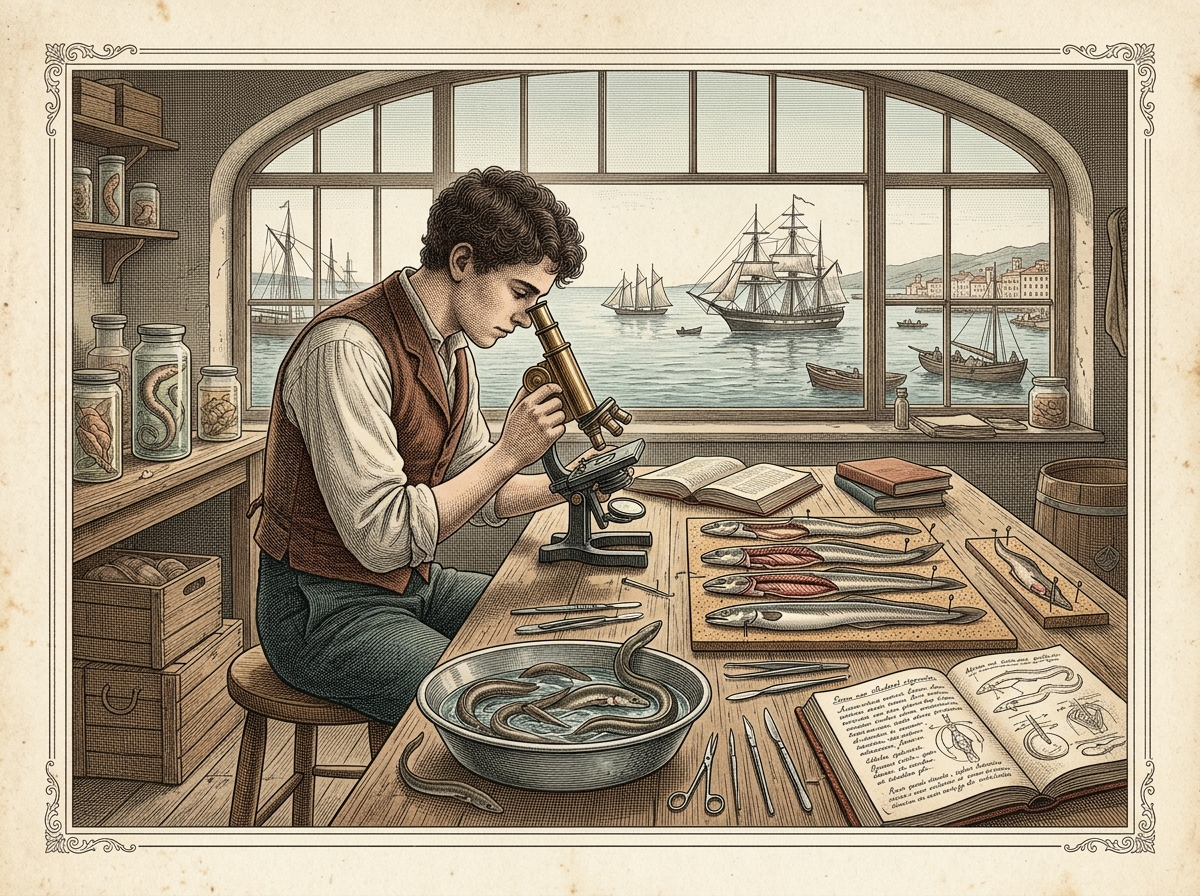
In the spring of 1876, a 19-year-old medical student named Sigmund Freud sat at a marine research station in Trieste, cutting open eel after eel. He was hunting for something no naturalist in recorded history had ever confirmed: a male eel. Roughly 400 eels later, he still hadn't found one. As he put it in a letter to a friend, all the eels he cut open were "of the gentler sex."
By the Curiosities Desk · · 5 min read · Filed under Biology · Today’s round
What happened?
The European eel (Anguilla anguilla) has been a dinner-table staple for thousands of years, and for nearly all of that time nobody could say where baby eels came from. Fishermen caught eels of every size, but never one carrying eggs or milt, the fluid that carries fish sperm. The eels simply appeared in rivers and ponds, grew fat, and then vanished downstream.
Ancient answers. Aristotle, writing in the 4th century BC, concluded that eels have no sex at all. In his account, they arise spontaneously from what he called the “guts of the earth” — wormlike things that form in mud and damp soil. Pliny the Elder, four centuries later, offered a different idea: eels rub themselves against rocks, and the scraps of skin that flake off come to life as new eels. Other writers proposed foam, slime, and dew. These weren’t silly guesses. Without a microscope, and with no eggs to be found, “they come from the mud” fit the evidence about as well as anything.
Eggs, at last. In 1777, the Italian anatomist Carlo Mondini identified eel ovaries, settling that eels were ordinary egg-laying fish. Females, then, were real. Males remained missing. In 1874, Szymon Syrski, director of the natural history museum in Trieste, announced that he had found a small, lobed organ in some eels that might be the long-sought testes.
Enter Freud. That claim is what sent young Freud to Trieste in 1876. His zoology professor at the University of Vienna, Carl Claus, ran the university’s marine station there, and he gave his student a grant and a task: check Syrski’s organ. Freud spent weeks dissecting and examining eels under the microscope, then came back later in the year for more. His 1877 paper described the lobed organs carefully, but he could not find sperm in them and could not settle whether they were testes. The young scientist effectively conceded he hadn’t solved it — and moved on, eventually, to the human mind.
The leaf that was a fish. Part of the answer had been swimming in plain sight. Naturalists had long known a tiny, transparent, leaf-shaped sea creature and classified it as its own species, Leptocephalus brevirostris. In the 1890s, the Italian zoologist Giovanni Battista Grassi watched these “leptocephali” in tanks change into glass eels — the clear, wriggling young eels that swim up European rivers. The mysterious leaf was the eel’s own larva. Around the same time, the first clearly male eel gonads were confirmed in a specimen caught off Sicily.
Following the leaves. That left one question: where were the larvae born? In 1904, the Danish biologist Johannes Schmidt, aboard the research ship Thor, caught an eel larva west of the Faroe Islands, far out in the Atlantic. Backed largely by the Carlsberg brewery’s foundation, he spent the next two decades crisscrossing the ocean, even handing nets and instructions to commercial ships. His method was simple and patient: follow the larvae as they got smaller. The smallest ones led him to the Sargasso Sea, a calm patch of the western Atlantic south of Bermuda. He published the result in a landmark paper for the Royal Society in 1922.
Why was it strange?
The eel is not a rare or remote animal. It lived in village ponds and city markets across Europe, and people ate it constantly. Yet its basic life story — where it’s born, how it mates — stayed hidden for more than two thousand years, defeating Aristotle, Renaissance anatomists, and a future founder of psychoanalysis.
The reason is that eels live their lives backward from what anyone expected. They don’t mature where we see them. They grow up in fresh water, and only near the end of their lives, during a migration of up to about 10,000 kilometers back to the open ocean, do their bodies fully develop for spawning. The eels in Freud’s dissecting tray simply weren’t ready to show him anything. It’s a cousin of the idea in The Recipe for Making Mice Out of a Sweaty Shirt and a Jar of Wheat: when the evidence is missing, spontaneous generation fills the gap.
What did scientists learn?
The eel question taught biologists that an animal’s life can be split across wildly different places and forms, so that one creature looks like two species. It also showed the power of indirect evidence. Schmidt never saw an eel spawn; he mapped where the youngest larvae were and reasoned backward to their birthplace.
That reasoning held up for a century without direct proof. In 2022, a team led by Ros Wright of England’s Environment Agency published the missing piece in Scientific Reports. They fitted 26 female eels from the Azores with satellite tags. Five tags surfaced inside the boundaries of the Sargasso Sea, and one eel reached the presumed breeding area — the first direct evidence of adult European eels arriving there. Even so, the authors noted, no eggs or spawning adults have ever been sampled in the Sargasso. Another migration mystery solved by an unexpected clue: The Stork That Came Home With an African Spear Through Its Neck.
How does it affect us today?
The answer arrived just as the eel began to disappear. The European eel is listed as Critically Endangered, and the number of young eels returning to Europe’s rivers has fallen by about 95 percent since the 1980s. Because the full breeding cycle has never been reproduced at commercial scale in captivity, eel farming still depends largely on catching young eels from the wild. Knowing where and how the adults travel helps conservationists protect them on the way out — past dams, turbines, and fishing nets. For another long thread of discovery that runs right up to the present, see From Mendel’s Peas to CRISPR: A Short History of Genetics.
Fun fact
No one has ever found a wild European eel egg. The first wild eggs of any freshwater eel species — 31 eggs of the Japanese eel — weren’t scooped out of the Pacific Ocean until May 2009.
Sources
- Wright, R. M., et al. “First direct evidence of adult European eels migrating to their breeding place in the Sargasso Sea.” Scientific Reports 12, 15362 (2022) — https://pmc.ncbi.nlm.nih.gov/articles/PMC9562336
- Harvard Collection of Historical Scientific Instruments, “Freud the Scientist: The Riddle of the Eel” — https://chsi.harvard.edu/current_exhibitions/freud-interp-drawings/freud-scientist-riddle-eel
- Linda Hall Library, “Scientist of the Day: Johannes Schmidt” — https://lindahall.org/about/news/scientist-of-the-day/johannes-schmidt
- Tsukamoto, K., et al. “Oceanic spawning ecology of freshwater eels in the western North Pacific.” Nature Communications 2, 179 (2011) — https://pmc.ncbi.nlm.nih.gov/articles/PMC3105336
- History Today, “Sexual Eeling” (Natural Histories) — https://www.historytoday.com/archive/natural-histories/sexual-eeling
Related stories
- The Recipe for Making Mice Out of a Sweaty Shirt and a Jar of Wheat — The old belief that living things could spring from nonliving stuff
- The Stork That Came Home With an African Spear Through Its Neck — The bird that proved migration with a souvenir
- From Mendel’s Peas to CRISPR: A Short History of Genetics — How heredity went from pea plants to gene editing