Science Through Time · Biology
From a Dinner Party Inside an Iguanodon to Feathered Raptors: A Short History of Picturing Dinosaurs
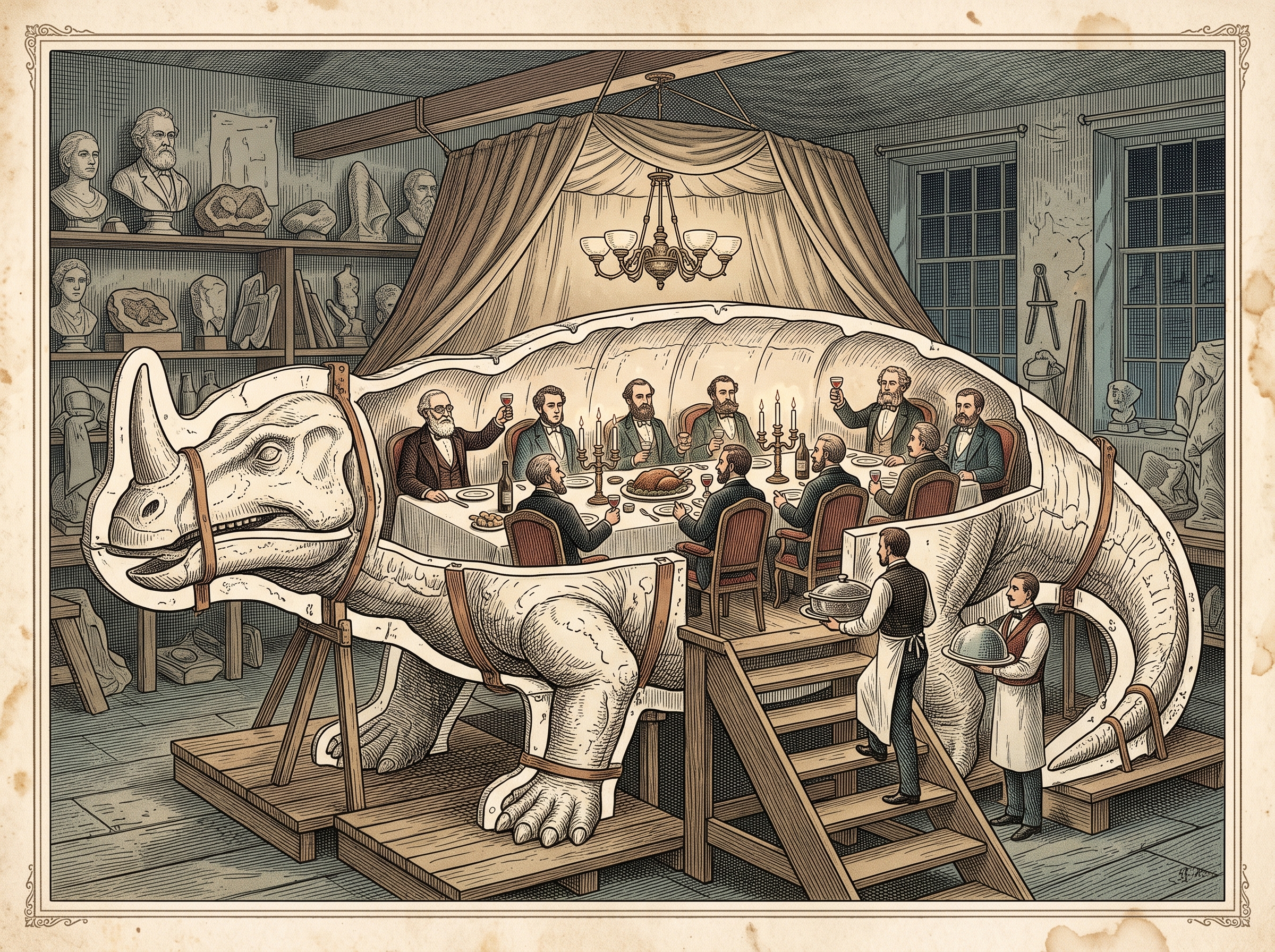
On New Year's Eve 1853, twenty-one gentlemen in evening dress climbed a raised platform in a south London workshop and sat down to an elegant dinner inside a dinosaur. The dinosaur was the hollow mold of a life-size *Iguanodon*, still under construction, and at the head of the table, sitting quite literally where the animal's brain would be, was Richard Owen, the man who had invented the word "dinosaur." Around them, the sculpture had four sturdy legs, lizard scales, and a proud horn on its nose. Almost everything about it would turn out to be wrong, and that is exactly why the evening matters.
By the Curiosities Desk · · 6 min read · Filed under Biology · Today’s round
What happened?
The story starts with teeth. In 1822, in Sussex, England, the doctor and fossil collector Gideon Mantell obtained some large, worn fossil teeth. The popular version says his wife, Mary Ann Mantell, spotted them in a pile of roadside stones while he visited a patient. That account is disputed: Gideon later backed away from it, and historians have suggested the couple may have bought the first teeth from local quarrymen. A 2020 study of an 1887 newspaper account suggests both versions may hold some truth.
However they arrived, the teeth baffled the experts Mantell consulted. The great French anatomist Georges Cuvier first reportedly told a colleague they came from a rhinoceros, then changed his mind the next day. Only that first dismissal seems to have reached the Mantells. Mantell noticed the teeth looked like an iguana’s, only about twenty times larger. In 1825 he published a paper in the Philosophical Transactions of the Royal Society naming the animal Iguanodon, “iguana tooth.”
With only scattered bones to go on, early scientists did the natural thing: they reasoned by analogy. A big reptile must look like a lizard, only enormous. A cone-shaped spike found among the bones must be a horn, and horns go on noses, like a rhinoceros. In 1842, Owen grouped Iguanodon, Megalosaurus, and Hylaeosaurus into a new category he called Dinosauria, “terrible lizards,” and pictured them as heavy, four-legged beasts.
Then the Crystal Palace, the enormous glass exhibition hall from London’s Great Exhibition of 1851, was moved to Sydenham in south London. Its directors wanted an educational park, and they hired the sculptor Benjamin Waterhouse Hawkins to build the first full-scale dinosaur models in the world, with Owen as scientific adviser.
To win the public’s trust before the grand opening, Hawkins staged the dinner. According to The Illustrated London News, his invitations were written on a drawing of a pterodactyl’s wing. The newspaper reported “one-and-twenty guests,” including Owen, the zoologist Edward Forbes, the geologist Joseph Prestwich, and the bird expert John Gould, plus the Crystal Palace Company’s directors. Owen gave a speech praising the models’ accuracy. The paper closed by noting that there was “no reason to suppose” the Iguanodon’s sides had ever before “been shaken with philosophic mirth.” The park opened in June 1854.
Twenty-four years later, the picture cracked. In 1878, coal miners at Bernissart, Belgium, digging 322 meters (about 1,056 feet) underground, broke into a pocket of clay and found what looked like tree trunks glittering with gold. The “gold” was pyrite, and the trunks were dinosaur bones: dozens of Iguanodon skeletons, many nearly complete. For the first time, scientists could see how the pieces actually fit together. The “horn” was attached to the hand. It was a thumb spike.
Why was it strange?
We tend to imagine science moving from ignorance to truth in one leap. Dinosaur pictures show something messier and more human: every generation drew the best dinosaur its evidence allowed, and every generation’s dinosaur looked a little silly to the next.
The Belgian correction created its own mistake. The paleontologist Louis Dollo, who supervised mounting the Bernissart skeletons starting in 1882, stood them upright like kangaroos, tails dragging on the ground. That pose shaped museum displays for about a century. In 1980, the paleontologist David Norman restudied the fossils and concluded that Iguanodon mostly walked on all fours, with its back held roughly horizontal. The Victorian sculptures were right about the four legs after all, just for the wrong reasons. The original Brussels skeletons still stand in their kangaroo pose, because they’re too fragile to rearrange.
Another thread pulled across centuries: From a Sticky Weed Named for a Critic to a Beetle Named for Kate Winslet: A Short History of Naming Species.
What did scientists learn?
The big lesson is that a reconstruction is a hypothesis, a testable best guess. Early naturalists could only compare bones to animals they already knew, so dinosaurs became giant lizards and crocodiles. As more complete skeletons turned up, the analogies changed.
The biggest shift came in the 1960s. In 1969, Yale paleontologist John Ostrom described Deinonychus, a nimble, sickle-clawed predator that looked built for speed, not sluggishness. Ostrom noticed its skeleton had striking similarities to Archaeopteryx, an early bird, and argued in 1973 that birds evolved from dinosaurs like it. Many paleontologists now call this period the “Dinosaur Renaissance”: dinosaurs were redrawn as active, alert animals.
Then, in August 1996, a farmer and part-time fossil hunter named Li Yumin found a small predator in Liaoning Province, China. Named Sinosauropteryx, it was the first known dinosaur outside the bird lineage preserved with feather-like fuzz. Since then, feathers or feather-like structures have turned up on many dinosaur species. Scaly skin wasn’t wrong for every dinosaur, though: according to the Natural History Museum in London, scales are still the best bet for Iguanodon itself.
Another idea followed the long way: From Mendel’s Peas to CRISPR: A Short History of Genetics.
How does it affect us today?
Every dinosaur you’ve seen in a museum, a movie, or a picture book is a descendant of Hawkins’s concrete beasts, a visual argument built from bones. Paleoartists today work closely with scientists and update their work as new fossils arrive, and the public usually meets new science through their pictures first.
The Crystal Palace dinosaurs still stand in the park, horns and all. They were upgraded to Grade I listed status in 2007, a protection England reserves for sites of exceptional importance. Rather than hiding the Victorians’ errors, the park keeps them as a record of what careful people once believed, and a reminder that today’s feathered raptors may look quaint someday too.
The same thread — Paleontology — continues in The Geologist Who Tried to Eat His Way Through the Entire Animal Kingdom.
Fun fact
The first expert opinion on Iguanodon’s teeth reportedly guessed they belonged to a rhinoceros. Years later, the animal was rebuilt with a rhino-style horn on its nose. Somehow, the rhinoceros kept sneaking back in.
Sources
- Mantell, G. (1825). “Notice on the Iguanodon, a Newly Discovered Fossil Reptile, from the Sandstone of Tilgate Forest, in Sussex.” Philosophical Transactions of the Royal Society — royalsocietypublishing.org
- “The Crystal Palace, at Sydenham,” The Illustrated London News, 7 January 1854, transcribed by Prof. Joe Cain (UCL) — profjoecain.net
- Natural History Museum, London, “The world’s first dinosaur park: what the Victorians got right and wrong” — nhm.ac.uk
- Royal Belgian Institute of Natural Sciences, “The Bernissart Iguanodons at a glance” — naturalsciences.be
- Yale News, “A Yale scientist’s research changed our understanding of dinosaurs” (2019) — news.yale.edu