Science Through Time · Biology
From a Sticky Weed Named for a Critic to a Beetle Named for Kate Winslet: A Short History of Naming Species
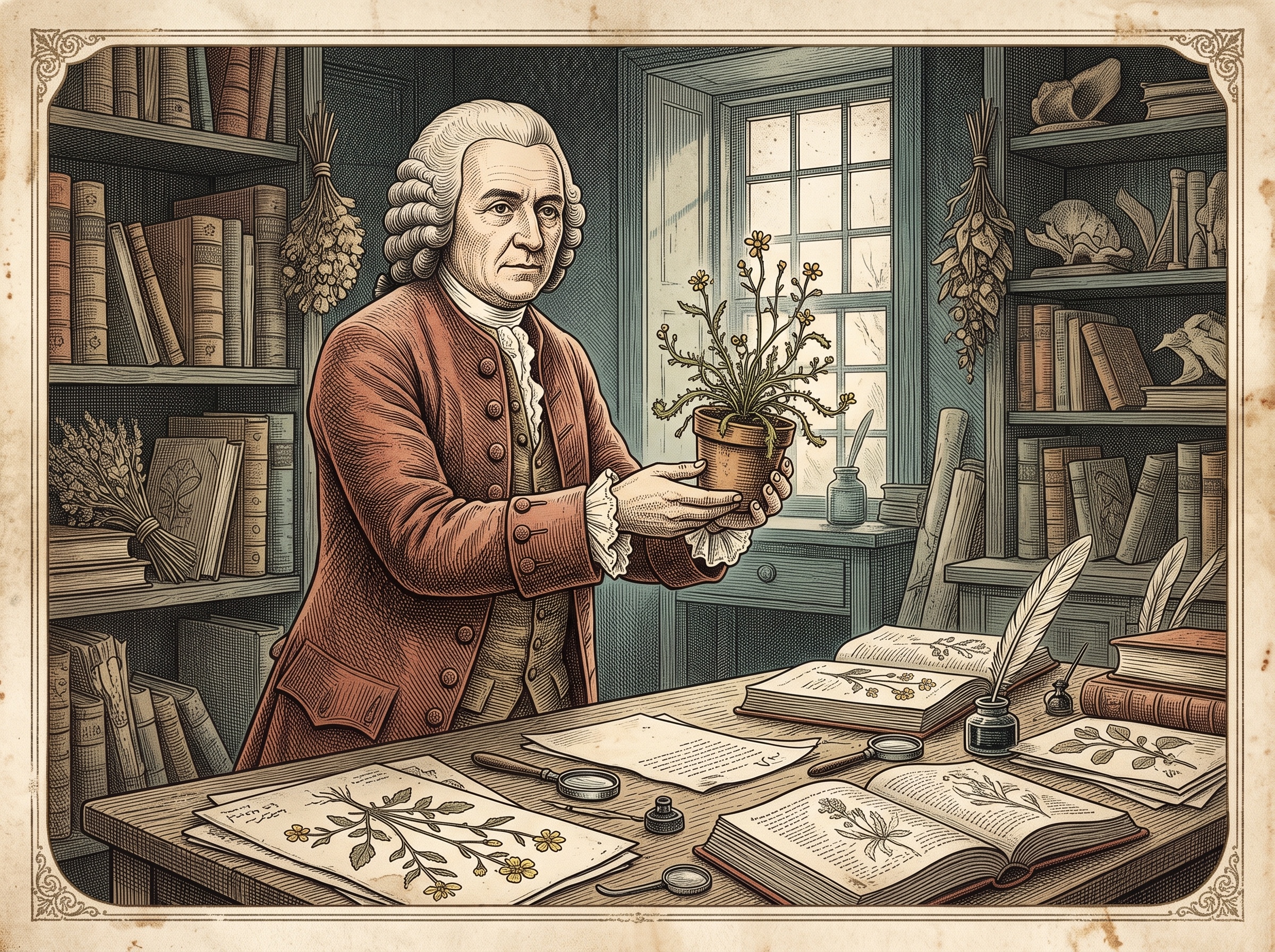
In 1737, the German botanist Johann Siegesbeck published a book attacking a young Swede named Carl Linnaeus. Linnaeus had sorted the plant kingdom by counting flowers' male and female parts, and Siegesbeck found the whole thing indecent; in the line still quoted in English translation, he called it "loathsome harlotry." Linnaeus answered the way only a botanist could. He gave Siegesbeck a plant. Specifically, a small, sticky, unremarkable weed — *Sigesbeckia* — and that name is still printed in botany books today.
By the Curiosities Desk · · 5 min read · Filed under Biology · Today’s round
What happened?
Before Linnaeus, a plant’s “name” was really a short description, and every author wrote their own. The wild briar rose, for example, went by Rosa sylvestris inodora seu canina — roughly, “the wild, scentless, or dog rose.” As naturalists found more species, these phrase-names (called polynomials) grew longer and harder to remember, and two books might describe the same plant in completely different words. There was no rule saying which name was the right one.
Linnaeus’s fix was almost embarrassingly simple. In Species Plantarum, published in 1753, he consistently gave every plant a two-word handle: a genus name (the group) plus a one-word “trivial name” for the species. The briar rose became Rosa canina. Five years later, the tenth edition of his Systema Naturae did the same for animals, cataloguing about 4,400 of them. This two-part label is called binomial nomenclature — literally, “two-name naming” — and it caught on quickly, because it worked.
It also came with a sense of humor, or at least a long memory. In his 1737 Critica Botanica, Linnaeus argued that a plant named after a person should resemble that person in some way. He meant it kindly at times: Bauhinia, a tree whose leaves split into two matching lobes, honors Johann and Caspar Bauhin, two sixteenth-century brothers who worked side by side. He meant it less kindly at others. Siegesbeck — the only living target on his list — got the weed. By most accounts the two men never patched things up, and the sexual system Siegesbeck hated was eventually dropped by botanists anyway. The weed’s name stayed.
Linnaeus also had to name one animal he knew unusually well. He called us Homo sapiens, “wise human,” and next to the genus Homo, where a physical description would usually go, he wrote a piece of advice instead: nosce te ipsum — know yourself.
Over the next 150 years, naturalists added thousands of names a year, and the old problem returned in a new form: different people were naming the same creature twice. By 1905, zoologists and botanists had each adopted international rules. The biggest one is the principle of priority — the first properly published name wins. To make that rule workable, both fields picked a starting line. For plants, it’s Linnaeus’s Species Plantarum of 1753. For animals, the zoological code says, the date of 1 January 1758 is “arbitrarily fixed” as the beginning, matching his tenth edition. Anything named earlier, however carefully, doesn’t count.
Then came the beetles. In the 1970s, Smithsonian entomologist Terry Erwin began fogging the treetops of Panama’s rainforest with insecticide and collecting whatever fell. From 19 trees of a single species, Luehea seemannii, he gathered roughly 1,200 kinds of beetles. In a two-page note published in 1982, he used that haul to extrapolate that the tropics might hold around 30 million species of arthropods (insects, spiders, and their relatives) — far more than anyone had imagined. Faced with so many beetles needing names, Erwin had some fun. In 2002 he described a Costa Rican canopy beetle as Agra katewinsletae, after the Titanic actress, noting that her character survived the sinking but this beetle might not survive the clearing of its forest. The same paper gave the world Agra schwarzeneggeri.
Why was it strange?
Because the most important upgrade in the history of biology’s vocabulary wasn’t a discovery at all. It was a filing system. Linnaeus didn’t know about evolution or DNA, and his flower-counting method grouped some plants in ways that make little biological sense. Yet the labels he chose outlived the logic behind them. A grudge from 1737 is still filed in modern plant databases, and a rule that says names before 1758 “don’t exist” is enforced by an international commission to this day.
It’s also strange how personal the system has always been. In theory, a scientific name is neutral. In practice, it can be a thank-you note, a tribute to a hero, a pun, or — at least once — a very slow-acting insult.
The same thread — Taxonomy — continues in The Platypus Pelt a Museum Keeper Cut Open With Scissors, Hunting for the Stitches.
What did scientists learn?
That naming is a form of knowledge, not just bookkeeping. A binomial tells you two things at once: what a creature is, and what it’s related to. Rosa canina sits next to every other Rosa. Once Charles Darwin argued in 1859 that species share common ancestors, Linnaeus’s nested groups — species inside genera inside families — turned out to map roughly onto a family tree he had never imagined.
Erwin’s beetles taught a humbler lesson: we’ve barely started. His 30-million figure was controversial, and later studies showed it depended heavily on how picky each beetle is about its host tree. A widely cited 2011 study in PLOS Biology estimated about 8.7 million species of eukaryotes — organisms whose cells have a nucleus — on Earth, give or take 1.3 million. By the authors’ reckoning, about 86 percent of species on Earth still haven’t been described — and about 1.2 million had made it into the central catalogue they used.
Another thread pulled across centuries: From a Dinner Party Inside an Iguanodon to Feathered Raptors: A Short History of Picturing Dinosaurs.
How does it affect us today?
Every time a scientist anywhere in the world writes Escherichia coli or Plasmodium falciparum, colleagues in every other country know exactly which organism is meant — crucial for medicine, food safety, and conservation law. New species are still described every year, under codes that trace their rules straight back to Linnaeus’s two-word idea. And the playful streak lives on: naming a species after someone remains one of science’s oldest compliments, and occasionally its pointiest joke.
Another idea followed the long way: From Mendel’s Peas to CRISPR: A Short History of Genetics.
Fun fact
Every species is supposed to be anchored to a “type specimen,” a physical example that defines what the name means. Linnaeus never designated one for Homo sapiens, so in 1959 the botanist William Stearn proposed the obvious candidate: the only human Linnaeus is known to have studied closely — Linnaeus himself. Some taxonomists argue the step wasn’t necessary, but the designation is often cited, which means the man who named us may also be, officially, our example.
Sources
- University of California Museum of Paleontology — Carl Linnaeus (1707–1778)
- International Commission on Zoological Nomenclature — International Code of Zoological Nomenclature, Article 3: Starting point
- Erwin, T. L. (1982). Tropical forests: Their richness in Coleoptera and other arthropod species. The Coleopterists Bulletin, 36(1): 74–75. Smithsonian Research Online.
- Mora, C., et al. (2011). How many species are there on Earth and in the ocean? PLOS Biology, 9(8): e1001127.
- BBC Science Focus — How Carl Linnaeus used scientific naming to throw serious shade