The 'World's Most Venomous Spider' That Couldn't Bite You — So a MythBuster Let It Try
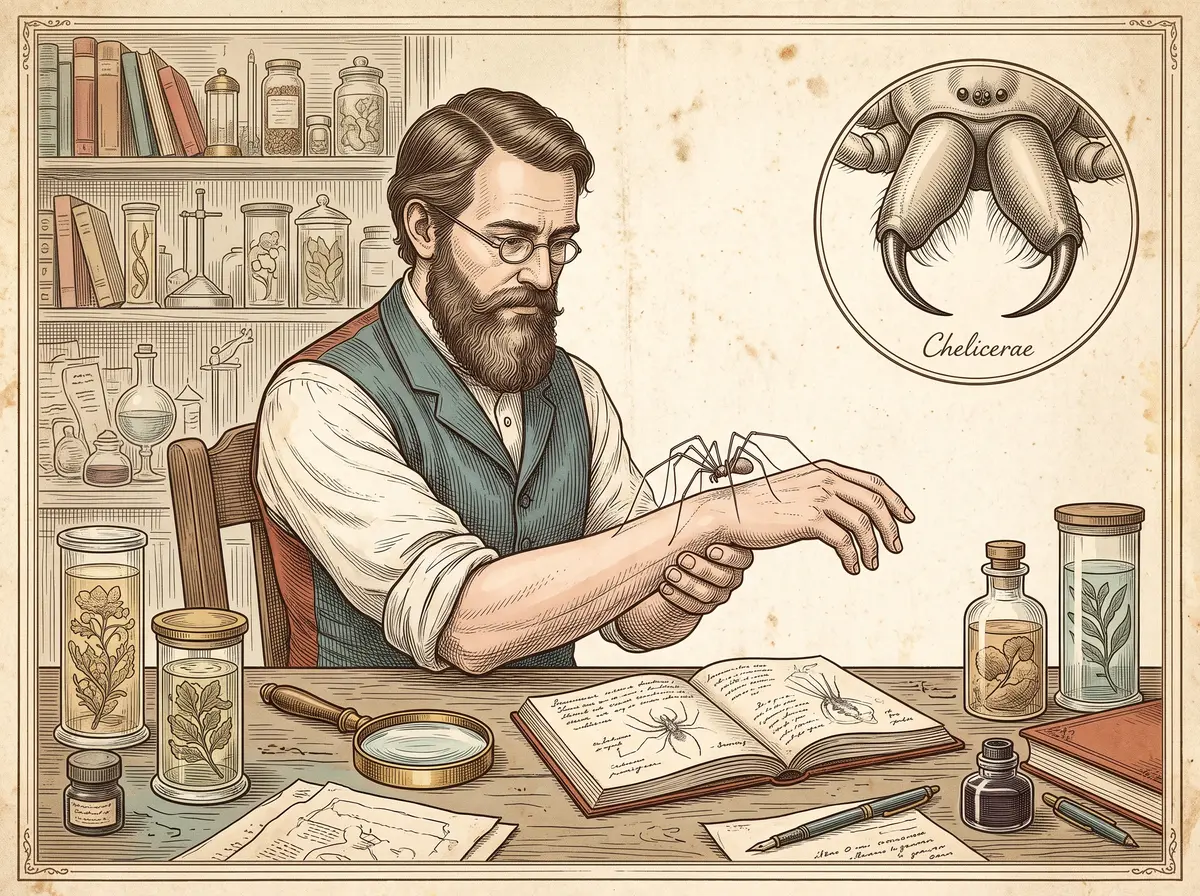
In early 2004, a man in a television workshop held out his bare forearm and waited for a spider to bite him. Not just any spider: the one playground wisdom called the deadliest on Earth, a creature supposedly saved from mass murder only by its tiny fangs. The spider was a daddy longlegs. It bit. Adam Savage reported a mild burning sensation that faded within seconds. Then everybody went back to work.
By the Curiosities Desk · · 5 min read · Filed under Biology · Today’s round
What happened: The 'World's Most Venomous Spider' That Couldn't Bite You — So a
Ask a room full of people about daddy longlegs and someone will recite the same rule: they have the most powerful venom of any spider in the world, but their fangs are too small and weak to pierce human skin. Rod Crawford, the longtime spider curator at the University of Washington’s Burke Museum, collected the claim for his Spider Myths site in 2003 and noted that it was repeated even by some teachers and documentary producers. Nobody has ever traced who said it first. Rick Vetter, a retired entomology researcher at the University of California, Riverside, has guessed that “it’s something that somebody said once and there was never enough knowledge to refute it.”
The first problem with the rule is that “daddy longlegs” is not one animal. It is three unrelated ones. Harvestmen are long-legged arachnids with a single fused body section; they are not spiders at all, and they have no fangs and no venom glands. Crane flies, the gangly insects that bump into porch lights, have no venom either, and many adult crane flies have barely functional mouthparts. Only the third, the cellar spiders of the family Pholcidae, are true spiders with fangs and venom — the delicate, wobbly spiders that hang upside down in the corners of basements and bathrooms.
So the myth, if it is about anything, is about cellar spiders. And in 2004 it got its first real test, from an unlikely laboratory. The Discovery Channel show MythBusters took it on in Episode 13, which aired on February 15, 2004. To check the “too weak to bite” half of the claim, co-host Adam Savage let a cellar spider bite his arm. Its fangs did break his skin. The result was a slight, brief burning feeling and nothing more. Busted, at least for the bite.
The other half — “most venomous” — needed a toxicologist. The show worked with arachnologist Charles Kristensen, who extracted venom from cellar spiders of the species Physocyclus mexicanus and injected it into mice alongside venom from western black widows. The black widow venom had the much stronger effect.
That on-camera test turned out to have a long shelf life. Fifteen years later, a team led by Greta Binford at Lewis & Clark College, with Kristensen as a co-author, published the first detailed study of what is actually in cellar spider venom. Their 2019 paper in Frontiers in Ecology and Evolution noted, a little drily, that the only previous test of the venom on mammals was the one done for television. It also described how hard it had been to get even a speck of the stuff: about one microliter of venom — a droplet far smaller than a raindrop — required milking 50 to 100 male spiders.
Why it was strange: The 'World's Most Venomous Spider' That Couldn't Bite You — So a
The myth sounds like science. It has a superlative (“most venomous”), a mechanism (“fangs too short”), and a twist that explains why nobody has ever been hurt. That last part is what made it nearly impossible to kill. A claim that predicts nothing will happen can never be contradicted by nothing happening.
It also may have borrowed real behavior. Cellar spiders are known to catch and eat other spiders, including dangerous ones. In Australia, where the myth is especially popular, Western Australian Museum arachnologist Mark Harvey has explained that a cellar spider can throw silk from a distance and use its long, thin legs to keep a redback’s fangs away while it wraps the redback up. The win comes from silk and reach, not chemistry — but “it kills redbacks” is an easy step from “it must have deadly venom.”
Myths that explain away their own lack of evidence are a recurring theme in The Version Everyone Remembers.
What scientists learned: The 'World's Most Venomous Spider' That Couldn't Bite You — So a
The 2019 study found that cellar spider venom is unusual — just not in the way the legend says. Most of it is made of enzymes called metalloproteases, which break down proteins. One family of them, the neprilysins, appeared in quantities the authors called unprecedented for a spider venom. The team also identified 17 new groups of small toxin-like peptides.
When the researchers injected the venom into crickets, it caused paralysis at doses comparable to other spiders in the same broad lineage — effective for catching insects, but not exceptional. For people, the authors concluded that cellar spider bites are inconsequential: documented bites cause a mild, brief sting and no lasting effects. As Vetter put it, they are “definitely not the most toxic spider in the world.”
Another animal legend that outlasted the evidence: The Lemmings That Never Jumped Off the Cliff.
How it reaches us today: The 'World's Most Venomous Spider' That Couldn't Bite You — So a
The myth still circulates, but it has become something useful: a classic example in how arachnologists teach the public to tell a harvestman from a spider, and why a common name can bundle together animals with nothing in common. It is also a small lesson in where knowledge comes from. For years, the best mammal data on one of the world’s most common household spiders came from a TV show — and that data ended up cited in a peer-reviewed paper.
For most homeowners, the practical takeaway is gentler. Cellar spiders are harmless to people and quietly eat other spiders and insects, so many arachnologists suggest leaving the one in the basement corner alone.
For another case of an animal “proven” to be something it wasn’t, see The Bumblebee That Science Supposedly Proved Couldn’t Fly.
Fun fact: The 'World's Most Venomous Spider' That Couldn't Bite You — So a
Harvestmen, the most famous “daddy longlegs” of all, have no venom, no fangs, and no silk — their main defense is a foul-smelling chemical, plus the ability to drop a leg that keeps twitching on the ground to distract a predator.
Sources: The 'World's Most Venomous Spider' That Couldn't Bite You — So a
- Zobel-Thropp, P. A., Mullins, J., Kristensen, C., Kronmiller, B. A., David, C. L., Breci, L. A., & Binford, G. J. (2019). Not so Dangerous After All? Venom Composition and Potency of the Pholcid (Daddy Long-Leg) Spider Physocyclus mexicanus. Frontiers in Ecology and Evolution, 7, 256. (Primary source.)
- Crawford, Rod. “Myth: Daddy-longlegs would be deadly if they could bite”. Spider Myths, Burke Museum of Natural History & Culture, University of Washington.
- “Are daddy longlegs really the most venomous spiders in the world?” UC Riverside Department of Entomology (originally published by Live Science, January 14, 2022), quoting Rick Vetter.
- “MythBusters Episode 13: Buried in Concrete, Daddy Long-legs, Jet Taxi” (aired February 15, 2004). MythResults episode guide.
- “The daddy longlegs myth that we keep falling for”. Australian Geographic, October 2018, quoting Mark Harvey of the Western Australian Museum.