The Library Supposedly Sinking Because the Architect Forgot About the Books
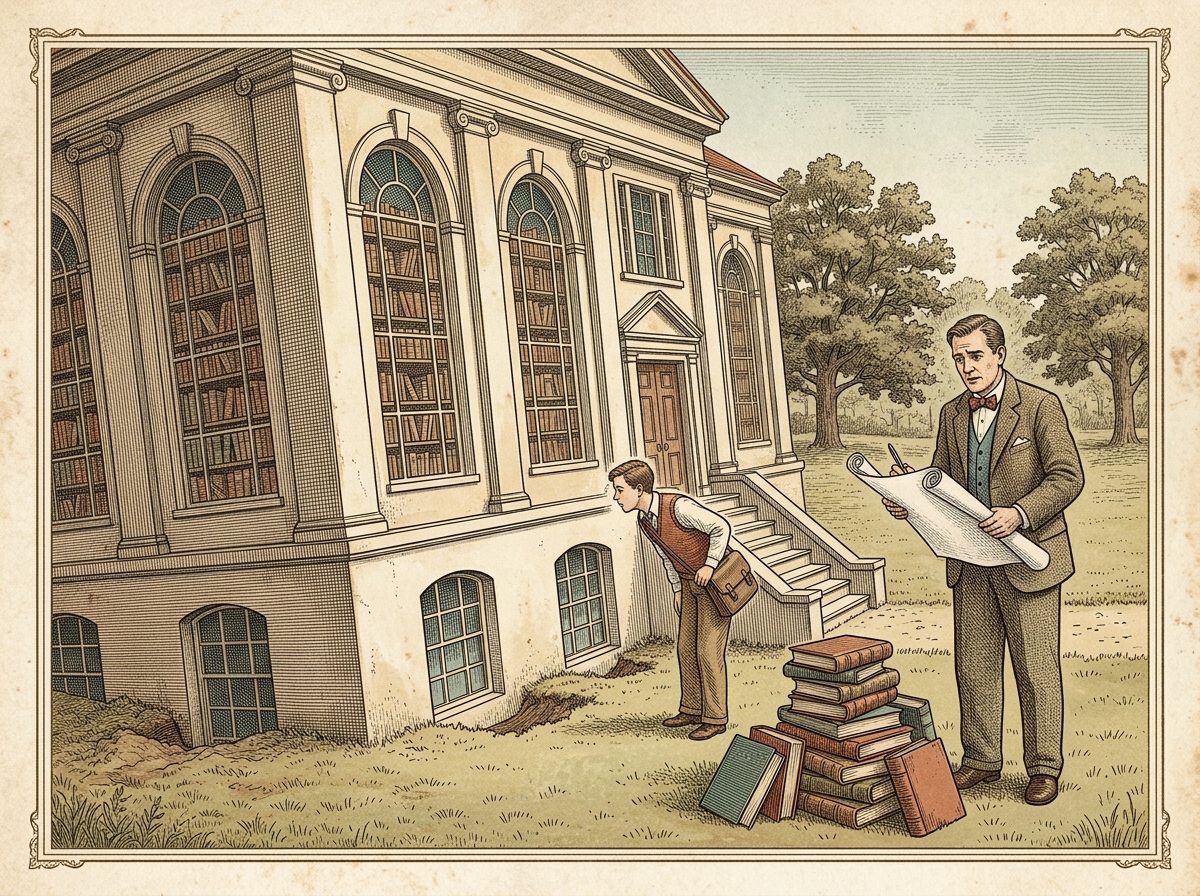
Ask around Indiana University's 12-story Herman B Wells Library, which went up in the late 1960s, and sooner or later a student will lean in and explain that the building is sinking. The architect, the story goes, did a beautiful job on everything except one tiny detail: he forgot that a library would be full of books. Now, inch by inch, the weight of all that knowledge is pushing the whole thing into the ground. It's a wonderful story. It's also told, nearly word for word, about libraries in Illinois, Utah, Connecticut, Rhode Island, California, Ontario, and Newfoundland.
By the Curiosities Desk · · 5 min read · Filed under Engineering · Today’s round
What happened?
Nothing happened — and that’s the interesting part. The “sinking library” is one of the most widespread pieces of campus folklore in the English-speaking world, and it has been tracked for decades by the people whose job is to collect stories like it.
Snopes, the long-running myth-checking site, dates the legend in campus lore to “at least since the late 1970s.” The American folklorist Jan Harold Brunvand, who spent his career collecting urban legends, included sinking libraries in The Baby Train (1993) and kept a running list of where students had heard it: the University of Utah, Yale, Colgate, the Robarts Library at the University of Toronto, the University of Waterloo, Northwestern, Brown’s Science Library, and the University of California, San Diego, among others.
The details shift to fit each campus. At Northwestern University, whose main library opened in the early 1970s on land filled in where Lake Michigan used to be, the soggy setting made the story sound plausible. In 1985 the Northwestern scholar Dwight Conquergood told the student newspaper it was “The Legend of the Sinking Library” and suggested its charm was that it could “unsettle, through laughter, the foundations of authority.”
At Indiana, folklore students recorded classmates telling it in 1996. One version blamed the architects for not planning for more than two million books, plus the students and faculty walking around inside. One of the students telling it was a skeptic, noting that half the windows weren’t underground and neither side of the building was higher than the other.
At Memorial University in St. John’s, Newfoundland, the Queen Elizabeth II Library collected a whole bundle of legends: it was sinking, so some shelves had to be left empty; it had been built facing the wrong way because someone misread the blueprints; and it was haunted. A former librarian, Richard Ellis, patiently pointed out that columns, not bookshelves, hold the building up, and that real sinking would be easy to see.
Why was it strange?
Because it accuses architects of forgetting the one thing a library is for. It’s like a story about a bridge designer who forgot about cars. That’s exactly what makes it fun to repeat: a brilliant expert overlooks something any student could have spotted.
Folklorists notice something else. The legend also says something about how students feel — that the sheer weight of everything they’re supposed to learn is enough to crush a building. Snopes even records a joke version that flips it around: a library begins to rise after throwing out its outdated books, and a consultant blames the loss of all that heavy knowledge.
Another “fact” that outran the evidence: The Bumblebee That Science Supposedly Proved Couldn’t Fly.
What did scientists learn?
The real answer lives in a structural engineering idea called live load: the weight a floor must carry from things that come and go — people, furniture, and, yes, books — as opposed to dead load, the weight of the building itself.
Building codes don’t leave live loads to an architect’s memory. The International Building Code, which most U.S. states adopt in some form, includes a table of minimum live loads by room type. An ordinary office floor must be designed for 50 pounds per square foot. A library reading room: 60. A library stack room, where the shelves are packed together: 150 — three times the office figure. The code even assumes a particular kind of stack: shelves no more than about 90 inches tall and 12 inches deep per side, with aisles at least 36 inches wide. Anything denser needs its own engineering.
In other words, the weight of books isn’t something engineers might forget. It’s written into the rules as one of the heaviest everyday loads a building is expected to carry.
What about the foundations? At Indiana, campus geologists have long pointed out that the Wells Library sits on a thick layer of limestone. Real buildings do sometimes settle, but for reasons with nothing to do with their contents: soft clay, underground springs, or poor construction. Snopes points to a few libraries with genuine structural trouble — including one in Sweetwater County, Wyoming, built on the site of an old cemetery, and the University of Connecticut’s library, which needed major repairs to its walls and floors — and notes that none of these problems came from forgetting about the books.
For a bridge that really did surprise its engineers: Galloping Gertie: The Bridge That Taught Engineers to Fear the Wind.
How does it affect us today?
Book weight is still a live engineering question, just not the way the legend imagines. Many libraries now use compact mobile shelving — rows of shelves on rails that slide together to remove most of the aisles. Squeezing out the empty space concentrates the load, and shelving makers say floors for paper files or books typically need to handle 125 to 200 pounds per square foot. So when a library wants to install them in an older building, someone has to check whether the floor can take it. That’s the true version of the story: people remember the books very carefully.
Meanwhile, the legend keeps finding new campuses, and new students keep checking the windows for signs of sinking.
A myth that took real effort to test: The Bathtub That Took 24 Hours to Drain to Test a Myth.
Fun fact
Memorial University’s library wasn’t built backward either. According to its former librarian, the main reading room faces north on purpose, because north light is steadier, cooler, and long preferred for reading rooms and art galleries.
Sources
- California Building Code (based on the International Building Code), Section 1607, Live Loads, Table 1607.1 and Section 1607.17 (primary source for library and office design loads).
- Snopes, “Sinking Library” (legend’s history, variants, and real settling cases).
- Indiana University Archival Folklore of Student Life, “Got That Sinking Feeling…” (version collected from IU students, Fall 1996).
- Northwestern University Libraries, “Shelving Library Myths: Sorting Folklore from Fact” (Dwight Conquergood, 1985).
- Janes, Burton K. “The revival of an urban legend” (2016; quotes Jan Harold Brunvand, The Baby Train, 1993, and his list of campuses, plus Memorial University’s librarian on the QEII Library).