The Leonardo da Vinci Bicycle That Showed Up 455 Years Late — Next to Some Very Rude Doodles
In 1974, an Italian scholar announced that he had found a bicycle in Leonardo da Vinci's notebooks. Not a vague wheel or two, but a recognizable two-wheeler with pedals and a chain drive, sketched centuries before anyone rode one. There was one small problem: it shared the page with some crude cartoons of the kind teenagers draw in the margins of school books, and a scholar who had studied the very same sheet in 1961 remembered seeing no bicycle at all.
By the Curiosities Desk · · 5 min read · Filed under Engineering · Today’s round
Part of The Version Everyone Remembers
What happened: The Leonardo da Vinci Bicycle That Showed Up 455 Years Late — Next to Some
The sketch lives in the Codex Atlanticus, the largest collection of Leonardo’s papers, held by the Biblioteca Ambrosiana in Milan. It isn’t a notebook Leonardo bound himself. After his death in 1519, the sculptor and collector Pompeo Leoni pasted and glued hundreds of loose sheets into a giant album, more than 1,100 leaves in all. Some sheets were folded or stuck down so that one side was hidden from view for centuries.
In the late 1960s, the Ambrosiana sent the codex to the Abbey of Grottaferrata near Rome, where monks ran a conservation laboratory, to be taken apart and remounted. (Sources disagree on the exact years; the work ran from roughly 1966 to the early 1970s.) Once the sheets were freed, hidden sides came back into view.
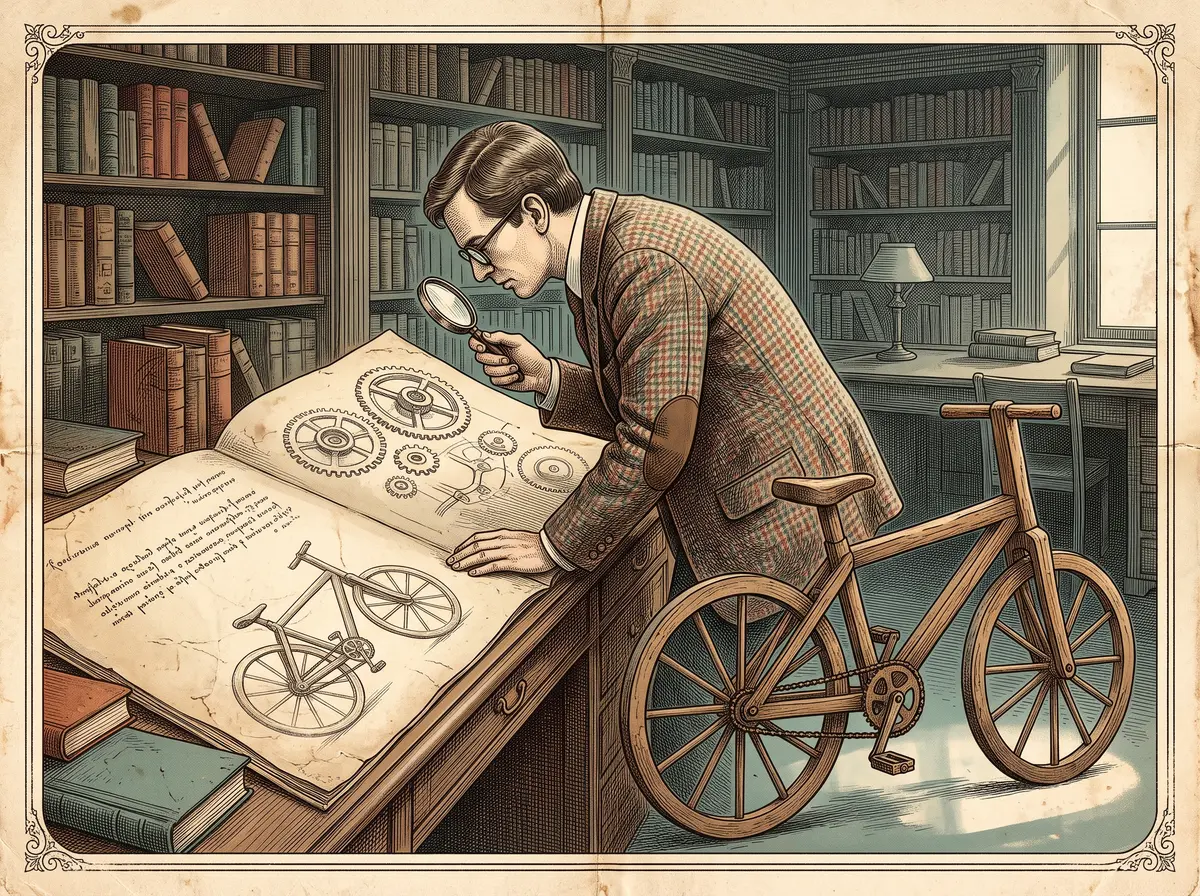
Augusto Marinoni, a philologist (a scholar of historical texts) who spent years transcribing the codex, worked from photographs of the restored pages. On the back of folio 133, a sheet that had once been joined to folio 132, he spotted the drawing. He presented it in the spring of 1974 and published a reconstruction in a lavish book called The Unknown Leonardo. The sketch shows two equal-sized wheels, a saddle, pedals on a toothed wheel, and a chain looping back to the rear wheel.
Marinoni never claimed Leonardo drew it himself. The linework was too clumsy. His argument was that a pupil in Leonardo’s workshop had copied a lost original by the master. That would explain the company it kept on the page: crude graffiti, including a caricature that seems to mock Salaì, Leonardo’s long-time pupil and assistant, along with a set of anatomical doodles best left undescribed.
The story spread anyway. Full-size wooden models were built, and “Leonardo invented the bicycle” became a favorite fact in museum shops and textbooks.
Then, in August 1997, Hans-Erhard Lessing, a retired curator of the Museum of Technology and Labour in Mannheim, Germany, stood up at the 8th International Conference on Cycling History in Glasgow with a paper titled “The Evidence against ‘Leonardo’s Bicycle.’” New Scientist picked it up that October. Lessing’s key witness was Carlo Pedretti, a leading Leonardo scholar at UCLA, who had examined the same sheets in 1961, before the restoration. According to Lessing’s account, Pedretti held the paper up to strong light and saw only two circles with some curved lines, but no chain, no pedals, and no bicycle.
Why it was strange: The Leonardo da Vinci Bicycle That Showed Up 455 Years Late — Next to Some
Because the drawing is too modern. The first two-wheeled, rider-powered machine we can firmly date is Karl Drais’s “running machine,” which he rode on 12 June 1817 from Mannheim to a coaching inn about seven kilometers away. It had no pedals at all; you pushed it along with your feet. Pedals arrived in the 1860s, and a chain drive to the rear wheel only caught on with the “safety bicycles” of the 1880s.
So the sketch skips three and a half centuries of trial and error, and lands almost exactly where bicycle design ended up. To Lessing, that was the giveaway. He argued that someone around the time of the restoration had turned Leonardo-era circles into a bicycle, perhaps inspired by real chain drawings by Leonardo that had made headlines in 1967 (more on those below). Defenders of the sketch pushed back hard, and nobody has ever been shown to have done it.
The truth is that the question is still open. The Ambrosiana has never released the page for the kind of ink and pigment testing that could settle it. What almost everyone agrees on is narrower: Leonardo did not draw this bicycle himself.
Another machine that seemed too clever for its century: The Chess-Playing Machine That Beat Napoleon (With a Man Hidden Inside).
What scientists learned: The Leonardo da Vinci Bicycle That Showed Up 455 Years Late — Next to Some
The case is a lesson in provenance, the documented history of an object: who had it, where, and what happened to it. A drawing with a gap in its history, and a dramatic change on either side of that gap, needs more than a good story to hold it up.
It also shows how to separate what Leonardo really did from what we wish he’d done. His genuine notebooks include careful drawings of link chains wrapping around toothed wheels to transmit motion. Many of them are in the Madrid Codices, two Leonardo notebooks found in Spain’s national library in the mid-1960s and announced to the world in 1967. That timing is exactly why Lessing found the 1970s bicycle so suspicious: the parts were real, but there’s no evidence Leonardo ever put them together into something you could ride.
Cycle historians also point to a design gap. The sketch shows no clear way to steer, a problem Drais solved with a pivoting front wheel. A drawing can look perfectly sensible and still describe a machine that won’t work.
The real story of how bikes came together: From Starving Horses to ‘Bicycle Face’: A Short History of the Bicycle.
How it reaches us today: The Leonardo da Vinci Bicycle That Showed Up 455 Years Late — Next to Some
The “Leonardo bicycle” is still out there, doing marketing work. In 2004, an Italian bike maker named a limited-edition carbon-fiber frame after Leonardo and called him the “inventor of the bicycle.” In 2005, a Rome exhibition of Codex Atlanticus designs displayed a full-size model of the sketch beside a modern bike.
Historians mostly use it differently: as a classic example of a myth that’s hard to kill because it flatters a genius we already admire. It’s a reminder to ask where a document came from before asking what it shows.
Another tale that was too good to check: The Space Shuttle Boosters Supposedly Sized by the Rear Ends of Two Roman Horses.
The bicycle everyone remembers in Leonardo’s notebook sits with the other sticky versions in The Version Everyone Remembers.
Fun fact: The Leonardo da Vinci Bicycle That Showed Up 455 Years Late — Next to Some
Hans-Erhard Lessing, the man who challenged “Leonardo’s bicycle,” is also Karl Drais’s biographer, and he lived and worked in Mannheim, the city where Drais made his 1817 ride. Supporters of the sketch were quick to point that out.
Sources: The Leonardo da Vinci Bicycle That Showed Up 455 Years Late — Next to Some
- Lessing, Hans-Erhard. “The Evidence against ‘Leonardo’s Bicycle.’” Cycle History 8: Proceedings of the 8th International Cycling History Conference, Glasgow, 1997; summarized in “Leonardo’s bike sketch termed a forgery”, Deseret News, 16 October 1997 (reporting on New Scientist).
- Sherlock, Amy. “Did Leonardo da Vinci Invent the Bicycle?” Frieze, 25 September 2019.
- BrickBats Cycle Journalism, “Not the Leonardo Bicycle?” (folios 132–133, Marinoni’s 1974 announcement, the graffiti).
- BikeBiz, “Reuters says Leonardo invented the bicycle”, 12 January 2005 (Rome exhibition and 2004 marketing).
- “Karl Drais”, Wikipedia, citing Lessing’s biography of Drais (first ride, 12 June 1817).