The Astronomer Whose Escaped Caterpillars Are Still Eating America
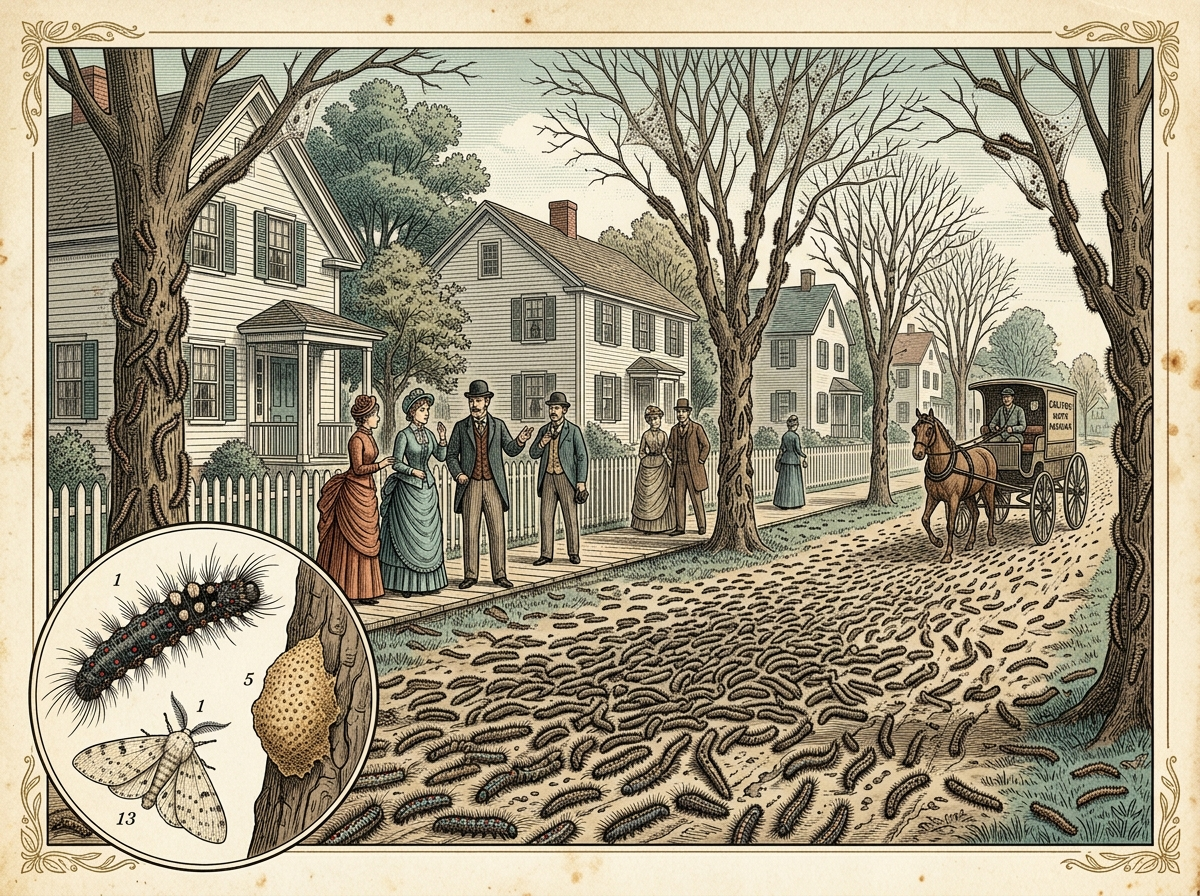
In the summer of 1889, the people of Medford, Massachusetts, watched their dirt streets turn into a crawling carpet of hairy caterpillars. Shade trees went bare. Gardens vanished. The insects traced back to one backyard in town, where a French artist had once tried to farm silk. By then he was long gone, busy making some of the most admired drawings of the planets ever made.
By the Curiosities Desk · · 5 min read · Filed under Biology · Today’s round
What happened?
Étienne Léopold Trouvelot was born in France in 1827. After Louis-Napoléon’s coup of 1851, he left with his family for the United States and settled in Medford, just outside Boston, in a house at 27 Myrtle Street. He made his living as an artist, but his passion was insects.
In the mid-1800s, disease was wrecking silkworm farms, and Trouvelot thought America’s native moths might fill the gap. He raised caterpillars of the polyphemus moth, a large native silk moth, in the woods behind his house under netting. According to the Smithsonian, at one point he had more than a million larvae in cultivation.
Then, in 1868 or 1869, he brought a European insect home: Lymantria dispar, then called the gypsy moth and now officially called the spongy moth. Exactly why is not documented. The usual explanation is that he hoped to cross it with a silk moth to breed a hardier silk producer, though the species aren’t closely related enough for that to have been likely.
How the insects got loose is also uncertain. A U.S. Forest Service atlas says only that Trouvelot accidentally released them “in various life stages” on his property. Popular retellings say a storm tore his nets or a breeze carried off the eggs; those details are legend. A friend later recalled that the netting had holes big enough for birds to get in. Some neighbors remembered Trouvelot warning people about the escape, but no record of an official warning survives. An entomology journal mentioned the escape in 1870.
Meanwhile, Trouvelot’s attention was turning upward. On November 14, 1868, he watched a meteor shower from an upstairs window of the Medford house and recorded it in pastel. Around 1870 he bought a small telescope. In 1872, Joseph Winlock, director of the Harvard College Observatory, saw his work and invited him onto the staff. Trouvelot went on to produce roughly 7,000 astronomical drawings, publish about 50 scientific papers, and, in 1881–82, see 15 of his best pastels issued by Charles Scribner’s Sons as large color prints. He returned to France around 1882, worked at the Meudon Observatory, and died in 1895.
Back in Medford, the moths had spent roughly two decades quietly multiplying. In 1889 came the first recorded defoliation, on street trees in Trouvelot’s old neighborhood. Medford’s officials tried to fight it, then begged the state for help. In 1890 the Massachusetts legislature created a Gypsy Moth Commission and set aside $25,000. Crews sprayed Paris green, an arsenic-based insecticide, scraped egg masses off trunks, wrapped trees in burlap to trap climbing caterpillars, and burned brush.
It was a decade-long war. In 1900, after a lull in outbreaks, the legislature cut off the money. The moths came back. By 1922 they were found in every city and town in Massachusetts.
Why was it strange?
Most ecological disasters have many authors. This one has a street address. A single amateur’s backyard experiment launched one of the most destructive forest insects in North America.
The timing is strange, too. In the same years the moths were slipping into the Medford woods, Trouvelot was turning into an astronomer. History now remembers him twice: as a gifted artist of the night sky and as the man who let loose the caterpillars. Neither reputation cancels the other.
And for years, nothing seemed to happen. The roughly 20-year gap between escape and outbreak made it easy to shrug off. For another animal that was released on purpose and backfired, see The Toad Australia Released to Fight a Pest — and Turned Into a Bigger One.
What did scientists learn?
The moth became a textbook case of invasive species, organisms that thrive and cause harm after being moved outside their native range.
One lesson is the lag phase: a newly arrived species often stays rare for years while its numbers build, then explodes. By the time anyone notices, removing it is far harder.
Another is enemy release, the idea that an invader does well partly because it left its natural predators, parasites, and diseases behind. In its native range across Europe, Asia, and North Africa, the moth has plenty of enemies. None came with it to Medford. Its caterpillars feed on more than 300 kinds of trees and shrubs, with oaks a favorite.
The moth also taught people how invaders travel. In North America, the females of this strain don’t fly. They lay masses of several hundred eggs on tree trunks, rocks, and objects nearby, and people do the rest by moving firewood, lumber, and vehicles. Scientists eventually turned to biological control, bringing over enemies from the moth’s homeland. A fungus called Entomophaga maimaiga, released in 1910–11, began killing large numbers of caterpillars only in 1989. For another species whose American arrival got wrapped in legend, see The Starlings America Blamed on Shakespeare.
How does it affect us today?
The caterpillars never left. Since 1980 the moth has defoliated more than a million acres in many years, peaking at about 12.9 million acres in 1981. Severe outbreaks hit parts of the Northeast and Midwest again in 2024. A federal program called Slow the Spread uses moth sex pheromones to confuse males along the advancing edge of the infestation, and many states restrict moving firewood because of egg masses.
The war also left chemical traces. In 1892, Massachusetts crews first sprayed lead arsenate against the moth. Apple growers soon adopted it, and it was used for decades until the EPA banned all insecticidal uses in 1988. Lead and arsenic don’t break down, so residues remain in the soil of some old orchards.
Even the insect’s name has changed. In March 2022, the Entomological Society of America adopted “spongy moth,” replacing a name that uses an ethnic slur. The new name comes from French and refers to the sponge-like egg masses. For more animals people moved to solve a problem, see The Mongooses Hired to Hunt Rats — Who Worked the Day Shift.
Fun fact
The man who unleashed one of North America’s worst forest pests has craters named after him on two worlds: one on the Moon and one on Mars.
Sources
- Liebhold, A. M., et al., Gypsy Moth in the United States: An Atlas, USDA Forest Service General Technical Report NE-233 (1997) — https://www.fs.usda.gov/ne/newtown_square/publications/technical_reports/pdfs/scanned/gtrne233.pdf
- Smithsonian National Air and Space Museum, “These Depictions of Celestial Wonders Helped Make Astronomy Mainstream” (2023) — https://www.smithsonianmag.com/blogs/air-space-museum/2023/12/27/depictions-celestial-wonders-helped-make-astronomy-mainstream/
- State Library of Massachusetts, “The War against the Gypsy Moth in Massachusetts” (2018) — http://mastatelibrary.blogspot.com/2018/05/the-war-against-gypsy-moth-in.html
- Schooley, T., et al., “The History of Lead Arsenate Use in Apple Production,” Journal of Pesticide Safety Education 10 (2008) — https://psdocs.spes.vt.edu/AOFT/History_Lead_Arsenate_in_Apples.pdf
- Entomological Society of America, “Spongy Moth” (2022) — https://entsoc.org/spongymoth
Related stories
- The Toad Australia Released to Fight a Pest — and Turned Into a Bigger One — Another introduced species that took over
- The Starlings America Blamed on Shakespeare — The myth behind a famous invasion
- The Mongooses Hired to Hunt Rats — Who Worked the Day Shift — When the cure becomes the pest