Impossible Inventions · Physics
The 'Free Energy' Wheel Congress Voted to Protect Before Anyone Saw It Run
On June 29, 1918, five scientists gathered in a private laboratory in Boston to inspect a machine that the United States Congress had already voted to protect. The House had backed it 234 to 14. The President had signed a resolution about it. Its inventor said it could drive ships across oceans without fuel. After about three hours, the scientists wrote their verdict: the model "was not in shape to run or to develop power."
By the Curiosities Desk · · 5 min read · Filed under Physics · Today’s round
Part of Built to Do the Impossible
What happened: The Garabed Free-Energy Wheel
Garabed T. K. Giragossian was an Armenian immigrant who had arrived in the United States in 1891 and settled in Boston. In the early 1900s he became convinced he had found what he described as a natural force people could tap “without toil or expense.” He named his machine after himself: the Garabed.
In 1917, as the country entered the First World War, Giragossian took his idea to Washington. He did not show anyone a working machine. Instead, he brought letters. Several prominent Bostonians vouched for his honesty and intelligence, and the House Committee on Patents said in its report that it was “fully convinced” of his good character. Giragossian’s request was unusual: before revealing his secret, he wanted a guarantee that the government would protect his rights to it. To make the point, the committee’s report even quoted Thomas Edison on how “the poor devil of an inventor” might never be rewarded for a great discovery.
The claims in that same report were enormous. The Garabed, it said, might let ships and airships cross oceans without refueling, replace the steam locomotive, and produce nitrates, a key ingredient in both fertilizer and explosives. The committee admitted that only a demonstration could prove any of it.
On October 3, 1917, the House passed a resolution on the Garabed by a vote of 234 to 14. Representative Robert Crosser of Ohio, who reported the measure for the Patents Committee, reportedly called it the “supreme discovery of the ages.” In the Senate, Ollie James of Kentucky was more candid, according to a 1986 history of the episode: he didn’t know whether it had any merit, but “the other branch of Congress thinks there is.”
A follow-up measure, House Joint Resolution 174, became Public Resolution No. 21 on February 8, 1918. It set up a simple deal. Giragossian would demonstrate his invention to a commission of scientists, and if it worked, he would be protected and rewarded. The Secretary of the Interior, Franklin K. Lane, would sign off on the results.
The commission, five scientists and engineers, most of them from MIT, met Giragossian in Boston on June 29. Afterward, the inventor told reporters he was completely satisfied with the demonstration. Two days later, the Acting Secretary of the Interior sent the commission’s report to the Senate. It was short. The model would not run. Giragossian, the report said, admitted he had no working machine and was “merely explaining principles.” And the commission did not believe the principles were sound or that the device could lead to any practical “free energy.”
Giragossian never gave up, and was back before a Senate subcommittee in 1923. In 1935, Time reported that a friendly congressman had once again persuaded Congress to consider the “Garabed wheel.”
Why it was strange: The Garabed Free-Energy Wheel
The odd part is the order of events. Science usually goes: build the thing, test it, then celebrate. The Garabed went the other way. Congress debated the inventor’s character, his patriotism, and his rights before anyone had checked whether the machine could turn.
The claim itself broke one of the firmest rules in physics: the conservation of energy, the principle that energy can change form but can’t be created from nothing. A machine that put out more energy than went into it would be a perpetual motion machine. Even Scientific American, which treated the episode harshly, called Giragossian an “honest victim of self-delusion” rather than a con man.
If you enjoy machines that seemed to run on nothing at all, see The Motor That Ran for Twenty-Six Years on a Secret Room Full of Compressed Air.
What scientists learned: The Garabed Free-Energy Wheel
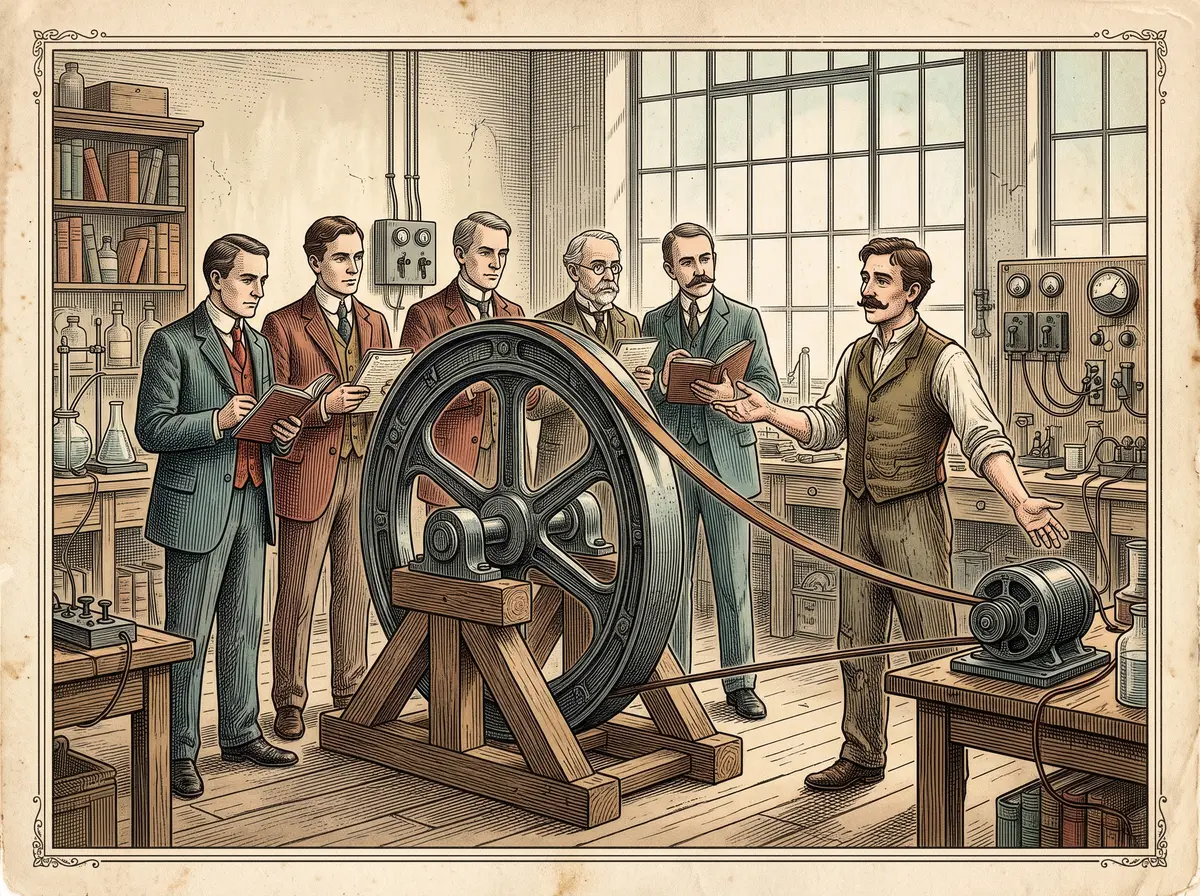
At its heart, the Garabed was a flywheel, a heavy wheel that stores energy by spinning. According to a 1986 history in Invention & Technology, Giragossian set it turning with pulleys and kept it going with a small electric motor. His “free energy” came from a comparison: it took about a twentieth of a horsepower to keep the wheel spinning, but about ten horsepower to stop it quickly.
That sounds like getting 200 times more out than you put in. But it mixes up two different things: energy and power. Energy is the total amount of work something can do. Power is how fast that work happens. A flywheel is like a piggy bank. You can drop in coins slowly for a long time and then smash it open all at once.
Here is the math. A twentieth of a horsepower is about 37 watts. Ten horsepower for one second is about 7,460 joules of energy. At 37 watts, the little motor puts that much energy into the wheel in about 200 seconds, a little over three minutes, ignoring friction. Slamming on the brakes simply releases, in a burst, what the motor had slowly saved up. Nothing extra appears. In practice, friction means you always get back less than you put in.
For another case of a whirring machine that seemed to defy the laws of motion, see The Antigravity Engine That Was Tested on a Bathroom Scale.
How it reaches us today: The Garabed Free-Energy Wheel
Giragossian’s piggy-bank trick is real engineering, just not free energy. Flywheels that store energy and release it fast are used today. In Stephentown, New York, Beacon Power built a 20-megawatt plant of high-speed flywheels that reached full capacity in 2011. They soak up electricity when the grid has a surplus and give it back within seconds when demand jumps, helping keep the power supply steady. The plant doesn’t make energy. It moves energy through time, which is exactly what the Garabed did.
The episode also became a cautionary tale about how claims get judged. Character references, wartime hopes, and a landslide vote couldn’t substitute for a three-hour test in a lab. More stories like this one sit on the shelf of Built to Do the Impossible.
Fun fact: The Garabed Free-Energy Wheel
The Garabed came back bigger. In 1935, Time described a later version: a heavy cast-iron flywheel spun up by a quarter-horsepower motor for two weeks, after which stopping it took a braking force of 150 horsepower. Same piggy bank, just a much longer wait between coins.
Sources: The Garabed Free-Energy Wheel
- “Message From the Acting Secretary of the Interior” (commission report on the Garabed, July 1, 1918), Congressional Record, Senate, 65th Congress, 2nd Session.
- U.S. House Committee on Patents, “Garabed T. K. Giragossian,” Report No. 213 on H. J. Res. 174, 65th Congress, 2nd Session, December 12, 1917.
- “65th Congress, House Vote 55” (H. J. Res. 116, October 3, 1917), Voteview, UCLA.
- Ken Alder, “The Perpetual Search for Perpetual Motion,” American Heritage of Invention & Technology, Summer 1986.
- NYSERDA, “Beacon Power LLC” (case study), New York State Energy Research and Development Authority.