Science Through Time · Biology
From a Rat-Catcher's Pied Pets to a Maze Copied From a Palace Hedge: A Short History of the Lab Rat
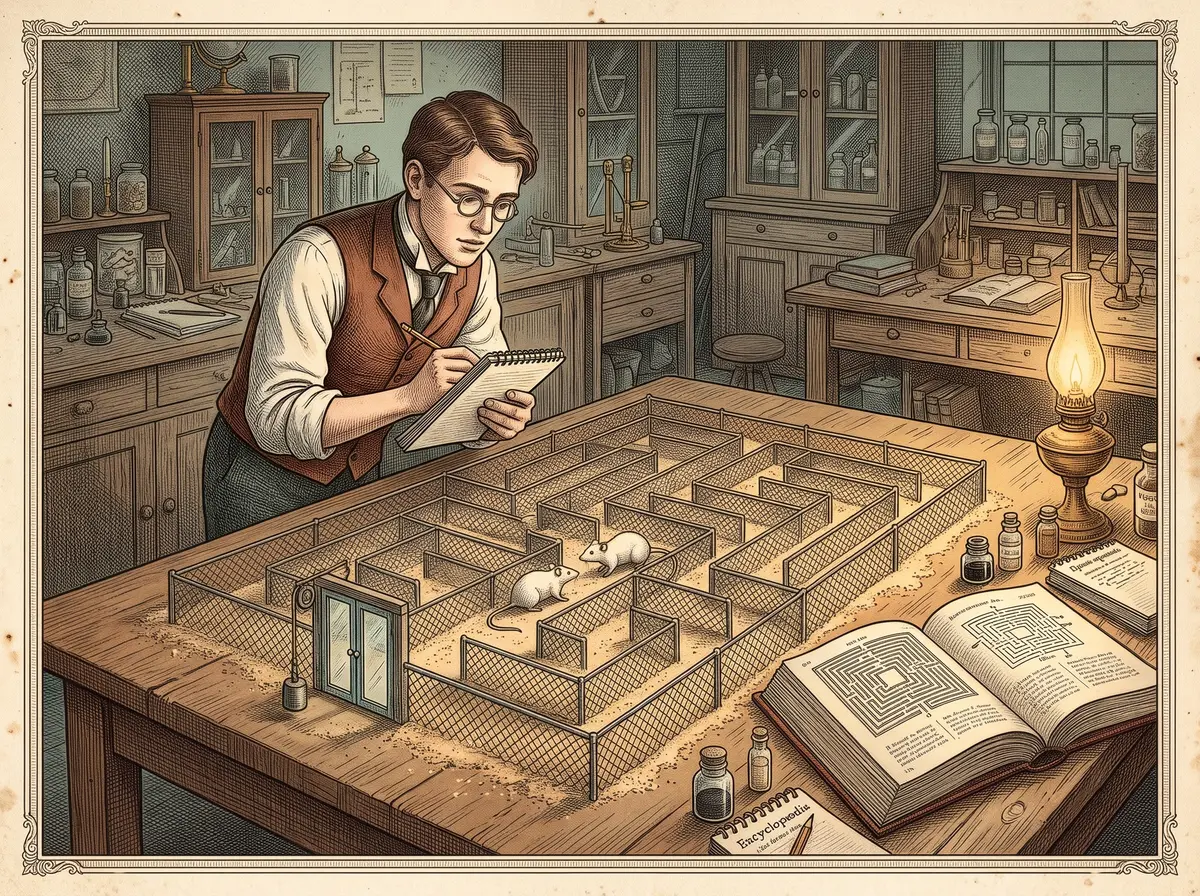
In 1900, a graduate student named Willard Small at Clark University in Worcester, Massachusetts, opened an encyclopedia to a picture of the royal hedge maze at Hampton Court Palace, outside London. Then he rebuilt it for rats: a sawdust-covered platform about six feet by eight, with walls of wire netting. One evening, a rat paused at a fork and made "5 or 6 abortive starts each way" before picking a path. Small wrote that it showed "a very human-like indecision." A maze once meant for strolling courtiers had become one of psychology's most famous tools.
By the Curiosities Desk · · 5 min read · Filed under Biology · Today’s round
Part of Creatures That Changed Science
What happened: The History of Lab Rats
The lab rat’s story starts not in a laboratory but in the rougher corners of 19th-century London. Brown rats were everywhere, and catching them was a trade. Some were sold to pubs for rat-baiting, a grim and popular pastime in which spectators bet on how quickly a dog could kill a pit full of rats. Historians suspect that breeding rats for that market helped produce the white (albino) and “hooded” (white with a dark head) rats that would later fill laboratories.
One of the best-known catchers was Jack Black of Battersea, whose flyers called him “Rat and mole destroyer to Her Majesty.” The title appears to have been his own branding rather than a confirmed royal appointment. The journalist Henry Mayhew interviewed him for London Labour and the London Poor, and Black told him he had been bitten “nearly everywhere.” But Black had a gentler sideline. He kept rats with unusual colors and bred what he called “the finest collection of pied rats” ever known: fawn and white, black and white, blue-black and white. “I’ve sold many to ladies for keeping in squirrel cages,” he said.
Scientists were borrowing rats too. An albino rat is reported to have appeared in a fasting experiment as early as 1828, and a 2012 genetics paper describes rat research “dating back to before 1850.” Between 1877 and 1885, the German researcher Hugo Crampe bred some 15,000 white, grey, black, and piebald rats to study inheritance, putting Mendel’s then-obscure laws of heredity to an early test in mammals.
Then came the maze. Small’s adviser, Edmund Sanford, suggested it, reasoning that rats are natural tunnelers that find their way in the dark. Small wanted the setup to feel like home to them, “couched in a familiar language” of rodent burrows. Each evening he slid open a glass door with a pulley, let two rats in, watched, took notes, and left them to explore overnight. He published “An Experimental Study of the Mental Processes of the Rat” in the American Journal of Psychology in 1900 and 1901. Within a few years, other psychologists, including John B. Watson, were running rats through Hampton Court–style mazes of their own.
The final step was standardization. In 1906, the Wistar Institute in Philadelphia began its own albino rat colony. The neuroanatomist Henry H. Donaldson wanted a mammal that grew up fast enough to chart its whole life. The institute’s director, Milton J. Greenman, wanted a niche for his small institute. And the embryologist Helen Dean King, who had earned her Ph.D. at Bryn Mawr in 1899, did the patient breeding that turned a jumble of animals into reliable, predictable research rats. One of her inbred lines, still in use, is listed in a rat database as “King 1909.”
Why it was strange: The History of Lab Rats
The animal that would become one of medicine’s most important partners was, a few decades earlier, the star of a betting pit and a Victorian pet shop. Nobody set out to design a research animal. A rat-catcher’s color experiments, a psychology student’s love of a palace garden, and an embryologist’s careful record keeping happened to stack up into a scientific institution.
There is another irony. Many scientists began with rats because they seemed simple. Small found the opposite: rats hesitated, sniffed, dug when an odor caught their attention, and sometimes wandered off together. For a much later look at how much rats can learn, see The Rats That Learned to Drive Tiny Cars — and Revved the Engine Before the Ride.
What scientists learned: The History of Lab Rats
Quite a lot, starting with the rats themselves. In 2012, a team led by Takashi Kuramoto at Kyoto University examined 117 albino laboratory rat strains collected from around the world. Every single one carried the same mutation in the Tyr gene, which the body needs to make pigment. That points to one ancestral albino rat behind them all. Every albino strain also carried the genetic change that causes the hooded coat pattern, which suggests the first albino rat was born to hooded parents.
The Wistar colony became the trunk of a family tree. Historian Bonnie Tocher Clause counts some 60 surviving rat strains that trace their origins to Wistar. The Long-Evans rat, created in 1915, came from crossing several Wistar females with a wild grey male. In 1915, Donaldson also published The Rat, a reference book of growth tables and data, so researchers everywhere could compare their animals against a common standard.
That shared standard was the real breakthrough. If every lab’s rat is roughly the same animal, an experiment in Philadelphia can be checked in Tokyo. The tighter hub for animals like this is Creatures That Changed Science.
How it reaches us today: The History of Lab Rats
Rats remain a mainstay of research in nutrition, psychology, neuroscience, and drug safety, and the maze lives on in simpler forms, such as T-shaped and Y-shaped mazes and water mazes. Rat-maze studies also shaped the behaviorist movement in psychology, which focused on measurable actions instead of inner thoughts.
The story also shaped how scientists think about animal welfare. Today, many countries require researchers to follow the “3Rs”: replace animals where possible, reduce how many are used, and refine methods to cause less suffering. The fact that so many lab rats share a known ancestry also helps scientists interpret their results, and it is a reminder of how much modern medicine owes to an animal most people would chase out of the kitchen. For a related tale of the science of heredity, see From Mendel’s Peas to CRISPR: A Short History of Genetics.
Fun fact: The History of Lab Rats
The pet-rat hobby got its official start in October 1901, at a show in Aylesbury, England. Fifteen rats were entered, and Best in Show went to a black-and-white rat belonging to Mary Douglas, the hobby’s earliest champion.
Sources: The History of Lab Rats
- Kuramoto et al., “Origins of Albino and Hooded Rats,” PLoS ONE (2012) — the genetic study of 117 albino strains, plus Crampe’s 15,000 rats.
- Bonnie Tocher Clause, “The Wistar Institute Archives: Rats (Not Mice) and History,” Mendel Newsletter (1998) — on Donaldson, Greenman, King, and the Wistar strains.
- Clark University, “A-mazing fact: First-ever labyrinth for observing rats was created at Clark in 1900” — on Small’s Hampton Court maze.
- Daniel Engber, “The Mouse Trap: Rat Mazes and Mouse Mazes, a History,” Slate (2011) — on Small’s notebook observations and later maze research.
- Henry Mayhew, London Labour and the London Poor, Vol. 3, “Jack Black” (Tufts Digital Library) — Black’s own account of rat-catching, his bites, and his pied rats.