The Scientist Behind It · Biology
The Rose Thorns a Zoologist Stuck Into Starfish Larvae While His Family Was at the Circus
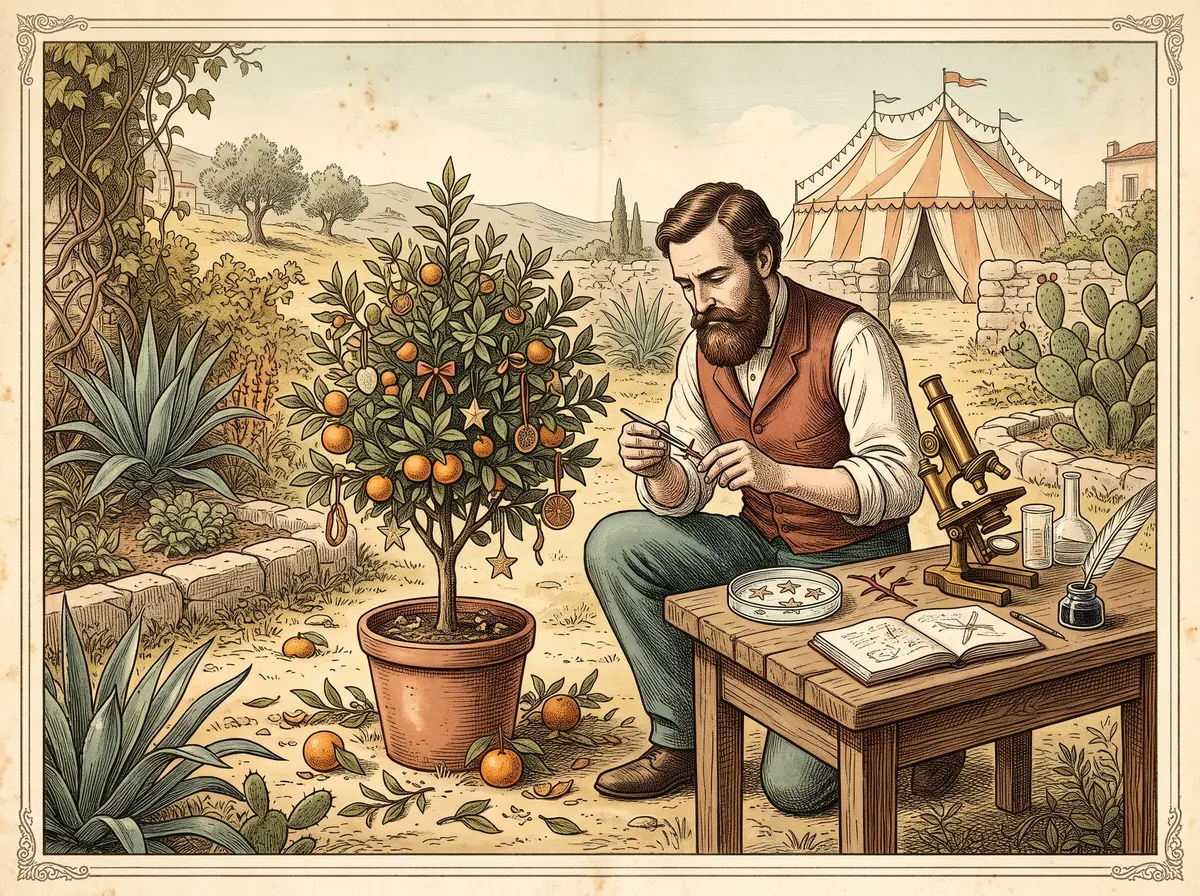
In 1882, in Messina, Sicily, the whole family went off to the circus to see a troupe of performing apes. One man stayed home with his microscope. While everyone else was watching the show, the Russian zoologist Élie Metchnikoff walked into the garden, gathered a few rose thorns, and pushed them into the bodies of tiny, see-through starfish larvae. He was so excited he couldn't sleep that night. By morning, the thorns had been surrounded, and the modern idea of the immune system had its first eyewitness.
By the Curiosities Desk · · 5 min read · Filed under Biology · Today’s round
Part of Creatures That Changed Science
What happened: Metchnikoff
Metchnikoff (born Ilya Ilyich Mechnikov in 1845, near Kharkiv in what is now Ukraine) was not a doctor. He was an embryologist, someone who studies how animals develop from a fertilized egg. He was especially fond of sea creatures whose young are transparent, because you can watch their insides work under a microscope without cutting anything open.
In 1882 he left a university post in Odessa and set up a private laboratory in Messina, a port city on the Strait of Messina that was rich in marine life. There he spent hours watching starfish larvae, tiny drifting creatures that look nothing like adult starfish. Inside their clear bodies he could see certain cells that weren’t fixed in place. They crept around on their own, much like amoebas.
According to the account he gave later, which his wife Olga published in her 1921 biography of him, a thought struck him while he was alone that day: perhaps these wandering cells were there to defend the larva against intruders. If so, a foreign object pushed into the larva should attract them.
There happened to be a makeshift “Christmas tree” in the garden, which he had decorated for the children on a mandarin bush. He fetched a few rose thorns from the shrubbery and slid them under the skin of some larvae. (Some retellings say the thorns came from the citrus tree itself; Metchnikoff’s own account names rose thorns.) He compared the idea to what happens when a person gets a splinter: the spot swells and fills with pus. If his hunch was right, the wandering cells would do something similar around the thorn.
He spent a restless night. Early the next morning he looked again and, as he later put it, saw “with immense joy” that the experiment had worked. The mobile cells had gathered around each thorn.
Metchnikoff presented his idea in Odessa in 1883. While visiting Vienna, he talked it over with the zoologist Carl Claus, and Claus’s lab suggested a name for the cells: phagocytes, from Greek words meaning “eating cells.” The process became phagocytosis.
Why it was strange: Metchnikoff
Because the experiment that launched a branch of medicine was done by a zoologist, in a home lab, on an animal with no blood vessels, using thorns borrowed from a children’s holiday decoration.
It was also strange because most experts at the time thought he had it backward. Other scientists had already seen white blood cells swallowing particles (the German biologist Ernst Haeckel watched them take up dye in 1862). But many bacteriologists assumed those cells were helping germs, perhaps carrying them through the body. Metchnikoff turned that around and claimed the cells were the defenders.
The idea also challenged the leading rival theory of the day, that immunity came mainly from substances dissolved in the blood, later called antibodies. Supporters of this “humoral” view and Metchnikoff’s “cellular” camp argued for decades, a fight some historians call the antibody wars.
His starfish larvae now sit on a crowded shelf: see Creatures That Changed Science.
What scientists learned: Metchnikoff
The starfish larvae made a quiet but powerful point. They have no blood vessels, yet their cells still rushed to an injury. That suggested that this kind of defense was very old in evolution, older than circulating blood. Metchnikoff came to see inflammation, the redness and swelling around a wound, not as a disease but as the body sending its eating cells to the site.
He spent the rest of his career testing the idea. In 1888 he moved to Paris to work at the Pasteur Institute, where he stayed until his death in 1916. In 1908 he shared the Nobel Prize in Physiology or Medicine “in recognition of their work on immunity” with Paul Ehrlich, the leading champion of the antibody side. The prize went to both rivals, because both were partly right. The body defends itself with cells and with molecules, and the two systems work together.
Another early clue about the body’s own defenses came from a runny nose: The Head Cold That Showed Alexander Fleming Your Tears Kill Germs — and the Lab Staff Paid Threepence to Cry.
How it reaches us today: Metchnikoff
Phagocytes are now a basic part of every biology textbook. The ones Metchnikoff saw are cousins of the macrophages (“big eaters”) and neutrophils in your own body, which swallow bacteria, clear away dead cells, and gather at a cut within hours. Together they belong to what immunologists call innate immunity, the fast, built-in first line of defense that doesn’t need to have met a germ before. The second line, adaptive immunity, includes antibodies and is what vaccines train.
Research on innate immunity is still winning prizes. The 2011 Nobel Prize in Physiology or Medicine went in part to Bruce Beutler and Jules Hoffmann for discovering how the innate immune system is switched on. Phagocytes also explain the everyday splinter that Metchnikoff had in mind: the pus is largely made of white blood cells that went to fight.
To see how scientists learned to train the other half of the immune system, read From a Milkmaid’s Blisters to mRNA: A Short History of the Vaccine.
Fun fact: Metchnikoff
The man who discovered germ-eating cells also helped start a yogurt craze. After a lecture in Paris in 1904 in which Metchnikoff suggested that soured milk might keep harmful gut bacteria in check, Parisians lined up to buy yogurt. He then had to tell the public he did not consider it “an elixir of longevity.”
Sources: Metchnikoff
- Siamon Gordon, “Elie Metchnikoff, the Man and the Myth,” Journal of Innate Immunity 8(3), 223–227 (2016) (quotes Metchnikoff’s own account of the Messina experiment).
- Olga Metchnikoff, Life of Elie Metchnikoff, 1845–1916 (1921), pp. 116–117, excerpted at Today in Science History.
- The Nobel Prize, “Ilya Mechnikov — Facts” (1908 prize “in recognition of their work on immunity”).
- Arizona State University Embryo Project Encyclopedia, “Ilya Ilyich Mechnikov (Élie Metchnikoff) (1845–1916)”.
- Smithsonian Magazine, “A Science Lecture Accidentally Sparked a Global Craze for Yogurt”.