Accidental Discoveries · Biology
The Head Cold That Showed Alexander Fleming Your Tears Kill Germs — and the Lab Staff Paid Threepence to Cry
In late 1921, a London bacteriologist with a stuffy nose did something most of us would never think to do: he smeared a little of his own nasal mucus onto a dish of germ food and set it aside. About two weeks later he picked the dish back up and saw a ring of nothing around the blob. Bacteria had covered the rest of the plate, but close to the mucus they had stopped growing. "This is interesting," said Alexander Fleming. Within weeks, his lab was buying tears from its own staff at threepence a time.
By the Curiosities Desk · · 5 min read · Filed under Biology · Today’s round
What happened: The Head Cold That Showed Alexander Fleming Your Tears Kill Germs — and
Alexander Fleming worked in the Inoculation Department at St Mary’s Hospital in London, run by the formidable Sir Almroth Wright. Seven years before his famous moldy dish, Fleming’s bench was already famously crowded. Dozens of old culture plates sat around for weeks in case something odd turned up on them.
In late 1921 Fleming had a cold. On impulse, he cultured some mucus from his own nose on a plate of nutrient jelly, the kind bacteriologists use to grow colonies they can see. The plate went into the pile. According to the recollections of his research student, V. D. Allison, about two weeks later the two men were clearing old dishes when Fleming paused over this one.
The plate was covered in harmless yellow bacteria, a stray germ from the air that had settled and multiplied. But around the blob of mucus there were none. A little farther out, the colonies looked “translucent, glassy and lifeless,” Allison remembered. Something in the mucus had spread through the jelly and dissolved them.
A popular retelling says a drop simply fell from Fleming’s nose onto an open plate as he leaned over it. That makes a better cartoon, but the accounts from people who worked with him describe a deliberate sample from a scientist curious about his own cold. The luck was in which germ happened to land on the plate.
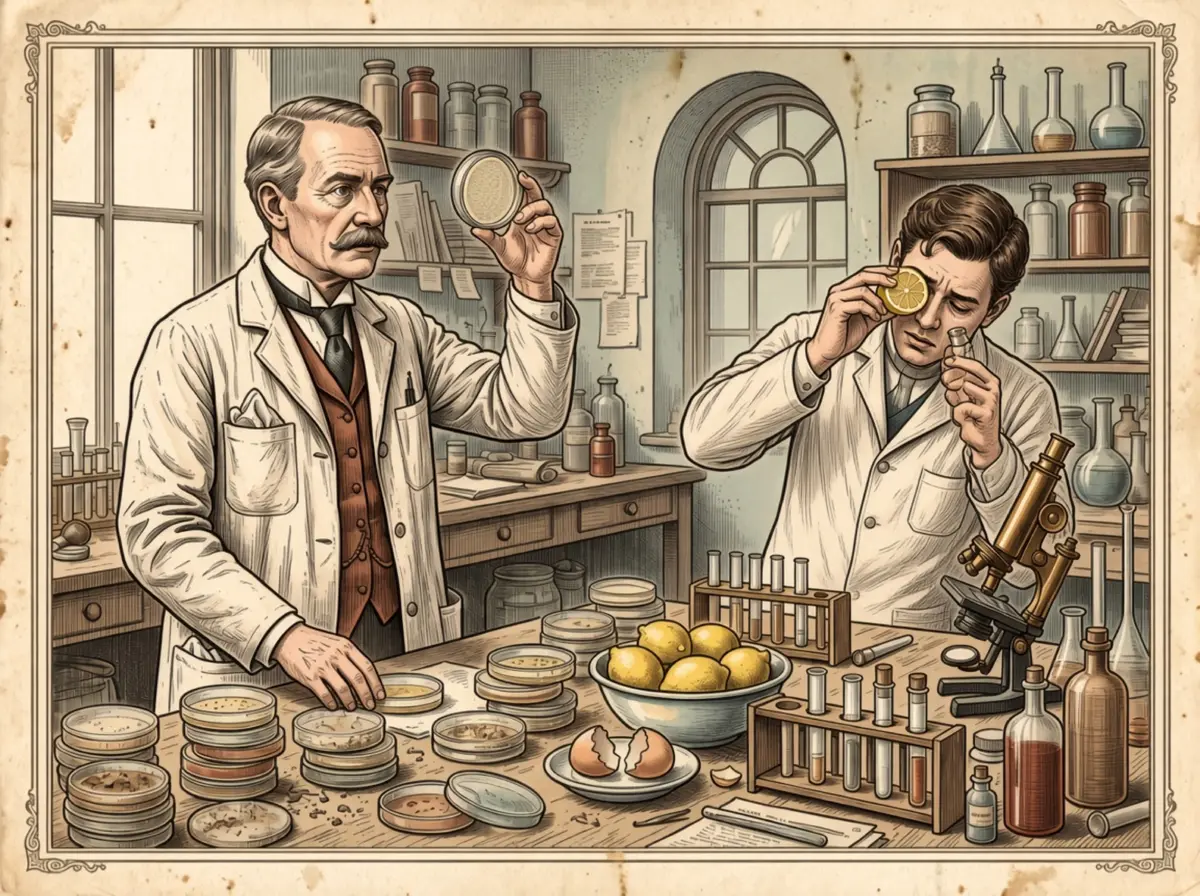
Fleming and Allison went looking for the substance everywhere they could. Fresh mucus worked. Saliva worked. Tears worked especially well. That created a supply problem, because tears are hard to produce on demand. Onions failed. Lemons, squeezed near the eyes, did better. According to Allison, laboratory attendants were “pressed into service” and paid threepence for each contribution, and for five or six weeks the department ran partly on crying. The hospital’s own gazette ran a joke cartoon in 1923 showing technicians flogging children to collect tears for Fleming’s work.
The search spread. The team found the same activity in blood serum, pus, sputum, turnips, and the tissues of rabbits, dogs, and guinea pigs. Allison later collected tears from horses, cows, and geese, and the pair tested pike eggs. The champion was hen egg white. Diluted almost a million times, it still dissolved the yellow germ.
Fleming described the substance to the Medical Research Club in December 1921. Nobody asked a question. His paper, received by the Royal Society on February 13, 1922, gave the substance its name: lysozyme, from “lyse,” to dissolve, and “zyme,” for an enzyme-like ferment. The yellow germ that had revealed it got the tongue-twister Micrococcus lysodeikticus, roughly “the coccus that shows dissolving.”
Why it was strange: The Head Cold That Showed Alexander Fleming Your Tears Kill Germs — and
In 1921, the body’s defenses were thought to be mostly about cells. Wright’s department focused on white blood cells and the antibodies in blood. Fleming had found something quieter: a chemical that sits in ordinary fluids, waiting, and breaks bacteria apart on contact. It was in his runny nose all along.
It was also a disappointment, which made it easy to ignore. Lysozyme demolished harmless germs like that yellow coccus but barely troubled the dangerous ones, such as staphylococci, that Fleming most wanted to stop. A germ-killer that left the real threats alone looked like a curiosity. The silent audience at the Medical Research Club seemed to agree.
Fleming’s most famous plate also came from a bench nobody had tidied: The Moldy Petri Dish That Almost Got Thrown Away.
What scientists learned: The Head Cold That Showed Alexander Fleming Your Tears Kill Germs — and
Lysozyme turned out to be an enzyme, a protein that speeds up a specific chemical reaction. Its job is cutting. Many bacteria wrap themselves in a cell wall made of long sugar chains stitched together, a mesh called peptidoglycan. Lysozyme snips the links in those chains. Without an intact wall, the bacterium cannot hold back the pressure inside it and bursts.
That explained the selective killing. Some bacteria leave their wall exposed. Others hide it under an extra outer membrane or build it in a way the enzyme struggles to reach. In 2012, a team at the University of California, Irvine watched a single lysozyme molecule at work by wiring it to a tiny electronic circuit. It opened and closed like a jaw as it chewed along the wall, one bond after another.
Lysozyme also became a landmark in chemistry. Edward Abraham crystallized it in 1937. In 1965, David Phillips’s group used X-rays to map hen egg-white lysozyme in three dimensions. It was the first enzyme whose structure was solved this way, and it showed how the shape of a protein lets it grab and cut another molecule.
There was one more payoff. Fleming had spent years watching germs vanish around a mystery substance. When a mold did the same thing to his staphylococci in 1928, he knew what he was looking at. Ernst Chain, who later helped turn penicillin into a drug, at first suspected it was “a sort of mould lysozyme.”
The lysozyme years fill a whole shelf of lucky detours: The Finds That Started on the Wrong Errand.
How it reaches us today: The Head Cold That Showed Alexander Fleming Your Tears Kill Germs — and
Lysozyme is now recognized as part of innate immunity, the always-on defenses you are born with. It is in tears, saliva, mucus, and breast milk, part of why the surfaces of your eyes and mouth are not overrun by bacteria every day.
It also works in food. Some aged cheeses suffer a defect called “late blowing,” when a soil bacterium ferments inside the wheel and fills it with gas. Cheesemakers add egg-white lysozyme to stop it. In 1998 the US Food and Drug Administration proposed affirming it as safe for that purpose, with a label so people allergic to eggs know it is there. Purified lysozyme also shows up in labs, where researchers use it to crack open bacteria and get at their DNA and proteins.
Lysozyme’s chosen test germ grew on the same kind of jelly as nearly every germ since: The Pudding Recipe That Gave Microbiology Its Favorite Jelly.
Fun fact: The Head Cold That Showed Alexander Fleming Your Tears Kill Germs — and
The most potent source of lysozyme Fleming and Allison ever tested was not human tears but egg white. Diluted almost a million times, it could still dissolve the yellow germ. The breakfast egg out-cried the entire lab.
Sources: The Head Cold That Showed Alexander Fleming Your Tears Kill Germs — and
- Fleming, Alexander. “On a Remarkable Bacteriolytic Element Found in Tissues and Secretions”. Proceedings of the Royal Society B 93, no. 653 (1922): 306–317.
- Johnson, Louise N. “The Early History of Lysozyme”. Nature Structural Biology 5 (1998): 942–944.
- Scientific American. “Penicillin Wasn’t Alexander Fleming’s First Major Discovery”.
- U.S. Food and Drug Administration. “Direct Food Substances Affirmed as Generally Recognized as Safe; Egg White Lysozyme”. Federal Register 63, no. 49 (March 13, 1998).
- NPR. “How Tears Go Pac-Man To Beat Bacteria”. Shots: Health News from NPR, January 19, 2012.