Accidental Discoveries · Biology
The Bald Mouse From a Glasgow Virus Lab — and the Organ Nobody Noticed It Was Missing
In 1962, in a virus laboratory at Ruchill Hospital in Glasgow, a litter of white mice arrived with something missing: their fur. One pink, wrinkled, whiskerless male stood out in a colony that was supposed to be ordinary albino stock. Somebody had the good sense not to throw it away. It took six more years, and a closer look inside, to realize the bald mouse was missing something far more important than a coat.
By the Curiosities Desk · · 5 min read · Filed under Biology · Today’s round
Part of Creatures That Changed Science
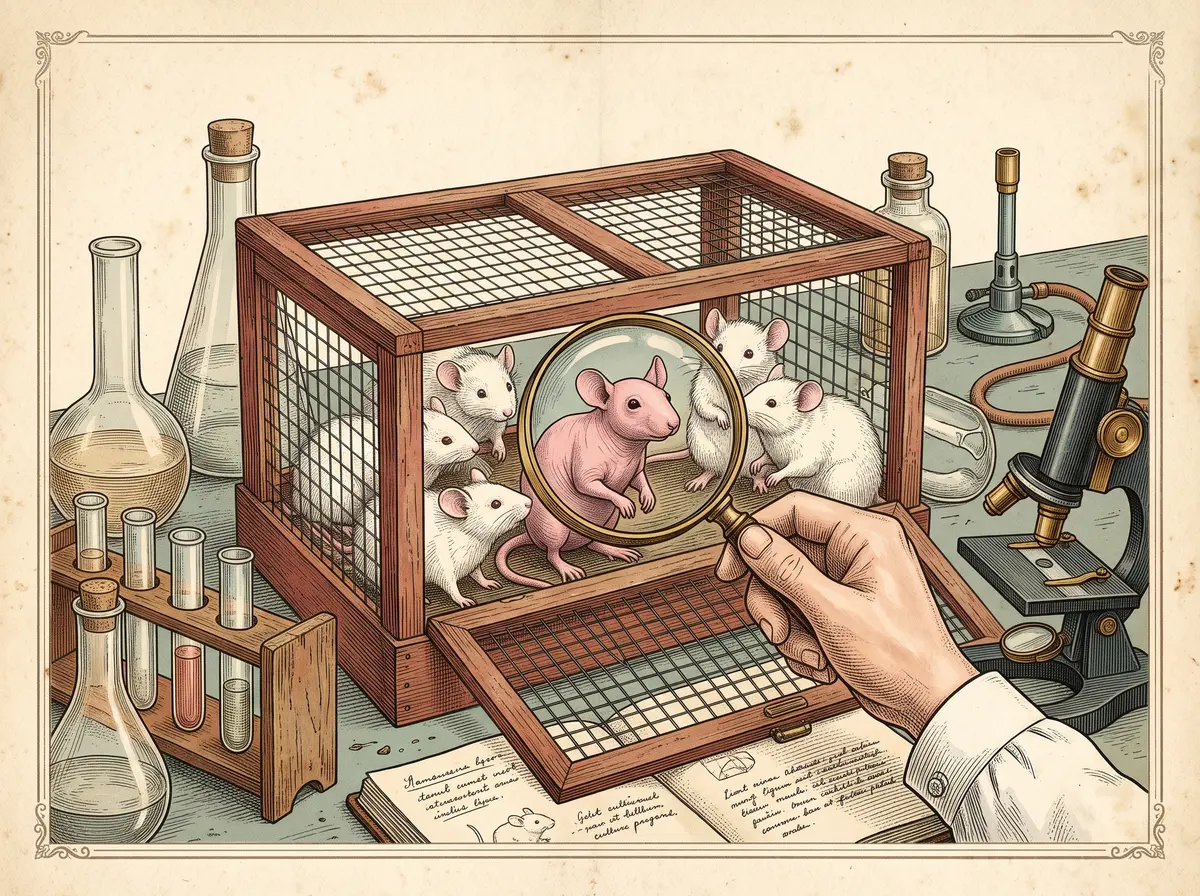
What happened: A Nude Mouse
The man who spotted the mutant was Dr. Norman R. Grist of the virus laboratory at Ruchill Hospital, a Glasgow infectious-disease hospital. His lab kept mice for virus work. They came from what geneticists call a “closed” colony, a group bred only among themselves but not deliberately inbred. A spontaneous mutation, a random change in a gene that nobody caused on purpose, had cropped up in it.
Grist sent the oddity east to the Institute of Animal Genetics in Edinburgh. There the geneticist S. P. Flanagan received one hairless male and two normal-looking relatives that seemed to carry the hidden trait. The original bald male died without fathering any young. Fortunately, the two carriers bred, and hairless babies turned up among their offspring.
Flanagan spent the next few years working out what he had. His 1966 paper in Genetical Research named the trait “nude,” with the gene symbol nu. He showed it was recessive, meaning a mouse needed two copies to look bald. He also described how to spot one: nude pups were born without whiskers, and they “never grow a first coat.”
The baldness was the least of their troubles. About 55 percent of nude pups in his colony died within two weeks of birth. Flanagan wrote that all of them “eventually die, usually between 3 and 14 weeks of age.” They grew slowly. Of 46 nude females paired with normal males, only four ever had a litter. Many also developed a fatal liver disease. Flanagan suspected a parasite called Toxoplasma but could not confirm it. He noted that he had found no link between the missing hair and the liver damage.
The missing piece came from E. M. Pantelouris. In 1968 he published a short report in Nature with a blunt title: “Absence of thymus in a mouse mutant.” The thymus is a small organ in the chest, just above the heart. In nude mice, it never formed properly. The mice were not simply bald and sickly. They were born without a working part of their immune system.
Why it was strange: A Nude Mouse
The timing was remarkable. Only seven years earlier, in 1961, a young researcher named Jacques Miller at the Institute of Cancer Research in London had published in The Lancet the first evidence that the thymus mattered for immunity at all. He removed it from newborn mice and watched them waste away, catch more infections, and run short of lymphocytes, the white blood cells that lead the body’s targeted defenses.
Miller had to operate to get that result. The Glasgow colony had done it for free, by accident, through a single broken gene. Nature had handed biologists a ready-made animal missing the organ they had only just learned to care about. Seen that way, Flanagan’s sad survival numbers made more sense. Mice with weak immune defenses would be expected to struggle with infections in an ordinary animal house.
The other oddity was the pairing itself. Why would one gene control both hair and an immune organ? That puzzle would take another generation to solve.
Another animal that won over doubtful scientists through an unexpected talent is The Armadillo Pitched as a Leprosy Lab — and the Researchers Who Laughed Until It Worked.
What scientists learned: A Nude Mouse
Without a thymus, nude mice cannot make mature T cells. T cells are the white blood cells that train in the thymus and then patrol the body, recognizing and attacking anything they classify as foreign. That includes transplanted tissue. A normal mouse rejects a skin graft or a tumor from another species within days. A nude mouse often does not.
In 1969, researchers Jørgen Rygaard and Carl O. Povlsen tested that idea with human cancer. They took a colon tumor from a 74-year-old patient and placed small pieces under the skin of nude mice. The tumor grew, was passed on to a second set of mice, and kept many features of the original human cancer. A human tumor living in a mouse is called a xenograft, from the Greek for “foreign,” and this was the start of a new kind of cancer research.
The double defect was finally explained in 1994, when Thomas Boehm’s team found the gene behind it. It codes for a “switch” protein, one that turns other genes on and off. Today it is called Foxn1. The same switch is needed both for the cells that build the thymus and for the cells that build hair. Nude mice actually do have hair follicles. The hair just coils up inside the follicle and cannot break through the skin.
For another rodent that rewrote the rules of mammal biology, see The Naked Mole-Rat: The Cold-Blooded Mammal That Lives Like an Ant and Won’t Age on Schedule.
How it reaches us today: A Nude Mouse
Nude mice became one of the most widely used animals in medical research. Scientists have used them to study leukemia, solid tumors, immune deficiency, AIDS, and leprosy, and to test whether experimental cancer drugs shrink human tumors growing inside them.
They are no longer the only option, and they are not perfect. Nude mice still have other immune defenses, including natural killer cells, which can stop some grafts from taking. Many labs now also use strains engineered to lack even more of the immune system. But the idea of growing a patient’s own tumor in a mouse to study it traces back to that Glasgow colony.
Living conditions changed the animals’ story too. In ordinary housing, nude mice live about six months to a year. Kept germ-free, they can live roughly as long as normal mice.
Another lab animal with a surprising second career is The Frog in the Hospital Basement That Told You If You Were Pregnant.
A bald mouse missing the organ that trains immune cells sits with the other animals that changed the work in Creatures That Changed Science.
Fun fact: A Nude Mouse
Nude mice are not always completely nude. Flanagan noticed that some adults grow a short, fuzzy coat that appears and then falls out again in cycles, so a “nude” mouse can spend part of its life looking faintly furry.
Research on cancer and immune deficiency touches many families. If you or someone you love is facing a diagnosis, a doctor or a patient-support group can be a good place to start for information and support.
Sources: A Nude Mouse
- Flanagan, S. P. “‘Nude’, a New Hairless Gene With Pleiotropic Effects in the Mouse”. Genetical Research 8 (1966): 295–309.
- Pantelouris, E. M. “Absence of Thymus in a Mouse Mutant”. Nature 217 (1968): 370–371. (Record via The Jackson Laboratory’s Mouseion.)
- Rygaard, J., and C. O. Povlsen. “Heterotransplantation of a Human Malignant Tumour to ‘Nude’ Mice”. Acta Pathologica et Microbiologica Scandinavica 77 (1969): 758–760. (Record via The Jackson Laboratory’s Mouseion.)
- Szadvari, I., O. Krizanova, and P. Babula. “Athymic Nude Mice as an Experimental Model for Cancer Treatment”. Physiological Research 65, Suppl. 4 (2016): S441–S453.
- The Institute of Cancer Research. “The Function of the Thymus” (on Jacques Miller’s 1961 discovery).