Strange Animals Scientists Studied · Medicine
The Armadillo Pitched as a Leprosy Lab — and the Researchers Who Laughed Until It Worked
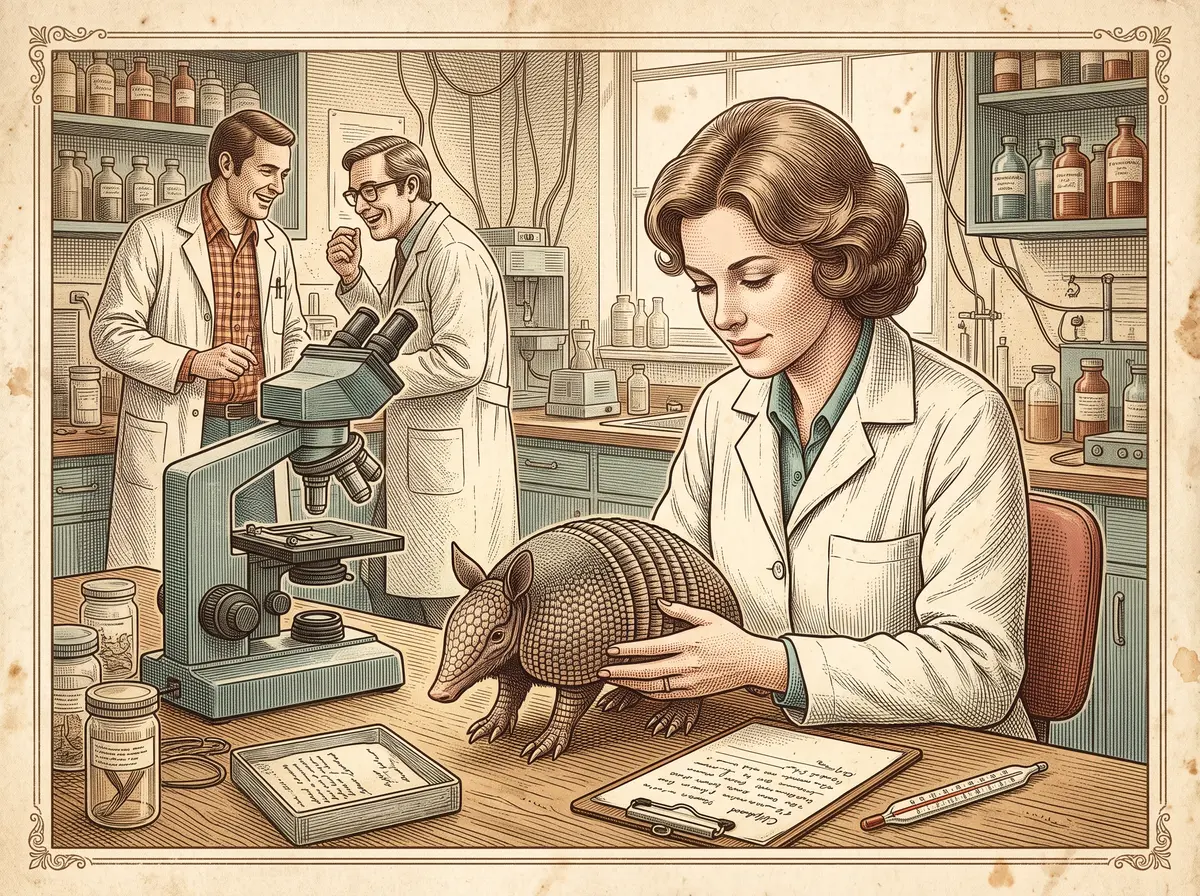
In 1970, at a research institute in the sugarcane country of New Iberia, Louisiana, four nine-banded armadillos were injected with bacteria taken from a leprosy patient. The idea had come from Eleanor Storrs, a biologist who studied armadillo reproduction. When she first floated it, she later recalled, the leprosy experts in the room laughed at her. About a year later, one of those armadillos was so thoroughly infected that its earlobe held five times more leprosy bacteria than the worst human case anyone knew of.
By the Curiosities Desk · · 5 min read · Filed under Medicine · Today’s round
What happened: The Armadillo Pitched as a Leprosy Lab — and the Researchers Who Laughed
Leprosy, also called Hansen’s disease, is caused by a slow-growing bacterium named Mycobacterium leprae. For most of the 20th century, it had a frustrating trick: it would not grow anywhere researchers wanted it to. It refused to multiply in a lab dish. Mice could be infected in their footpads, but only in small amounts, and mice live about two years, which is short for a disease that can take years to show itself. Without a reliable supply of the bacterium, testing drugs or vaccines was close to impossible.
Eleanor Storrs was not a leprosy researcher. She had earned her PhD at the University of Texas, at age 41, with a dissertation on the nine-banded armadillo, an animal she found fascinating for its odd reproduction. According to a history published by Florida Tech, where she later worked, she was at the Gulf South Research Institute in New Iberia when she overheard leprosy researchers complaining that their disease had no good animal model. She suggested armadillos. Her reasoning was simple: armadillos run cool. Their body temperature sits around 32 to 33°C (roughly 90°F), several degrees below ours, and M. leprae prefers cooler tissue. That’s why, in people, it attacks the hands, feet, nose, and earlobes first.
Storrs teamed up with Waldemar Kirchheimer, a researcher at the U.S. Public Health Service Hospital in Carville, Louisiana, the country’s national leprosy hospital. In February 1970, they inoculated four armadillos with about 8.9 million live bacteria from a patient. Then they waited.
The wait paid off. About a year later, one middle-aged armadillo developed the widespread form of the disease, called lepromatous leprosy, in which the bacteria multiply freely through the body. The animal died in July 1971. Its tissue was astonishingly loaded: bacteria made up about 2% of the weight of its earlobe, roughly 20 billion per gram. A federal health bulletin that November noted this was about five times the heaviest load ever recorded in a human patient. The team presented the results at a leprosy conference at the National Institutes of Health in late July 1971 and published them in the International Journal of Leprosy that year.
Then came a twist. In the mid-1970s, researchers in Louisiana began finding wild armadillos that already had leprosy, with no help from any lab. The animals the scientists had chosen for their convenience turned out to be carrying the disease on their own.
Why it was strange: The Armadillo Pitched as a Leprosy Lab — and the Researchers Who Laughed
Medicine usually reaches for mice, rats, or monkeys. An armored, ant-eating animal from the American South was not on anyone’s list, and the idea that a creature’s body temperature would decide its scientific career sounds almost like a joke. Yet the armadillo’s “flaw,” a cool body built for a slow, low-energy life, was exactly the feature that made it useful.
The second surprise was darker. Leprosy had long been thought of as a human-only disease. Discovering it in wild animals meant the line between “lab model” and “natural reservoir,” a population that keeps a disease alive in the wild, was blurrier than anyone expected.
For another animal recruited into medicine, see The Battlefield Maggots That Became a Prescription Medical Device.
What scientists learned: The Armadillo Pitched as a Leprosy Lab — and the Researchers Who Laughed
The armadillo finally gave researchers what they needed: large quantities of M. leprae. According to Florida Tech’s history, the World Health Organization and the NIH contracted Storrs’s lab to supply infected armadillo tissue for vaccine research. The armadillo also helped scientists study how the bacterium damages nerves, which is the source of leprosy’s numbness and lasting injuries.
Armadillos offered one more gift to experimenters: the nine-banded armadillo normally gives birth to identical quadruplets. That meant researchers could compare genetically identical siblings, a natural setup for studying why some individuals get sick and others don’t.
The animal link came into sharp focus in 2011. A team led by Richard Truman of the National Hansen’s Disease Programs in Baton Rouge compared the bacteria’s genetic fingerprints in The New England Journal of Medicine. They found a strain, previously unknown elsewhere, in 28 of 33 wild armadillos sampled, and in most of the U.S. patients they tested who had never traveled abroad. The authors called it “probable zoonotic leprosy,” meaning a disease that likely passes from animals to people.
More creatures like this live on Creatures That Changed Science.
How it reaches us today: The Armadillo Pitched as a Leprosy Lab — and the Researchers Who Laughed
Armadillos remain important to leprosy research. The National Institute of Allergy and Infectious Diseases notes that, other than humans, they are the only animal known to be naturally susceptible, and colonies of them have been central to modeling the disease. The bacterium still can’t be grown in a lab dish.
The 2011 study also changed advice for doctors in the American South. Physicians are now reminded to consider leprosy even in patients who have never left the country. Researchers stress that the risk is low: an estimated 95% of people are naturally immune, and brief contact with an armadillo is unlikely to cause infection. Truman told NPR that most infections likely come from handling or eating raw armadillo meat.
A fellow animal diagnostician: The Pigeons Trained to Spot Breast Cancer — and the Flock That Got It Right 99% of the Time.
Fun fact: The Armadillo Pitched as a Leprosy Lab — and the Researchers Who Laughed
Every litter of nine-banded armadillo quadruplets comes from a single fertilized egg that splits into four, so the four pups are genetically identical. Armadillos in this genus are among the very few mammals known to produce identical multiples as a matter of routine.
Leprosy today is curable with a course of antibiotics, and treatment in the U.S. is available free through the National Hansen’s Disease Program. If you have a numb patch of skin or a sore that won’t heal, a doctor is the right place to start.
Sources: The Armadillo Pitched as a Leprosy Lab — and the Researchers Who Laughed
- “Armadillo.” HSMHA Health Reports 86(11): 964–965 (November 1971), U.S. Public Health Service. https://stacks.cdc.gov/view/cdc/62750
- Kirchheimer WF, Storrs EE. “Attempts to establish the armadillo (Dasypus novemcinctus Linn.) as a model for the study of leprosy. I. Report of lepromatoid leprosy in an experimentally infected armadillo.” International Journal of Leprosy 39(3): 693–702 (1971). https://pubmed.ncbi.nlm.nih.gov/4948218/
- Truman RW, Singh P, Sharma R, et al. “Probable Zoonotic Leprosy in the Southern United States.” The New England Journal of Medicine 364: 1626–1633 (2011). https://www.nejm.org/doi/full/10.1056/NEJMoa1010536
- Patterson G. “The Secret History of Armadillos with Leprosy.” Florida Tech News+ (2018). https://news.fit.edu/?p=59110
- NPR, Shots. “Mysterious Leprosy Cases Linked To Armadillos” (April 28, 2011). https://www.npr.org/sections/health-shots/2011/04/28/135740951/mysterious-leprosy-cases-linked-to-armadillos