From a Watch Weighed Down With Lead to Breakfast at 3 P.M.: A Short History of Living on Mars Time
In August 2012, a family in a Los Angeles suburb sat down to breakfast at 3 in the afternoon. Lunch was at 8 p.m. Dinner was at 2:30 in the morning, and dessert came at 5 a.m. Nobody in the house was confused. The father was a flight director for NASA's Curiosity rover, and the whole family had agreed to live on Mars time for a while.
By the Curiosities Desk · · 5 min read · Filed under Space · Today’s round
What happened: From a Watch Weighed Down With Lead to Breakfast at 3 P.M.: A Short
The trouble started with a planet that spins a little too slowly. Mars takes about 24 hours and 39 minutes to bring the Sun back to the same spot in its sky. That leftover 40 minutes sounds small. It is not small when you are trying to run a robot that wakes up with the Martian sunrise.
The first problem was what to call it. While NASA was designing the Viking landers, which reached Mars in 1976, team members kept tripping over the word “day.” Did someone mean an Earth day or a Mars day? John Newcomb, an engineer at NASA’s Langley Research Center, offered a fix. As he recalled it later, he told the team, “Let’s call the Mars mean solar day that we will be using a Sol.” The name stuck. Mission teams still count “Sol 1, Sol 2” today.
Naming the sol was the easy part. Living by it came with the twin rovers Spirit and Opportunity, which landed in January 2004. A rover works in sunlight and sends its data home later in its day. Engineers then plan the next day’s commands while the rover “sleeps.” To keep up, key staff at NASA’s Jet Propulsion Laboratory (JPL) in Pasadena shifted their workday about 40 minutes later every day for roughly the first three months. A shift that started at 9 a.m. one week was starting in the middle of the night a couple of weeks later.
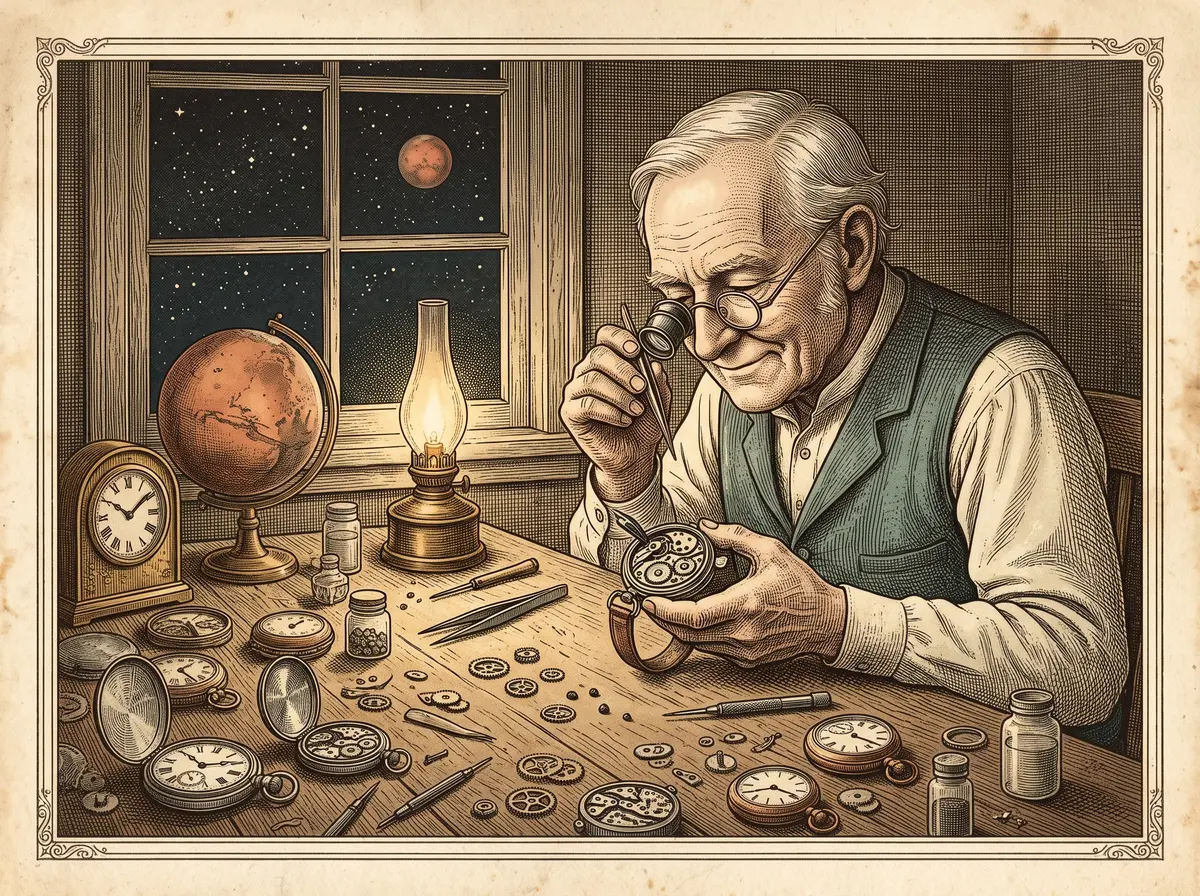
Ordinary watches couldn’t track this. Avionics engineer Julie Townsend and systems engineer Scott Doudrick went looking for watches that ran on Mars time. Several watchmakers turned them down, saying it couldn’t be done unless NASA ordered 10,000 or more quartz watches. Then they found Garo Anserlian, who ran a jewelry shop in Montrose, near JPL. Over about two months he worked out a method, attaching small lead weights inside self-winding mechanical watches to slow their movements just enough. He spent more than $1,000 on the experiments and ruined a few watches along the way. When he finished, Doudrick’s watch drifted no more than ten seconds per 24 Earth hours, and team members started wearing Martian time on their wrists.
The next mission brought in sleep scientists. During the 2008 Phoenix Mars Lander mission, a team led by researchers at Harvard Medical School and Brigham and Women’s Hospital tracked 19 ground-crew volunteers for 78 sols. Most volunteers got a panel of blue-tinted lights to use at their desks, and all got training on sleep and fatigue.
Then came Curiosity in August 2012, the busiest Mars-time operation yet. About 800 people on the project followed the Martian day. Flight director David Oh took the experiment home. He, his wife Bryn, and their three children covered their bedroom windows so they could sleep during daylight. They went on night hikes, caught a midnight movie, went bowling at odd hours, and held a Mars-themed barbecue with a cake shaped like Gale Crater, the rover’s landing site. The kids rejoined Earth time when school started. In November 2012, after about three months, the Curiosity team followed them back.
Why it was strange: From a Watch Weighed Down With Lead to Breakfast at 3 P.M.: A Short
Jet lag usually happens once. You fly across the world, feel awful for a few days, and recover. Mars time is jet lag that never stops. Every day the schedule moves 40 minutes later, so about every five weeks you have lived through a full lap of the clock, with your “morning” sliding through afternoon, evening, and the dead of night.
There is also something lovely about the gear it required. In the age of space probes and supercomputers, one fix for an interplanetary problem was a neighborhood watchmaker with a set of lead weights. For more on people who made a living from keeping time, see The Woman Who Sold London the Time From a Watch Named Arnold.
What scientists learned: From a Watch Weighed Down With Lead to Breakfast at 3 P.M.: A Short
Human bodies run on a circadian rhythm, an internal clock of roughly 24 hours. It resets every day mostly from light, especially the blue part of the spectrum, which tells the brain it is daytime. The big question was whether people could stretch that clock to a 24.65-hour sol.
The Phoenix study, published in the journal Sleep in 2012, found that most could. Of the 15 volunteers with usable data, 13 (87 percent) had internal clocks that synced to the Mars day. The researchers couldn’t say exactly how much the blue lights helped, because people used them unevenly and the study had no comparison group. The cost showed up in sleep. Volunteers averaged about 6.2 hours a night, and when their work shifts fell out of step with their body clocks, they got about 18 percent less sleep. Fatigue and sleepiness climbed after long stretches awake and during the body’s biological night.
How it reaches us today: From a Watch Weighed Down With Lead to Breakfast at 3 P.M.: A Short
The lesson has changed how missions are run. Curiosity’s team got off Mars time early by trimming its daily planning cycle from more than 16 hours to 12, so most work could fit between 8 a.m. and 8 p.m. Pacific time. Project manager Richard Cook put it simply: “People are glad to be going off Mars time.” When Perseverance landed in 2021, its team again worked Mars time for the first 90 sols, this time with many scientists working from home because of the COVID-19 pandemic.
The sleep research matters even more for the future. Astronauts on Mars would not be able to switch back to Earth time. Studies like the one from Phoenix are early evidence of what it will take to keep a crew rested under a slightly longer sky.
Keeping time when the day itself will not hold still belongs with the other long histories in From the First Spark to the Thing You Still Use.
Fun fact: From a Watch Weighed Down With Lead to Breakfast at 3 P.M.: A Short
To keep Curiosity’s night-shift crews going, the team stocked free ice cream. Mission manager Mike Watkins called it “a little pick-me-up in the middle of the night.”
Sources: From a Watch Weighed Down With Lead to Breakfast at 3 P.M.: A Short
- Barger, Laura K., et al. “Learning to Live on a Mars Day: Fatigue Countermeasures during the Phoenix Mars Lander Mission”. Sleep 35, no. 10 (2012): 1423–1435.
- “Curiosity Team Switches Back to Earth Time”. NASA Jet Propulsion Laboratory, November 6, 2012.
- “The Man Who Named the Martian Day”. Air & Space magazine, Smithsonian.
- “Mars watchmaker had time to lose”. NASA Jet Propulsion Laboratory feature, republished by collectSPACE, January 11, 2004.
- “Like NASA rover, family switches over to Mars time”. Associated Press via MPR News, August 19, 2012.