The Four Hedgehogs Let Loose to Eat a Gardener's Slugs — Whose Descendants Went for the Birds' Eggs Instead
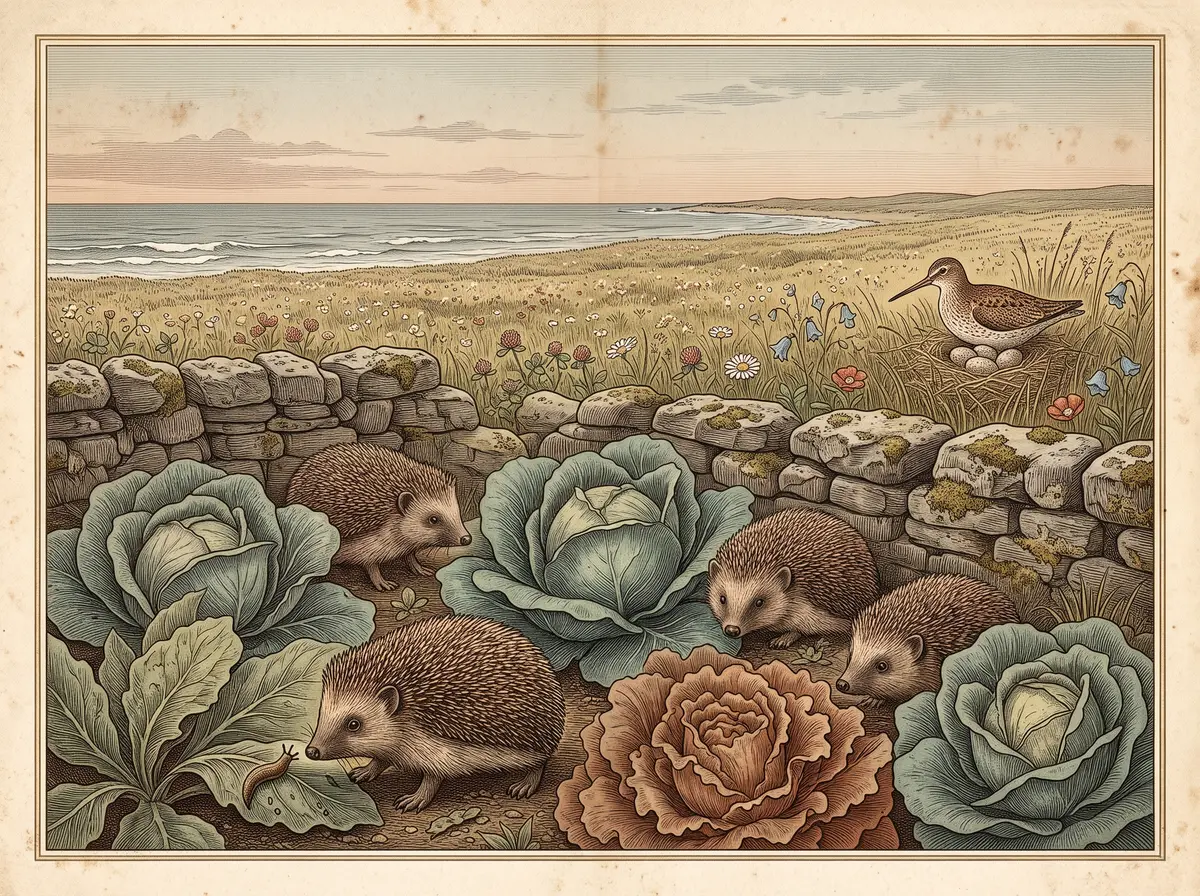
In 1974, on the island of South Uist in Scotland's Outer Hebrides, someone with a slug problem tried a gentle, old-fashioned fix: hedgehogs. A small handful (most likely four, by the best-documented account) were let loose to patrol a garden. The slugs were only the start. Thirty years later, their descendants numbered in the thousands, they were eating the eggs of internationally important wading birds, and governments, scientists, sniffer dogs, and animal-rescue volunteers were all on their trail.
By the Curiosities Desk · · 5 min read · Filed under Biology · Today’s round
Part of The Animals Hired for a Job
What happened: The Uist Hedgehogs
Hedgehogs are native to mainland Britain, where gardeners have long welcomed them as free pest control. They snuffle around at night eating beetles, worms, caterpillars, and slugs. But they had never lived on the Uists, a chain of low, windswept islands off Scotland’s west coast.
According to a 2004 study in the journal Biological Conservation, four hedgehogs are thought to have been released on South Uist in 1974, citing an earlier 1982 account. Other retellings give slightly different numbers, and accounts differ on the details. What everyone agrees on is the reason: a garden full of slugs and snails.
The islands turned out to be a hedgehog paradise. There were no natural predators to eat them and plenty of invertebrates to eat. By the 1990s, hedgehogs had spread across the fertile parts of South Uist, crossed to the neighboring island of Benbecula, and reached the southern end of North Uist.
That fertile land is called machair, a rare kind of low-lying grassland that grows on wind-blown shell sand along the Atlantic shore. In spring, machair is crowded with ground-nesting wading birds: dunlin, redshank, ringed plover, snipe, lapwing, and oystercatcher. Surveys in the early 1980s found these birds breeding at very high densities, and the populations were considered internationally important.
Then the counts started falling. Between 1983 and 1998, ringed plovers on South Uist dropped by 58 percent, dunlin by 65 percent, and redshank by 43 percent. A hedgehog, it turns out, will not pass up a nest of eggs sitting in the grass.
In 2000, Scottish Natural Heritage (the government’s nature agency, now called NatureScot), RSPB Scotland, and the Scottish Executive launched the Uist Wader Project to remove the hedgehogs. From 2003, captured animals were put down, and the public reaction was fierce. Volunteers formed Uist Hedgehog Rescue, offering to catch hedgehogs alive and carry them to the mainland instead. By early 2007, the agency had killed 690 hedgehogs, and rescuers had moved 756. A 2006 University of Bristol study found that relocated hedgehogs survived well if properly cared for, and in February 2007 the agency’s board switched to live trapping and relocation.
The work has gone on ever since, with cage traps and specially trained sniffer dogs. In one 2014 trial at Drimore on South Uist, teams removed 64 hedgehogs from an area under two square kilometers. Half were caught in traps, and half were found by dogs.
Why it was strange: The Uist Hedgehogs
Because almost nobody thinks of a hedgehog as a threat. In Britain it is the friendly garden visitor of picture books, the animal people leave saucers out for. Releasing a few to eat slugs sounded like the most harmless idea imaginable.
The trouble was not the hedgehog but the place. The same animal that is a gardener’s ally on the mainland became a top predator on islands where nothing hunted it and the birds had no defense against it. Eggs were a small part of a hedgehog’s diet, but with thousands of hedgehogs, a small part added up.
It also produced one of conservation’s odder standoffs. On one side, bird scientists trying to save internationally important nesting grounds. On the other, animal lovers defending a species whose numbers were falling elsewhere in Britain. Both sides cared about wildlife; they just disagreed about which wildlife came first. Mongooses once made a similar leap from helper to problem: The Mongooses Hired to Hunt Rats — Who Worked the Day Shift.
What scientists learned: The Uist Hedgehogs
The Uists became a natural experiment. Hedgehogs had colonized the south of the island chain but not yet the north, so researchers could compare the two. From 1983 to 2000, shorebird numbers along survey routes rose 8.6 percent in the hedgehog-free north and fell 39.1 percent in the south.
Nest studies sharpened the picture. In 1996 and 1997, hedgehogs caused between 36 and 64 percent of the nest failures of lapwing, dunlin, snipe, and redshank on South Uist. Experiments suggested that hedgehogs cut a nest’s chance of success by a factor of about 2.4. The birds with the biggest eggs, oystercatchers, suffered least.
The broader lesson is one ecologists see again and again on islands: whether an animal is harmless or harmful depends less on the animal than on where you put it. More stories on this shelf: The Animals Hired for a Job.
How it reaches us today: The Uist Hedgehogs
The cleanup is still unfinished, more than fifty years after the release. North Uist was largely cleared, with only a few stragglers trapped in 2016 and 2017. A 2019 report estimated that clearing Benbecula and South Uist could take five to ten years and cost £3.5 to £5 million.
In 2025, a new partnership called Saving Uist Nature, made up of RSPB Scotland, NatureScot, and the Scottish SPCA, received £97,840 from the Scottish Government’s Nature Restoration Fund to plan the next step: capturing hedgehogs alive on Benbecula and then South Uist and moving them to the mainland.
The Uists are now a standard warning in island conservation: release nothing, however cute or useful, onto an island it never reached on its own. Another well-meaning pest controller that backfired: The Snail Hired to Eat Another Snail — That Ate the Wrong Ones Instead.
Fun fact: The Uist Hedgehogs
The oystercatcher may owe its relative safety to the size of its eggs. The scientists who studied the Uist nests suggested that hedgehogs might simply “have difficulty biting into eggs as large as those of oystercatcher.”
Sources: The Uist Hedgehogs
- D. B. Jackson, R. J. Fuller & S. T. Campbell, “Long-term population changes among breeding shorebirds in the Outer Hebrides, Scotland, in relation to introduced hedgehogs (Erinaceus europaeus),” Biological Conservation 117 (2004): 151–166.
- R. C. Thompson & J. M. Ferguson, “Removing introduced hedgehogs from the Uists,” in Island Invasives: Scaling Up to Meet the Challenge, IUCN Occasional Paper SSC no. 62 (2019), pp. 274–281.
- RSPB, “Saving Uist Nature” press release (2025).
- Animal People, “Scottish Natural Heritage halts Hebrides hedgehog cull — agrees to relocate instead” (March 2007).
- OneKind, “Advocates for Animals joins Uist Hedgehog Rescue” (2002).