The Scientist Behind It · Engineering
The Inventor Who Roller-Skated Into a Masquerade Playing the Violin — and Forgot to Invent the Brakes
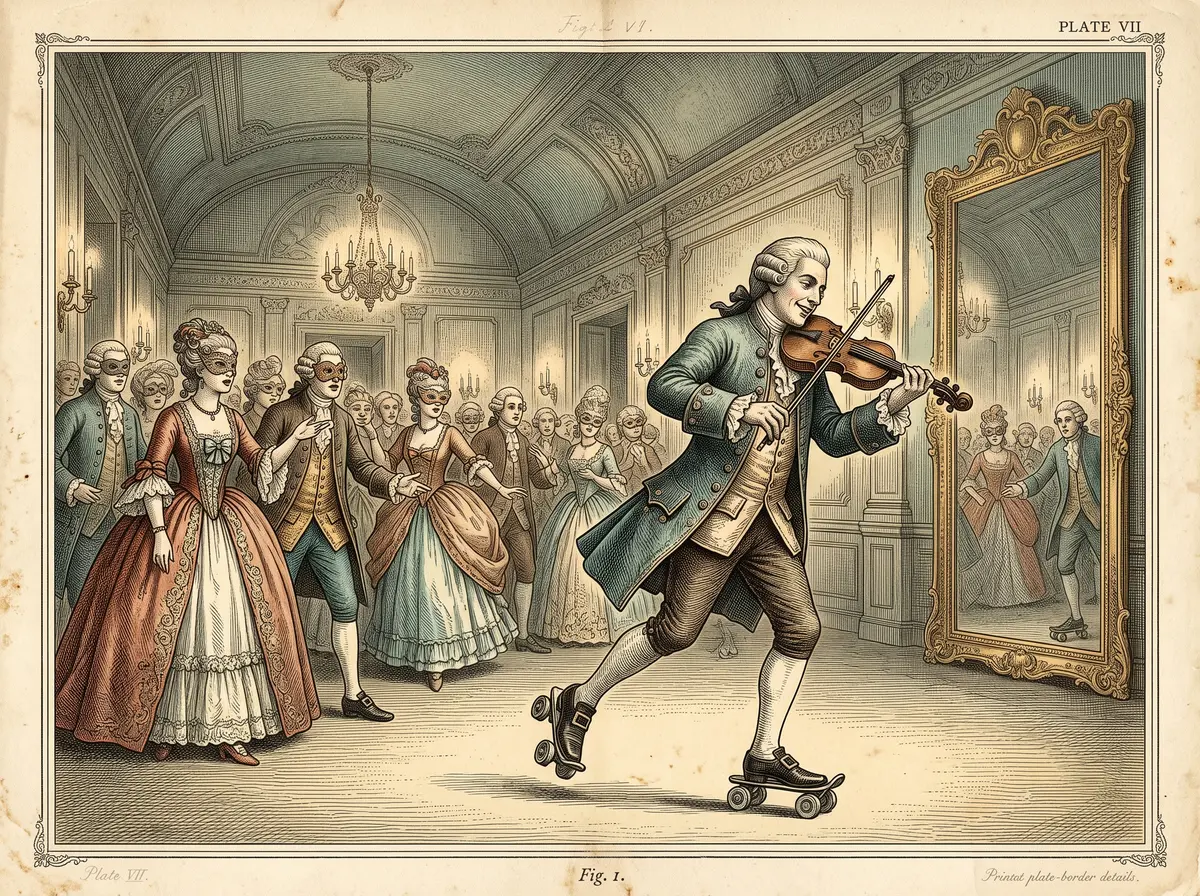
Picture a costume ball in Georgian London, lit by candles and packed with masked guests. Through the crowd glides a Belgian instrument maker named John Joseph Merlin, playing the violin and rolling on metal wheels strapped to his shoes. He is going faster than he meant to. He has no way to steer. And at the far end of the room hangs a very large, very expensive mirror.
By the Curiosities Desk · · 5 min read · Filed under Engineering · Today’s round
Part of The Person Who Would Not Drop It
What happened: Roller Skates
Jean-Joseph Merlin was born on 6 September 1735 in Huy, a town on the River Meuse in what is now Belgium. He trained in Paris as a maker of mathematical instruments, clocks, and other fine machinery. On 24 May 1760 he arrived in London as a technical adviser to the new Spanish ambassador, the conde de Fuentes. He never really left.
By 1766 he was working for James Cox, a jeweller and showman who sold dazzling clockwork toys to the rich. Merlin became Cox’s chief mechanician, the person who made the moving parts move. He also built harpsichords and pianos, and in 1774 he patented a way to add a piano mechanism to a harpsichord.
Somewhere in those busy years, he built a pair of skates that ran on small metal wheels set in a line under a wooden sole. Ice skating was already popular. Merlin’s idea was skating without the ice.
The famous story of how he showed them off comes from the musician and writer Thomas Busby. In his Concert Room and Orchestra Anecdotes, published in 1825, Busby describes Merlin skating into one of the masquerade balls held by Teresa Cornelys at Carlisle House in Soho Square, one of the most fashionable party venues in London. To make a grand entrance, Merlin played the violin as he rolled.
The entrance was grander than planned. According to Busby, Merlin had worked out no way to slow down or change direction. He rolled straight into a mirror worth more than £500, which in Busby’s words he “dashed it to atoms.” The mirror was destroyed, the violin was smashed, and Merlin was badly hurt.
It is worth being careful here. Busby wrote this down in 1825, more than twenty years after Merlin’s death, and he gives no exact date. Popular retellings often place the crash in 1760, but that is an assumption, not a recorded fact. No newspaper report from the night itself has turned up. So the crash is best treated as a well-loved anecdote, probably rooted in something real, rather than a documented event.
The mirror did not slow Merlin’s career. In 1783 he opened Merlin’s Mechanical Museum in Princes Street, near Hanover Square. Visitors paid to see, and try, his inventions over tea or coffee. In 1781 the painter Thomas Gainsborough painted his portrait, showing him holding a small pocket weighing balance of his own design.
Why it was strange: Roller Skates
Merlin was not a careless amateur. He was one of the most skilled precision engineers in London, a man trusted with the hidden gears of luxury automata, self-moving mechanical figures. Yet in the most famous story about him, his invention fails at the simplest job imaginable: stopping.
That gap is what makes the tale stick. Building a wheel that rolls is easy. Building something a person can control while rolling turns out to be hard. Merlin, according to the story, solved the first problem with flair and forgot the second one entirely. Most inventors find their flaws in a workshop; Merlin, in the story, found his in front of London’s best-dressed crowd.
Another clockwork marvel that drew Georgian crowds was The Chess-Playing Machine That Beat Napoleon (With a Man Hidden Inside).
What scientists learned: Roller Skates
The lesson is one engineers still teach: moving forward and staying in control are separate problems. A skate with wheels in one fixed line will run straight, but it resists turning. Without a brake, the only ways to stop are friction, a wall, or a fall.
Skate designers spent the next century working on exactly those missing pieces. In 1819 a Frenchman named Petitbled patented an inline skate, still difficult to turn. An English design called the Volito, patented in the 1820s, made the middle wheels slightly larger so skaters could rock and turn more easily. The real breakthrough came in 1863, when the American James Leonard Plimpton patented the “rocker” skate. It had two pairs of wheels on pivots cushioned with rubber, so skaters could steer just by leaning. A toe stop, a rubber pad at the front for braking, was patented in 1876.
Merlin’s sense of what a machine could do for the body also showed up in a quieter invention: his “gouty chair,” a wheeled chair the sitter could move and steer by turning handles on the arms. Medical historians count it as an early ancestor of the self-propelled wheelchair. In 1778 a newspaper reported him arriving at another masquerade, at the Pantheon, dressed as a gouty gentleman riding in a chair of his own design. This time, there was no record of a crash.
Another inventor of the same city and era, with very different feelings about noise, is The Computer Pioneer Who Declared War on London’s Organ Grinders.
How it reaches us today: Roller Skates
Merlin is often called the first known inventor of the roller skate, and every rink, roller derby bout, and pair of inline skates descends from the problem he ran into. Modern skates still balance the same trade-off he faced: wheels for speed, plus pivots, bearings, and brakes for control.
His finest surviving work does not roll at all. The Silver Swan, made in Cox’s workshop in 1773, is now at the Bowes Museum in Barnard Castle, England. Merlin is credited with the mechanism that moves the swan’s head and neck. It has about 2,000 moving parts, and it still performs for visitors, bending its neck to “catch” a silver fish from a stream made of twisting glass rods.
Merlin died in Paddington on 8 May 1803. His collection was later sold at auction. One buyer, in 1834, was Charles Babbage, the computing pioneer, who paid £35 for one of Merlin’s silver automata, a dancing figure he had first admired as a boy.
Merlin, still building machines after the mirror, sits with the others who would not stop in The Person Who Would Not Drop It.
Fun fact: Roller Skates
The Silver Swan was a star of the 1867 Paris International Exhibition, where it was priced at 50,000 francs. Six years later the collector John Bowes bought it for a tenth of that: 5,000 francs, or about £200.
Sources: Roller Skates
- Busby, Thomas. Concert Room and Orchestra Anecdotes of Music and Musicians, Ancient and Modern. First published 1825; reissued by Cambridge University Press, Cambridge Library Collection.
- Debenham, Margaret. “Joseph Merlin in London, 1760–1803: The Man Behind the Mask. New Documentary Sources.” Royal Musical Association Research Chronicle 45, no. 1 (2014): 130–163.
- Weiner, Marie-France, and John R. Silver. “Merlin’s ‘Invalid or Gouty Chair’ and the Origin of the Self-Propelled Wheelchair.” Journal of Medical Biography 24, no. 3 (2016): 412–417.
- The Bowes Museum. “The Silver Swan”.
- National Geographic. “The Roller-Skating Revolution Swept the World in the 1800s”.