The Kaleidoscope Craze That Sold 200,000 in Three Months — and Barely Paid Its Inventor
In 1817, a Scottish physicist patented a tube of mirrors he believed would help designers and scientists. Within months, by his own count, about 200,000 of them had sold in London and Paris. Tinsmiths were making the parts. Ships were carrying cargoes of them to the East Indies. And the inventor, David Brewster, reckoned that fewer than a thousand of those 200,000 had been built the right way.
By the Curiosities Desk · · 5 min read · Filed under Physics · Today’s round
What happened: The Kaleidoscope Craze That Sold 200,000 in Three Months — and Barely Paid
David Brewster was not a toymaker. In 1814 he was a serious Scottish physicist studying the polarization of light, the way light waves can be made to vibrate in a single direction. While working with angled glass plates, he noticed something he later described as “the circular arrangement of the images of a candle round a center.” On 7 February 1815, a related experiment produced an even more striking effect, and he kept tinkering.
Over the next two years he worked out how to turn that effect into an instrument. He set two long mirrors at a precise angle inside a tube. He put an eyehole at one end and a cell of loose colored glass at the other. Then he added an improvement he considered the most important of all: a draw tube with a lens, so the device could turn any object, near or far, into a symmetrical pattern. He named it from three Greek words meaning roughly “beautiful,” “form,” and “to look at”: the kaleidoscope.
In July 1817 Brewster received British patent number 4136 “for a new Optical Instrument called ‘The Kaleidoscope.’” He partnered with Philip Carpenter, a Birmingham optician, who would be the sole maker. Surviving instruments from this period, including one in the Science Museum Group collection, are stamped “P Carpenter, sole maker.”
Then the plan slipped. As Brewster later explained, one of the patent instruments was shown to some London opticians while Carpenter was still gearing up. The secret was out “before any number of them could be prepared for sale.” The idea was so simple to copy that copies appeared almost at once.
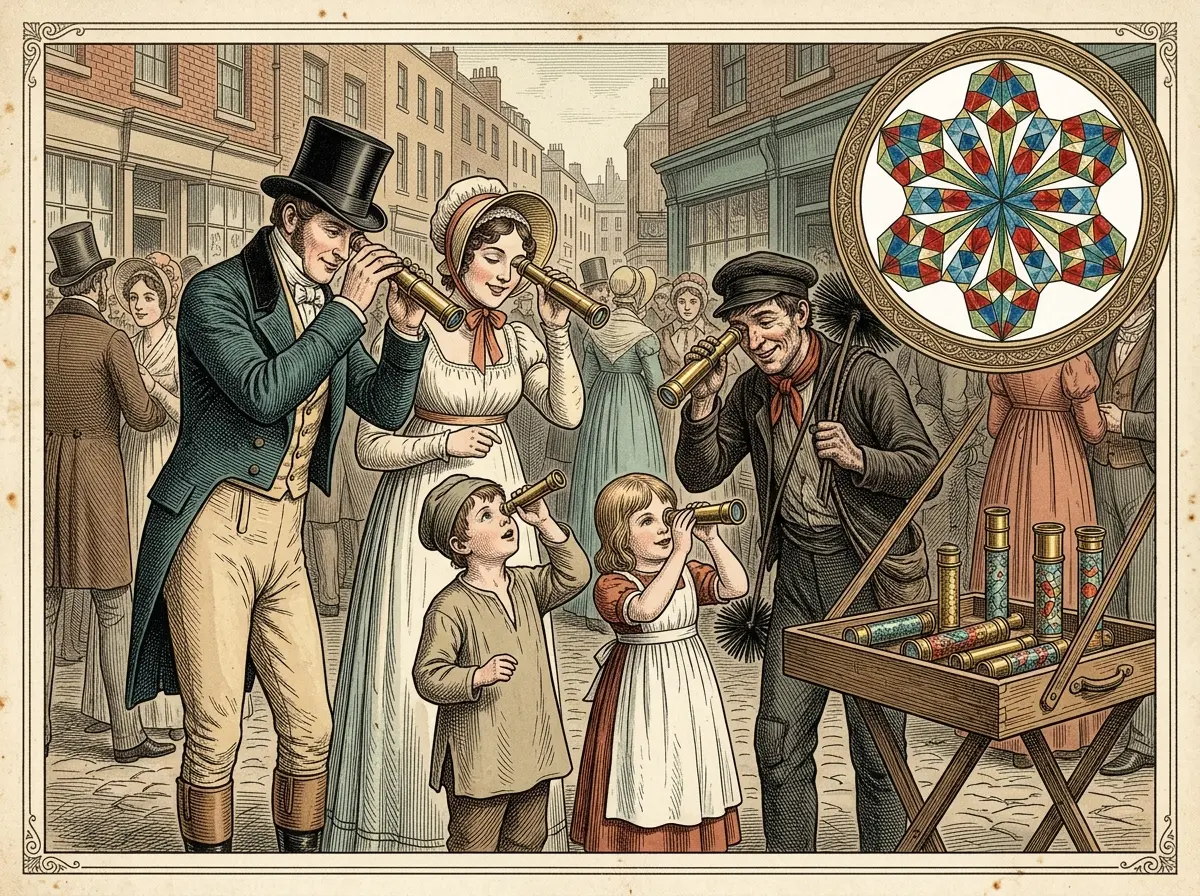
What followed was a full-blown fad. Brewster wrote that “no fewer than two hundred thousand instruments were sold in London and Paris during three months.” He quoted an encyclopedia writer, a Dr. Roget, who said the kaleidoscope excited “all ranks of people” and gave “delight to the poor as well as the rich.” Cargoes went to the East Indies. Travelers reported finding kaleidoscopes in remote Swiss villages. In 1818, the Philosophical Magazine said the device was “now in the hands of almost every person.”
That 200,000 figure comes from Brewster himself, and historians note it can’t be independently verified. But the flood of imitators is well documented, and Brewster’s own count of the properly built ones was sobering: “perhaps not one thousand.”
Why it was strange: The Kaleidoscope Craze That Sold 200,000 in Three Months — and Barely Paid
Patents are supposed to protect exactly this kind of breakthrough. Instead, the kaleidoscope’s patent did very little.
Part of the problem was that mirrors arranged at an angle were nothing new. Writers had described multiplied reflections for centuries, and a 1717 gardening book by Richard Bradley described angled mirrors set over geometric drawings to multiply them. Copiers could argue they were selling an old idea. Brewster complained that “tinmen and the glazers began to manufacture the detached parts” so buyers could assemble kaleidoscopes themselves and dodge the patent.
Brewster insisted the earlier versions missed the point. Old mirror tricks made jumbled, broken reflections. His kaleidoscope worked because of exact rules about the mirror angle and where the eye and the objects had to sit. By 1818, Carpenter could not keep up with demand, and Brewster licensed other makers; one advertisement that year listed seventeen of them. Brewster earned little from the craze, and modern collectors say he never got the protection he hoped for.
There’s a whole shelf of stories like this in The Ordinary Object With the Strange Origin.
What scientists learned: The Kaleidoscope Craze That Sold 200,000 in Three Months — and Barely Paid
The kaleidoscope is a lesson in how reflections stack up. A single flat mirror makes one image. Put two mirrors at an angle, and each mirror reflects the other’s reflection, again and again, until the images wrap all the way around the center.
Brewster’s key insight was that the angle matters enormously. If the angle between the mirrors divides evenly into a full circle, such as 60 degrees for six wedges or 45 degrees for eight, every reflected wedge lines up perfectly with its neighbors. The result is a seamless, symmetrical pattern. Pick an angle that doesn’t divide evenly, and the wedges collide in a messy, mismatched seam. That is why most of the cheap copies disappointed him: get the angle or the eye position slightly wrong and the magic breaks.
His telescopic version went further. By adding a lens, Brewster turned the kaleidoscope into a machine that could take anything — a bookshelf, a tree, a crowd — and fold it into a pattern. For more on how mirrors helped physicists pin down light itself, see From Lanterns on Two Hills to Mirrors Left on the Moon: A Short History of Measuring the Speed of Light.
How it reaches us today: The Kaleidoscope Craze That Sold 200,000 in Three Months — and Barely Paid
Brewster hoped artists and designers would use the kaleidoscope to invent patterns for carpets, wallpaper, and jewelry, and many did. Historians of decorative art link the device to a fashion for bright, abstract patterning in the decades that followed.
The same mirror geometry still turns up today. Designers use mirror symmetry tools in drawing apps. Kaleidoscope filters on phone cameras do digitally what Brewster’s mirrors did with glass. And the story is still a classic case study in how a patent can fail when an idea is simple, beautiful, and easy to copy.
The kaleidoscope also joined a long tradition of toys that hide real physics, alongside The Slinky: The Walking Spring That Fell Off a Navy Workbench.
Fun fact: The Kaleidoscope Craze That Sold 200,000 in Three Months — and Barely Paid
Brewster didn’t just invent the kaleidoscope. He invented the word: kalos (beautiful) + eidos (form) + skopeo (to look). It has since become everyday English for anything colorful and constantly shifting.
Sources: The Kaleidoscope Craze That Sold 200,000 in Three Months — and Barely Paid
- Brewster, David. The Kaleidoscope: Its History, Theory and Construction, with Its Application to the Fine and Useful Arts (3rd ed., London: John Camden Hotten, 1870). Project Gutenberg. https://www.gutenberg.org/ebooks/74417
- Science Museum Group Journal. “Philip Carpenter and the convergence of science and entertainment in the early-nineteenth century instrument trade.” https://journal.sciencemuseum.ac.uk/article/philip-carpenter/
- Science Museum Group Collection. “Kaleidoscope, by Philip Carpenter, Birmingham, with case” (object 1911-270). https://collection.sciencemuseumgroup.org.uk/objects/co3752
- Physics World. “Meet the kaleidoholics.” https://physicsworld.com/a/meet-the-kaleidoholics/
- University of Edinburgh, School of Physics and Astronomy blog. On David Brewster and the kaleidoscope. https://blogs.ed.ac.uk/physics-astronomy/?p=418