The Victorian Lady Who Kept Corals Alive in Her Drawing Room — With a Maid Pouring Seawater at the Window
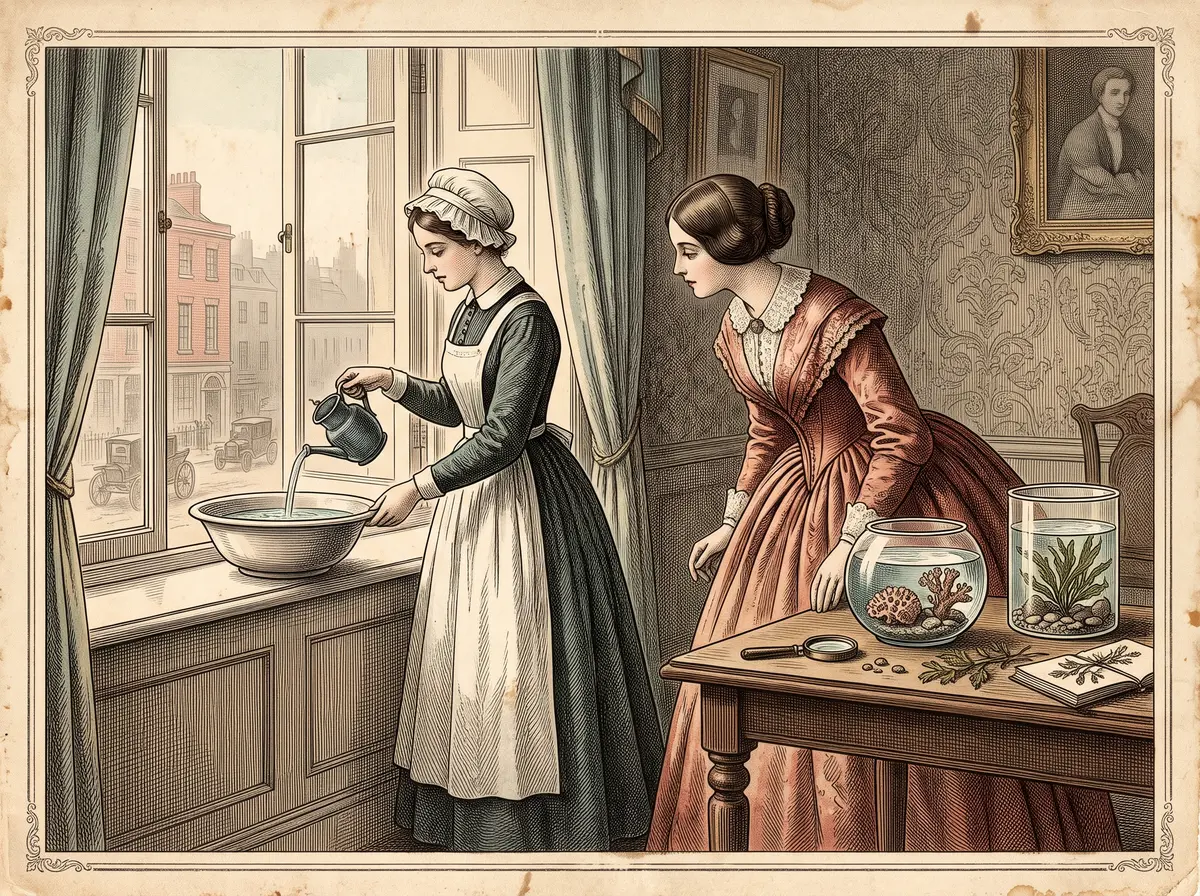
In a house beside Westminster Abbey, sometime around 1847, a maid stands at an open window with a small watering-pot, pouring seawater from one vessel into another. Then back again. Then again. She keeps it up for half an hour or more. Across the room, in glass bowls, sit a few stony little corals collected on the Devon coast, and the whole point of the pouring is to keep them breathing. Her employer later wrote that the maid "thought it rather an amusement." Out of that chore came the first home marine aquarium on record.
By the Curiosities Desk · · 5 min read · Filed under Biology · Today’s round
What happened: The Victorian Lady Who Kept Corals Alive in Her Drawing Room — With a Maid
The employer was Anna Thynne (1806–1866), born Anna Beresford in Ireland and married to Lord John Thynne, a canon of Westminster Abbey who became its sub-dean in 1835. She had a long-standing interest in geology and natural history, and in the autumn of 1846, at the seaside resort of Torquay, she collected some living madrepores. “Madrepore” was the Victorian word for stony corals. The ones in British waters are small, solitary cup corals, each a single soft-bodied animal sitting in a limestone cup it builds itself. To most visitors they looked like pebbles. To Thynne they were animals worth watching.
Getting them home was the first problem. According to a contemporary account she supplied, she carried them to London in seawater in a bottle covered with a bladder, an old-fashioned stopper made from animal membrane. Once home, she moved them into two glass bowls and started looking after them.
Keeping sea creatures alive in a city was not a solved problem in the 1840s. Seawater had to be brought up from the coast, and the water in a closed bowl quickly went stale as the animals used up its oxygen. Thynne renewed the water when she could, but, as she later wrote, she “could not have a continual supply sufficient for such a demand.”
So she improvised. To put air back into the water, she poured it “backwards and forwards through a small watering-pot, before an open window, for half or three-quarters of an hour.” This was where her maid came in. “I had a little maid,” Thynne wrote, “who, besides being anxious to oblige me, thought it rather an amusement.” Day after day, the corals were kept going partly by a servant’s patience and a garden tool.
Then, in the spring of 1847, she tried something different. She got hold of rocks and shells with living seaweed still attached and added them to the bowls. The seaweed seemed to keep the water fresh on its own. “From this time,” she wrote, “I regularly placed sea-weed in my glass bowls.” According to aquarium historian Albert Klee, her corals went on to live for about three years, an unheard-of stretch for marine animals kept indoors.
Thynne didn’t publish right away. Her full account, “On the Increase of Madrepores,” appeared in 1859 in The Annals and Magazine of Natural History, with notes by the naturalist Philip Henry Gosse. By then, the hobby she had helped start had become a national craze.
Why it was strange: The Victorian Lady Who Kept Corals Alive in Her Drawing Room — With a Maid
The breakthrough didn’t come from a laboratory or a learned society. It came from a drawing room, a watering-pot, and a household servant who found the job fun. Thynne had no formal scientific training and no special equipment. What she had was attention: she noticed that the corals did better when the water moved through the air, and better still when plants shared the bowl.
There’s also a quiet reversal here. The prevailing approach was to fight stale water by replacing it. Thynne’s eventual solution was to stop treating the bowl as a container and start treating it as a tiny community, in which some living things could clean up after others.
The craze that followed shares a shelf with The Sea-Monkeys That Hatched a Day Before You ‘Brought Them to Life’, in The Ordinary Object With the Strange Origin.
What scientists learned: The Victorian Lady Who Kept Corals Alive in Her Drawing Room — With a Maid
Two pieces of chemistry were at work, and Thynne hit on both.
The first is gas exchange at the surface. Water picks up oxygen from the air mainly where the two meet. Pouring water through a watering-pot breaks it into many thin streams, which hugely increases that meeting surface. That’s why the maid’s half hour at the window made such a difference.
The second is photosynthesis, the process by which plants and algae use light to turn carbon dioxide and water into sugars, releasing oxygen as a by-product. Animals do the reverse: they take in oxygen and give off carbon dioxide. Put the two together in the right proportions, under enough light, and each partly supplies what the other needs. Victorians called this a “balanced” aquarium.
Others reached the same idea around the same time. The chemist Robert Warington kept goldfish alive in a freshwater tank planted with eelgrass, plus snails to eat decaying matter, and presented his results to the Chemical Society in London in March 1850. Gosse worked out the same principle for seawater tanks. Modern aquarists would add a caveat: “balance” is never perfect, and much of the cleanup in a tank is done by bacteria the Victorians couldn’t yet see. But the core insight held.
For another tale of a kitchen-table trick turning into a lab staple, see The Pudding Recipe That Gave Microbiology Its Favorite Jelly.
How it reaches us today: The Victorian Lady Who Kept Corals Alive in Her Drawing Room — With a Maid
Gosse’s 1854 book The Aquarium set off what the naturalist J. G. Wood later called “a complete aquarium mania.” Cheaper glass helped: Britain had repealed its tax on glass in 1845, and shops soon sold ready-made tanks. A year before Gosse’s book, in May 1853, London Zoo opened its Fish House, the first public aquarium of its kind, where visitors could look through plate glass into the water.
The home aquarium is the direct descendant. The bubbling air stone in a modern fish tank does the maid’s job automatically, and live plants are still sold to aquarium keepers partly to help keep the water healthy. Public aquariums, and the coral-keeping labs that study reefs, all rest on the same basic idea Thynne arrived at in her bowls.
Thynne’s own name faded for more than a century. The historian Rebecca Stott brought her story back to wide attention in a 2003 biography.
Fun fact: The Victorian Lady Who Kept Corals Alive in Her Drawing Room — With a Maid
London Zoo’s pioneering 1853 Fish House didn’t open as an “aquarium.” It was billed as an “aquatic vivarium,” and the shorter word only took over after Gosse used it as the title of his 1854 bestseller.
Sources: The Victorian Lady Who Kept Corals Alive in Her Drawing Room — With a Maid
- Thynne, A. (1859). “On the Increase of Madrepores.” The Annals and Magazine of Natural History, 3rd series, vol. 3, pp. 449–461 (Google Books)
- Klee, A. J. (2012). “Who Invented the Aquarium?” Aquarium Hobby Historical Society (PDF)
- Horniman Museum and Gardens: “Inventing the aquarium: a short history”
- London Zoo: History of London Zoo
- Stott, R. (2003). Theatres of Glass: The Woman Who Brought the Sea to the City. University of East Anglia research portal