The Ball-Game Chant That Named the Fly Swatter
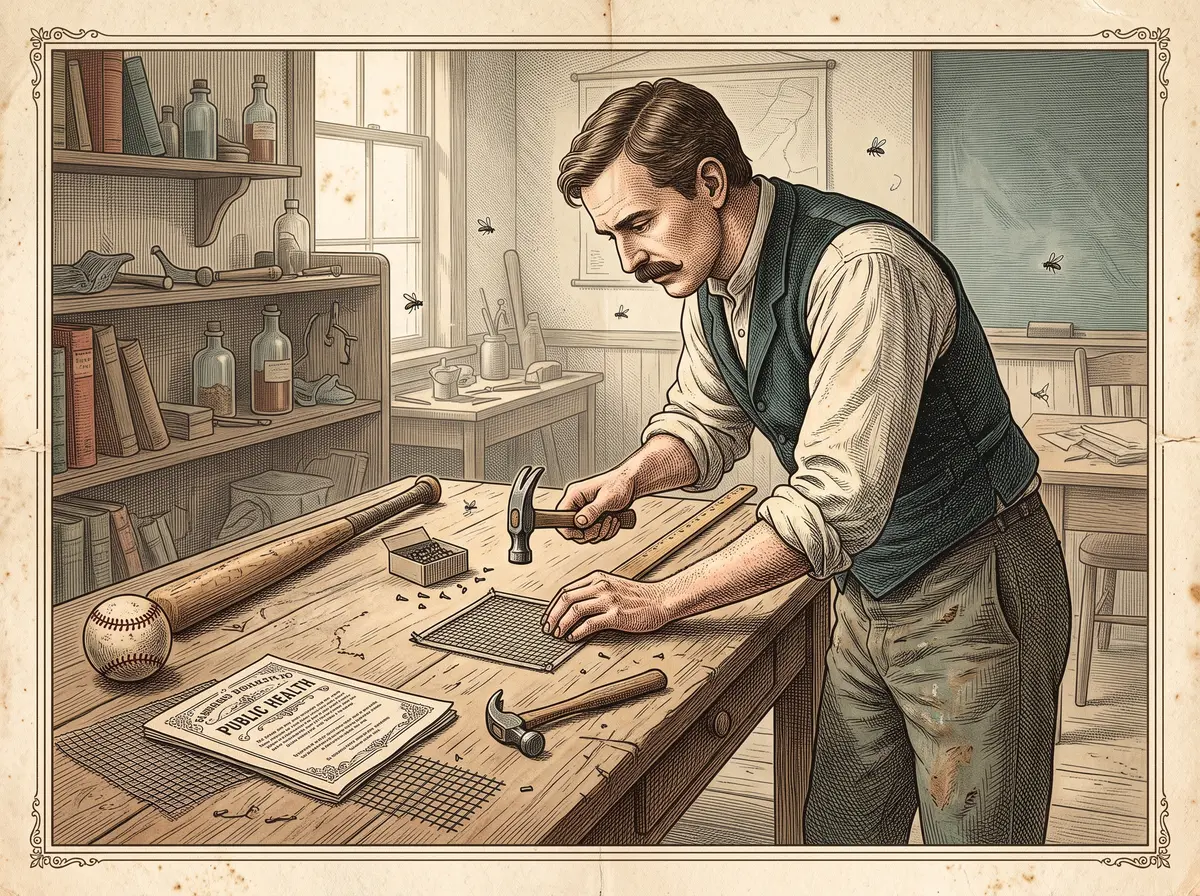
Around 1905, Kansas's top health officer was sitting in the stands at a ball game in Topeka, half-listening to the crowd, when the fans started yelling "Swat the ball!" Dr. Samuel Crumbine had been trying to get Kansans to take houseflies seriously. Somewhere between innings, he found his slogan. Soon afterward, a schoolteacher nailed window screen to a yardstick, and the doctor gave it the name it still has today: the fly swatter.
By the Curiosities Desk · · 5 min read · Filed under Biology · Today’s round
What happened: The Ball-Game Chant That Named the Fly Swatter
Samuel J. Crumbine was a country doctor who had practiced in Dodge City, Kansas, in its rough frontier years. He joined the Kansas State Board of Health in 1899 and in 1904 moved to Topeka as its secretary and executive officer. He soon became known for something unusual in a health official: catchy slogans.
His biggest worry was typhoid fever, a bacterial disease spread through contaminated food and water that killed thousands of Americans every year. Kansas, as he put it in his autobiography, had “far too many flies.” He had good reason to connect the two. A U.S. Army board led by Walter Reed had studied the typhoid outbreaks that swept military camps during the Spanish-American War of 1898, and it concluded that flies were one of the ways the disease spread, landing on open latrines and then on soldiers’ food.
So Crumbine went to war with the housefly. The board printed a “Fly Bulletin” explaining where flies bred, how to destroy their larvae, and why the insects were dangerous. It urged people to screen their windows and clean up the manure and garbage where flies laid their eggs. Fly posters went up in post offices, city halls, and railroad stations. Every letter the board mailed out carried a four-page leaflet about flies.
What the campaign lacked was a rallying cry. Crumbine found it at the ball game. According to the Kansas Health Institute, it was an opening-day baseball game, where fans shouted “swat the ball” and “sacrifice fly.” Other accounts call it a softball game, though “softball” wasn’t a common name for the sport until decades later, so “baseball” or one of its early indoor cousins is more likely. Either way, the words stuck in his head: swat the fly. Kansas’s own encyclopedia, Kansapedia, dates the slogan to 1905; some accounts say 1906.
The slogan needed a weapon. Fly-killing gadgets already existed. In 1900 Robert R. Montgomery of Decatur, Illinois, was granted U.S. Patent 640,790 for a “fly-killer,” a piece of wire netting with a handle, which he later sold to the inventor John L. Bennett. But the device that won Crumbine over came from a Kansas teacher named Frank H. Rose, who lived in the small town of Weir. Rose attached leftover window screen to a yardstick and called his invention a “fly bat.” Crumbine liked the tool but not the name. He renamed it the “fly swatter,” after his slogan.
Not every telling agrees on who made the first ones. One version credits a Kansas Boy Scout troop with nailing screen to yardsticks, though the Boy Scouts of America weren’t founded until 1910. The Rose story is the one most widely repeated by Kansas historians, but like many origin tales, the details are a little fuzzy.
What’s certain is that the name spread. Swatters were handed out at the Kansas State Fair, county fairs, and anti-fly parades, and the slogan traveled well beyond Kansas.
Why it was strange: The Ball-Game Chant That Named the Fly Swatter
For most of history, flies were a nuisance, not a threat. People waved them away from the dinner table without a second thought. The idea that a buzzing insect could carry a deadly disease asked people to believe in something they couldn’t see: germs riding on tiny legs.
Crumbine’s genius was that he didn’t try to win that argument with lectures. He borrowed the language of the most popular pastime in America and handed people a cheap tool that felt like a game. A public health campaign got its name from a baseball crowd, and its signature object was made from a yardstick and some leftover screen.
More humble household things with surprising backstories: The Ordinary Object With the Strange Origin.
What scientists learned: The Ball-Game Chant That Named the Fly Swatter
Houseflies don’t bite, but they are excellent couriers. A fly lands on manure or garbage, picks up bacteria on its legs, body, and mouthparts, and then walks across your sandwich. Flies also regurgitate digestive fluid onto food to soften it before eating, which adds another way to spread microbes. Researchers have since linked houseflies to the spread of illnesses including typhoid, cholera, and dysentery (a severe intestinal infection), especially where sanitation is poor.
The swatter itself is a neat bit of physics. A fly can see a solid object coming and dodge it. A mesh head pushes much less air ahead of it, so it gives less warning, and its light weight lets you swing it fast. Montgomery’s 1900 patent was already chasing that idea, promising a cheap device of “unusual elasticity and durability.”
Crumbine also knew swatting alone wouldn’t win the war. Killing one adult fly helps, but destroying the places where flies breed stops hundreds more. That is why his bulletins pushed window screens and clean stables as hard as they pushed swatting.
Crumbine’s war on another everyday germ carrier: The Germ-Fighting Paper Cup Named After the Doll Company Next Door.
How it reaches us today: The Ball-Game Chant That Named the Fly Swatter
Window screens, covered garbage cans, and keeping food away from flies all became ordinary habits in the decades after campaigns like Crumbine’s. Typhoid cases in the United States fell sharply over the 20th century, mostly thanks to clean water, sewage treatment, and food safety rules, with fly control playing a supporting role.
Crumbine went on to fight the shared public drinking cup, which Kansas banned in 1909, and the reusable roller towel. He had bricks stamped with “Don’t Spit on the Sidewalk.” The food-safety world still honors him with the Samuel J. Crumbine Award, created in 1955.
And the fly swatter is still in kitchen drawers around the world, almost unchanged: a handle, a mesh head, and a name borrowed from a ball game.
The doctor who fought invisible germs before most people believed in them: The Doctor Who Discovered Handwashing — and Was Locked Away for It.
Fun fact: The Ball-Game Chant That Named the Fly Swatter
In 1914, the city of Topeka ran a fly bounty, paying 15 cents for every quart of dead flies. Most of the eager collectors were children.
Sources: The Ball-Game Chant That Named the Fly Swatter
- Samuel J. Crumbine — Kansapedia, Kansas Historical Society
- Who Was Dr. Samuel J. Crumbine? — Kansas Health Institute
- US Patent 640,790, “Fly-killer,” Robert R. Montgomery (1900) — Google Patents
- Dr. Samuel Crumbine: Topeka’s Public Health Pioneer — Topeka & Shawnee County Public Library
- The Typhoid Board — University of Virginia Claude Moore Health Sciences Library