The Scientist Behind It · Engineering
The Man Who Strung Eight Miles of Telegraph Wire Around His Garden — and Was Told It Was 'Wholly Unnecessary'
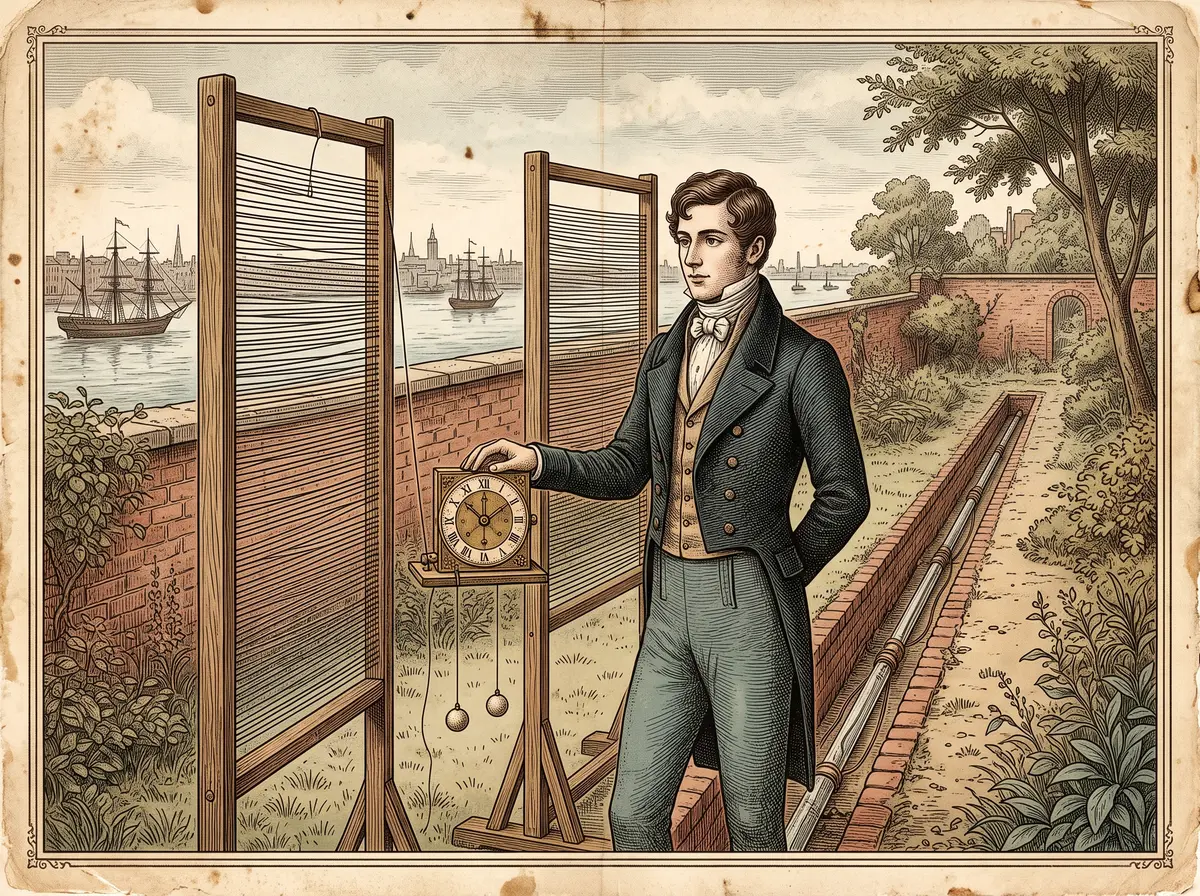
In 1816, a 28-year-old Londoner named Francis Ronalds stood in his family's back garden in Hammersmith, surrounded by two towering wooden frames wrapped in about eight miles of iron wire. At one end, a clock-driven dial ticked past letters of the alphabet. When the right letter came around, a pair of tiny balls hanging from threads dropped together, and a message arrived almost instantly. He offered the whole thing to the British Admiralty for free. The Admiralty wrote back that telegraphs of any kind were "wholly unnecessary."
By the Curiosities Desk · · 5 min read · Filed under Engineering · Today’s round
What happened: The Man Who Strung Eight Miles of Telegraph Wire Around His Garden — and
Ronalds didn’t come from a laboratory. He was born in London in 1788 into a family of cheese merchants and worked in the business for some years before electricity pulled him away around 1810. Encouraged by Jean André De Luc, an elderly Swiss scientist living in England, he spent several years building clockwork devices powered by static electricity — the same kind of charge that makes a balloon stick to your hair.
By 1816 he was ready to try sending signals over a distance. In the garden of the family home on Upper Mall, beside the River Thames, he put up two large wooden frames about 60 feet apart and wound iron wire back and forth between them on insulated supports until he had roughly 8 miles (13 kilometers) of line. He also dug a trench 525 feet long and 4 feet deep down the side of the garden. In it, the wire ran through narrow glass tubes coated with sealing wax, laid in a wooden trough lined with pitch — an early attempt at underground cable.
The system worked like a pair of synchronized clocks. At each end of the wire was a dial marked with letters and numbers, turning in step with its partner. A friction machine kept the wire charged, and while it was charged, two pith balls (tiny balls of light plant material) hanging at each end pushed apart. To send a letter, the operator waited until it appeared in the dial’s window and then briefly connected the wire to the ground. The charge drained away, the balls at both ends fell together, and the person at the far end wrote down whatever letter their own dial was showing. To get the receiver’s attention first, the sender could overcharge the line enough to set off a small gas pistol. Ronalds also devised a numbered codebook so a few signals could stand for whole stock phrases.
It was slow, but it worked. Ronalds wrote to Viscount Melville, head of the Admiralty, describing “a mode of conveying telegraphic intelligence with great rapidity, accuracy, and certainty.” On August 5, 1816, he received a reply from John Barrow, the Admiralty’s secretary. Telegraphs of any kind, Barrow wrote, were “wholly unnecessary,” and no other than the one now in use would be adopted. The one in use was a chain of signal stations on hilltops, passing coded messages by moving visible arms or shutters. The Napoleonic Wars had ended the year before, and the Navy saw no urgent need for anything new.
Ronalds took it remarkably well. He later wrote that he felt “not a shadow of resentment.” In 1823 he published a booklet, Descriptions of an Electrical Telegraph, and of Some Other Electrical Apparatus, the first detailed description of a working electric telegraph. Then he largely moved on.
Why it was strange: The Man Who Strung Eight Miles of Telegraph Wire Around His Garden — and
The rejection wasn’t foolish by the standards of 1816. Hilltop semaphore was proven, the war was over, and an unknown amateur’s garden full of wire was a hard sell. What makes the moment strange is how completely Ronalds saw what was coming. In his 1823 booklet he asked why people should “add to the torments of absence those dilatory tormentors, pens, ink, paper, and posts,” and imagined “electrical conversazione offices, communicating with each other all over the kingdom.” That’s a fair sketch of a telegraph network, two decades before one existed.
There’s also the question of how this story stayed so quiet. The inventor was right, the government said no, and he simply went off to do other things.
Another London inventor who took on the establishment with far less calm: The Computer Pioneer Who Declared War on London’s Organ Grinders.
What scientists learned: The Man Who Strung Eight Miles of Telegraph Wire Around His Garden — and
Ronalds showed that an electrical signal could travel through miles of wire, both overhead and underground, and still arrive almost instantly. He believed it had a finite speed but couldn’t detect any delay over his eight miles. He also ran into problems that dogged telegraph engineers for decades: keeping the charge from leaking away, keeping moisture off the insulation, and keeping the two ends perfectly in step.
The weakness of his design was static electricity itself. It leaks easily and is hard to control over long lines. The telegraphs that eventually succeeded used batteries and electromagnetism, which gave steadier, more reliable currents.
His ideas join a long shelf of inventions that started as a spark in someone’s workshop: From the First Spark to the Thing You Still Use.
How it reaches us today: The Man Who Strung Eight Miles of Telegraph Wire Around His Garden — and
About twenty years later, William Fothergill Cooke and Charles Wheatstone took out the first English telegraph patent in 1837. Both had links to Ronalds’s work. Cooke was a family friend who had operated the Hammersmith telegraph, and Wheatstone is said to have seen it as a boy. Their system went on to wire Britain’s railways, and the telegraph eventually grew into the network of cables that still carries most of the world’s internet traffic under the oceans.
Ronalds kept inventing. As honorary director of the Kew Observatory near London, he developed some of the first cameras to record weather and magnetic readings automatically, around the clock, starting in 1845. He also collected thousands of books and pamphlets on electricity, a library that went to the Society of Telegraph Engineers, which became today’s Institution of Engineering and Technology.
In 1870, in his early eighties, he was finally knighted for his early telegraph work. Within days, he wrote to The Times to disclaim the title of “original inventor” of the electric telegraph. He died in 1873, aged 85.
Another quiet Londoner who changed how the city kept in sync: The Woman Who Sold London the Time From a Watch Named Arnold.
Fun fact: The Man Who Strung Eight Miles of Telegraph Wire Around His Garden — and
The Hammersmith house with the wire-filled garden later became Kelmscott House, the home of designer William Morris. A plaque on the building still remembers the eight miles of telegraph wire that once looped around the back garden.
Sources: The Man Who Strung Eight Miles of Telegraph Wire Around His Garden — and
- Ronalds, Francis. Descriptions of an Electrical Telegraph, and of Some Other Electrical Apparatus. London, 1823. (Google Books scan.)
- Ronalds, Beverley F. “The Bicentennial of Francis Ronalds’s Electric Telegraph”. Physics Today 69, no. 2 (2016): 26.
- Institution of Engineering and Technology Archives. “Sir Francis Ronalds (1788–1873)”.
- American Physical Society. “This Month in Physics History: August 5, 1816”. APS News, August 2017.
- Ashworth, William B., Jr. “Scientist of the Day: Francis Ronalds”. Linda Hall Library.