Strange Animals Scientists Studied · Archaeology
The Mummified Baboons That Helped Find a Lost Kingdom — Using Their Teeth as a Return Address
On the walls of Queen Hatshepsut's temple at Deir el-Bahri, carved about 3,500 years ago, Egyptian ships sail home loaded with treasure from a land called Punt. Perched in their rigging are baboons. Nobody today knows exactly where Punt was. In 2020, a team led by Dartmouth anthropologist Nathaniel Dominy decided the best people to ask were the baboons themselves, and the baboons had been dead for thousands of years.
By the Curiosities Desk · · 5 min read · Filed under Archaeology · Today’s round
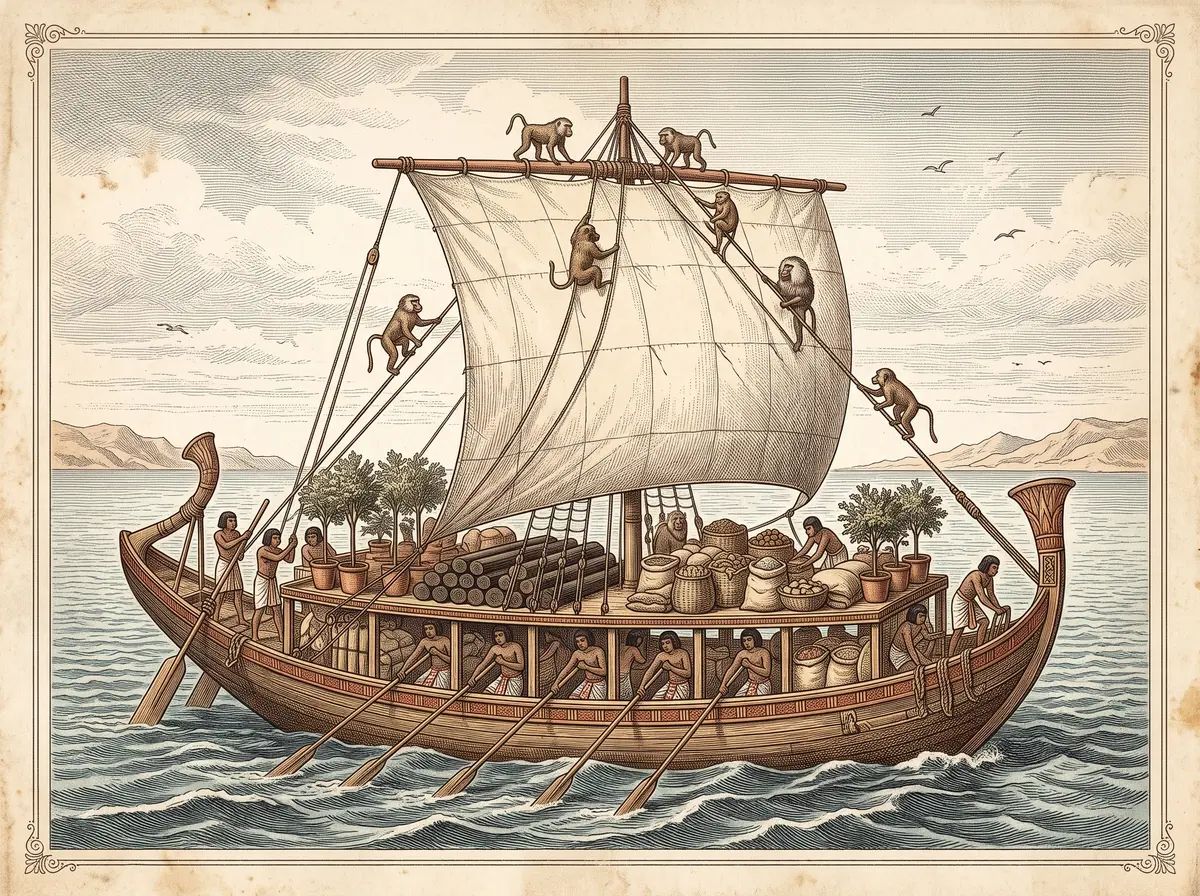
What happened: The Mummified Baboons That Helped Find a Lost Kingdom — Using Their Teeth
Punt shows up in Egyptian records from the Old Kingdom onward, more than 4,000 years ago. It was a place reached by long expeditions to the south and east, and it sent back luxuries: aromatic resins for incense, ebony, gold, exotic animals. Hatshepsut’s expedition, in the 1400s BC, is the most famous, because she had it carved in stone. What the Egyptians never left behind was a map. “For over 150 years, Punt has been a geographic mystery,” Dominy said. Scholars have placed it everywhere from Sudan to Somalia to southern Arabia.
The baboons were a clue hiding in plain sight. Baboons did not live wild in Egypt in pharaonic times, yet Egyptians kept them, revered them, and mummified them. The hamadryas baboon embodied Thoth, the god of wisdom and writing. And, as Dominy put it, “The Egyptians described importing baboons from Punt.” So if you could work out where a mummified baboon was born, you might learn where Punt was.
Dominy’s team, which included primatologists, Egyptologists, geographers and geochemists, sampled baboon mummies held by the British Museum and the Petrie Museum of Egyptian Archaeology in London. Two were hamadryas baboons from the New Kingdom, the era of Hatshepsut; one had come from ancient Thebes, modern Luxor. Five were olive baboons from the much later Ptolemaic period. The researchers measured chemical signatures in their tissues and compared them with 155 modern baboons from 77 locations across eastern Africa and southern Arabia.
The results, published in the journal eLife in December 2020, split neatly in two. The five Ptolemaic baboons looked local: they had lived in Egypt long-term, which fits ancient texts describing baboons being bred in captivity there. But the two New Kingdom baboons had been born somewhere else. Their signatures pointed to a region covering much of today’s Ethiopia, Eritrea and Djibouti, plus parts of Somalia and Yemen.
Three years later, a second team, with genetic work led by primate researcher Gisela Kopp at the University of Konstanz, narrowed it further. They pulled ancient DNA from a baboon mummy excavated in 1905 at Gabbanat el-Qurud, the “Valley of the Monkeys” near Luxor, and now held in Lyon, France. It dated to Egypt’s Late Period, around 800 to 500 BC. Its mitochondrial DNA matched baboons living today in coastal Eritrea, near the site of Adulis, an ancient port later famous for trading luxury goods and animals.
Why it was strange: The Mummified Baboons That Helped Find a Lost Kingdom — Using Their Teeth
Archaeologists usually hunt for a lost place by looking for the place: ruins, inscriptions, harbors. This search ran the other way. The strongest physical evidence for Punt’s location came not from Punt but from its exports, and specifically from animals that had been carried far from home, worshipped, wrapped in linen and stacked in tombs. The baboons had been carrying their birthplace around with them the whole time. It just took three millennia for anyone to learn to read it. It is a close cousin of The 180,000 Mummified Cats That Were Sold by the Ton as Fertilizer, another case of animal mummies turning out to hold far more history than anyone expected.
What scientists learned: The Mummified Baboons That Helped Find a Lost Kingdom — Using Their Teeth
The 2020 study relied on isotopes, which are versions of the same chemical element with slightly different weights. The ratio of two strontium isotopes varies with the underlying rock, and it travels from bedrock into soil, plants, and then into the animals that eat them. Oxygen isotope ratios vary with local water and climate. Tooth enamel forms in youth and then stops changing, so it works like a chemical return address for where an animal grew up. Match the address to a map built from living baboons, and you get a likely birthplace.
The 2023 study, published in eLife by Grathwol, Kopp and colleagues, was the first to analyze ancient DNA from mummified monkeys. It led the authors to a bolder idea: “Punt and Adulis are two different names used for the same place at different points in time.” That remains a hypothesis, not a settled fact, partly because the Lyon mummy is older than Adulis’s heyday as a major port.
A separate 2023 study in PLOS ONE, led by Wim Van Neer of Belgium’s Institute of Natural Sciences, examined the skeletons of about 36 baboons from the same Valley of the Monkeys. Only four looked healthy. Most had bent limbs typical of rickets, a bone disease caused by a lack of vitamin D, which suggested that the sacred animals were kept indoors with too little sunlight and poor food. They were revered, but not well cared for. For more animals whose remains rewrote what we thought we knew, see Creatures That Changed Science.
How it reaches us today: The Mummified Baboons That Helped Find a Lost Kingdom — Using Their Teeth
Punt matters because many scholars see Egypt’s trade with it as one of the first steps in the maritime spice route, the long-distance sea trade that would eventually link Africa, Arabia and Asia. “Punt was central to the rise of maritime commerce, so determining its location is important,” Dominy said. The baboon results suggest Egyptian sailors were making long voyages down the Red Sea well over 3,000 years ago.
The methods travel well, too. Isotope tracing is now routine for asking where ancient people and animals grew up, and museum collections gathered a century ago keep turning into new data. The baboons in Lyon and London sat on shelves for more than a hundred years before anyone thought to ask them where they were from. The same patient habit of looking closely at overlooked animals runs through The Earthworms Darwin Caught Slowly Burying Stonehenge.
Fun fact: The Mummified Baboons That Helped Find a Lost Kingdom — Using Their Teeth
One of the few healthy baboons from the Valley of the Monkeys has a faint horizontal line across two of its incisors. Researchers think it marks a period of stress around age two, most likely the moment it was captured and taken from home.
Sources: The Mummified Baboons That Helped Find a Lost Kingdom — Using Their Teeth
- Nathaniel J. Dominy et al., “Mummified baboons reveal the far reach of early Egyptian mariners,” eLife 9:e60860 (2020): https://elifesciences.org/articles/60860
- Grathwol et al., “Adulis and the transshipment of baboons during classical antiquity,” eLife 12:e87513 (2023): https://elifesciences.org/articles/87513v1
- Dartmouth College, “Mummified Baboons Shine New Light on the Lost Land of Punt” (2020): https://home.dartmouth.edu/news/2020/12/mummified-baboons-shine-new-light-lost-land-punt
- University of Konstanz, “On the trail of a great mystery” (2023): https://campus.uni-konstanz.de/en/node/2363
- Institute of Natural Sciences (Belgium), “Baboons among the ancient Egyptians: revered but suffering,” on Van Neer et al., PLOS ONE (2023): https://www.naturalsciences.be/en/science/archives/2023/baboons-among-the-ancient-egyptians-revered-but-suffering