Strange Animals Scientists Studied · Archaeology
The Earthworms Darwin Caught Slowly Burying Stonehenge
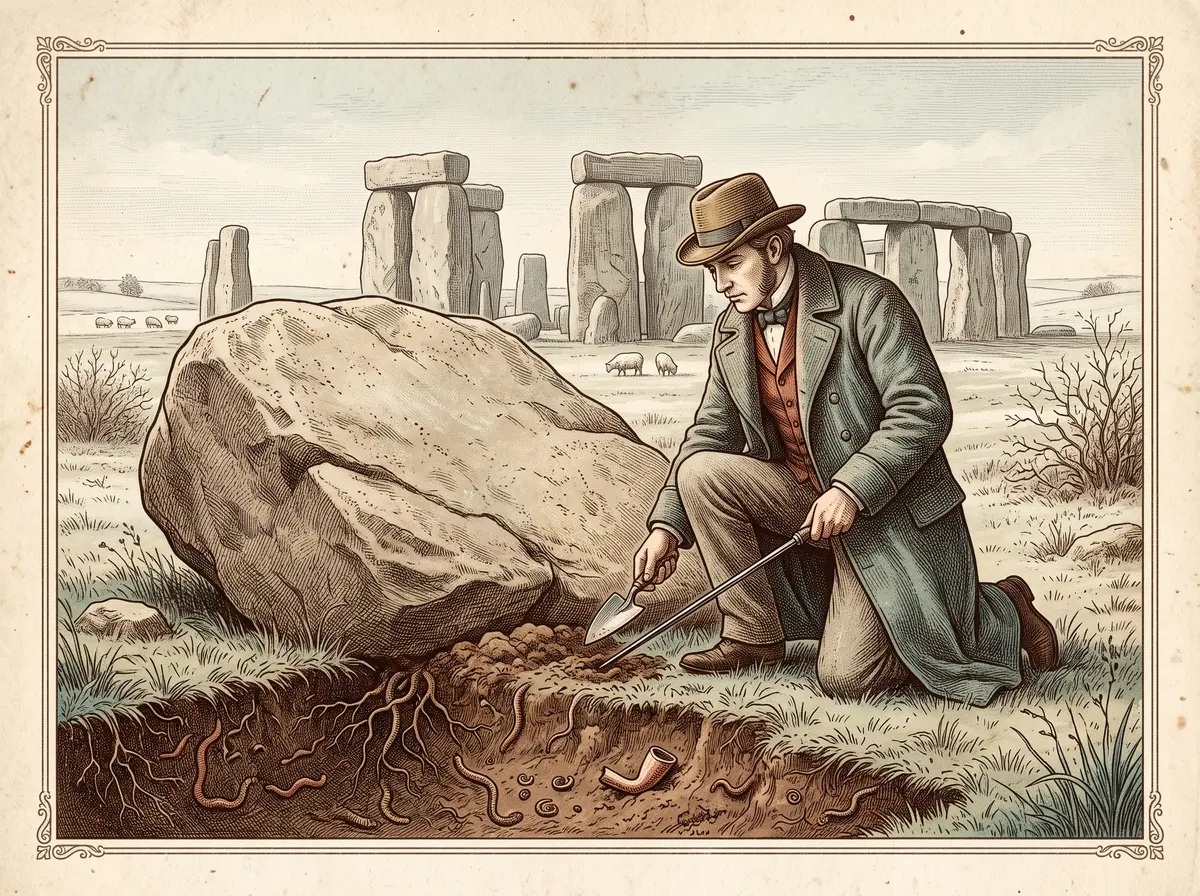
On the last day of 1871, a banker named William Darwin walked out to Stonehenge with a trowel and a skewer, knelt beside one of the fallen stones, and started digging. He wasn't looking for treasure. He was checking on worms for his father. Four inches down, in soil wriggling with them, he turned up a piece of a tobacco pipe — proof that something had been quietly pulling the ground up over one of the most famous monuments on Earth.
By the Curiosities Desk · · 5 min read · Filed under Archaeology · Today’s round
What happened: The Earthworms Darwin Caught Slowly Burying Stonehenge
Charles Darwin had been curious about earthworms long before he was famous for evolution. In November 1837, freshly back from the voyage of the Beagle, he read a paper to the Geological Society of London arguing that the dark topsoil of English fields — what Victorians called “vegetable mould” — was largely made by worms. Worms swallow earth, digest what they can, and leave the rest on the surface as little piles called castings. Darwin suspected that, over enough years, those piles add up to an entire layer of ground.
He then set the subject aside for nearly four decades, returning to it in earnest in the 1870s. By then he had a family research team. His sons William, Francis, and Horace became his field crew, taking measurements at sites he was too old or too unwell to visit often.
William’s New Year’s Eve trip produced the first dispatch from Stonehenge. In a letter dated January 1, 1872, he reported that the standing stones and their lintels hadn’t sunk at all, but the stones lying on the ground had settled into the turf at odd angles. Turf had built up three or four inches around many of them, with fresh worm castings appearing between stone and grass. It was, he wrote, “pretty evidently caused by worms.” His father called the letter “quite splendid.”
Darwin went to see for himself in June 1877. A note written at Stonehenge on June 19, in Horace’s handwriting, records their measurements around the site. In his final book, Darwin described one fallen stone, 17 feet long, whose base now lay about nine and a half inches below the surrounding ground. Under another, they drove an iron skewer sideways to find its buried edge, 10 inches down.
Stonehenge was only the start. In late 1876, workmen digging in a farmyard at Abinger in Surrey had stumbled on the remains of a Roman villa, and when a proper excavation began on August 20, 1877, Darwin was there. The mosaic floor lay under 11 to 16 inches of soil. The morning after part of it was exposed, Darwin counted seven fresh worm burrows coming up through the concrete floor and between the small mosaic tiles. By the third morning there were 25. His neighbor, T. H. Farrer, kept watching for seven more weeks, and checked again three years later. The worms were “still at work.”
Darwin’s sons fanned out to other sites: the Roman town of Silchester in Hampshire, the ruins of Beaulieu Abbey, and Roman villas at Chedworth and Brading. At Silchester, a living worm turned up nearly 50 inches below the surface, inside a flint wall. At Chedworth — a villa discovered in 1866 by a gamekeeper digging for rabbits — another was found living inside rotten Roman concrete.
All of it went into The Formation of Vegetable Mould, Through the Action of Worms, published on October 10, 1881. It was Darwin’s last book. He died about six months later, in April 1882.
Why it was strange: The Earthworms Darwin Caught Slowly Burying Stonehenge
The monuments of the past seem to sink because time “buries” them, as though dust simply drifts down from the sky. Darwin’s point was that much of the burying happens from below. Worms tunnel under a stone or a floor, carry the soil beneath it up to the surface, and the heavy object slowly settles into the space they’ve left behind. The past isn’t only covered over. It’s undermined.
It was also an unusual way to study worms. Darwin tested their senses at home. They ignored a shrill metal whistle, shouting, and “the deepest and loudest tones of a bassoon.” They were, he concluded, deaf.
Stonehenge has outlasted stranger schemes than worms — see The Bluestone Bound for Stonehenge That Sank 17 Miles Into a 240-Mile Trip.
What scientists learned: The Earthworms Darwin Caught Slowly Burying Stonehenge
Darwin’s central idea was that tiny causes, repeated for long enough, produce enormous effects — the same logic behind his theory of evolution. He measured it. In a field near his home, broken chalk spread on the surface in December 1842 was found 7 inches down when he dug a trench in November 1871. By weighing castings, he estimated that worms bring up roughly 7 to 18 tons of dry earth per acre each year, depending on the site.
Some of those numbers have since been refined, and not every soil is as worm-rich as an English pasture. But the core process held up. Soil scientists now call the mixing of soil by living things “bioturbation,” and earthworms are among its most important agents.
Darwin’s book belongs on the same shelf as other small creatures that rewrote big ideas: Creatures That Changed Science.
How it reaches us today: The Earthworms Darwin Caught Slowly Burying Stonehenge
Archaeologists dig in layers, assuming that deeper usually means older. Worms complicate that. As they bring fine soil to the surface, small objects like coins, flints, and pottery shards gradually sink, while large stones settle into a buried line. In a 1983 study of an ancient shell mound in Kentucky, archaeologist Julie Stein found extensive earthworm disturbance and warned that it often goes unnoticed. Today, geoarchaeologists — scientists who study the soils and sediments that hold archaeological sites — routinely check for this before trusting what a layer seems to say.
It’s also why so many Roman floors survive in Britain at all. The worms that sank them into the ground also covered them with a protective blanket of soil.
For another animal that taught people something useful about digging, see The Ship-Sinking Clam That Taught an Engineer How to Dig Under the Thames.
Fun fact: The Earthworms Darwin Caught Slowly Burying Stonehenge
The worms that ignored Darwin’s bassoon weren’t completely oblivious. When he set their pots on top of a piano and struck a low C, they “instantly retreated into their burrows.” They couldn’t hear the note, but they could feel it vibrating through the wood.
Sources: The Earthworms Darwin Caught Slowly Burying Stonehenge
- Darwin, Charles. The Formation of Vegetable Mould, Through the Action of Worms, with Observations on Their Habits. John Murray, 1881. (Project Gutenberg edition.)
- Darwin, W. E. “Letter to Charles Darwin, 1 January 1872”. Darwin Correspondence Project, Cambridge University Library.
- Chancellor, Gordon. “Introduction to Earthworms”. Darwin Online.
- “We took the following measurements at two rings near Stonehenge” (MS DAR 63: 118–127), 19 June 1877. Cambridge University Library, Darwin Archive.
- Stein, Julie K. “Earthworm Activity: A Source of Potential Disturbance of Archaeological Sediments”. American Antiquity 48, no. 2 (1983): 277–289.