The Scientist Behind It · Medicine
The Neurologist Who Had His Own Arm Nerve Cut — Then Spent Four Years of Weekends Being Poked by a Friend
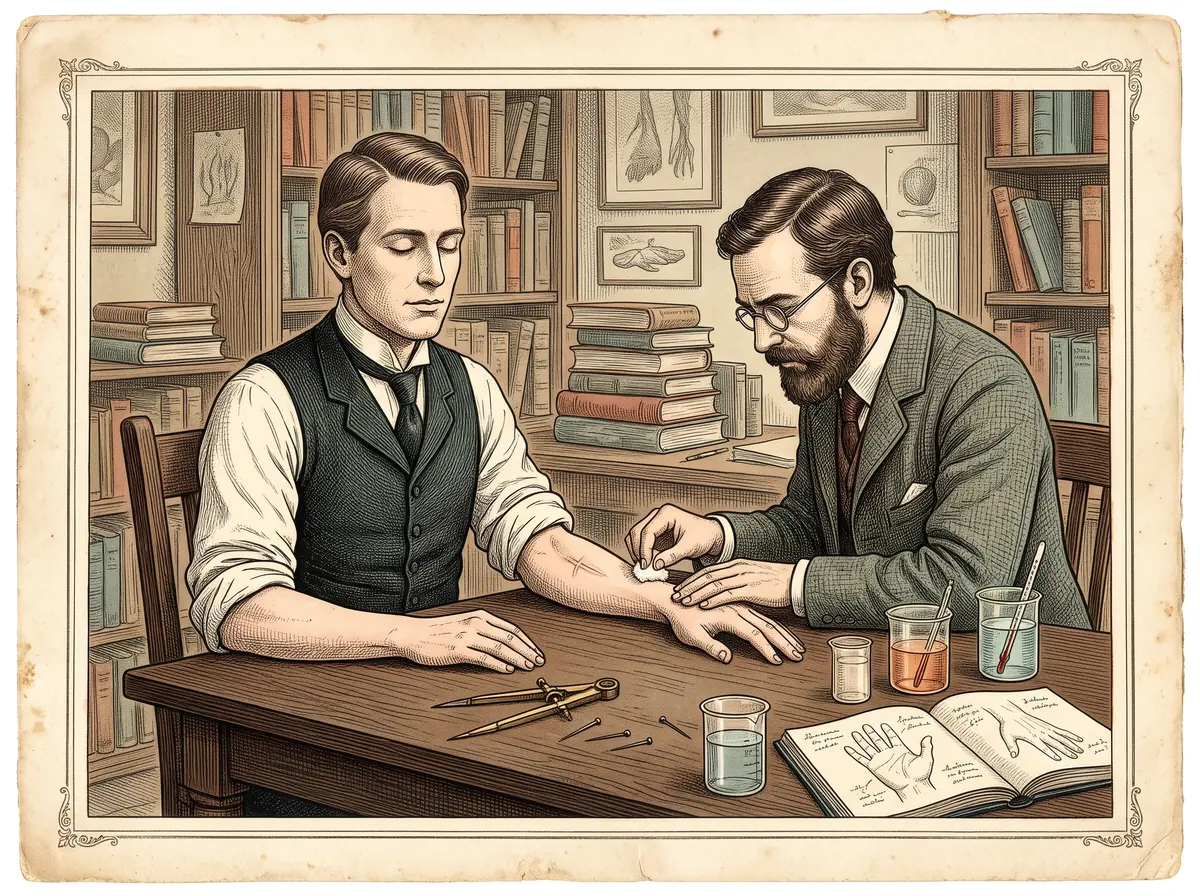
On April 25, 1903, the London neurologist Henry Head lay down for an operation nobody needed. A surgeon opened his healthy left forearm, cut two sensory nerves, and stitched the ends back together with silk. For the next four and a half years, Head spent his weekends in a friend's college rooms in Cambridge, eyes shut, while that friend touched his numb hand with cotton wool, pins, hairs, and hot and cold water, and wrote down everything he said.
By the Curiosities Desk · · 5 min read · Filed under Medicine · Today’s round
What happened: Henry Head's Arm Nerve
By 1903 Henry Head, then nearly 42, was one of Britain’s leading students of sensation. At the London Hospital he and the surgeon James Sherren had been examining patients whose nerves had been severed in accidents, trying to map what feeling came back, and in what order, as the nerves regrew.
The patients were the problem. An injured worker could tell you whether a pin hurt, but describing the exact quality of a strange, half-returned sensation takes practice. As the team later put it, introspection “could be made fruitful by the personal experiences of a trained observer only.” The best-trained observer of sensation they knew was Head himself.
So Head volunteered his own arm. A surgeon named Dean, assisted by Sherren, operated in his own house. The surgeon divided the superficial branch of the radial nerve, which carries feeling from the back of the hand and thumb, and the external (lateral) cutaneous nerve of the forearm near the elbow. A small piece of the radial nerve was removed, and the ends were sewn back together so they could regrow. Muscle nerves were left alone, so Head could still use his hand; he had only lost feeling in part of it.
The day after the operation, the back of his hand and thumb could no longer sense light touch, a pinprick, or heat and cold. Only deep pressure still came through.
Then the patient testing began. The examiner was Head’s friend W. H. R. Rivers, a Cambridge physiologist and psychologist. To keep the busy London Hospital from distracting Head, accounts of the collaboration describe the sessions taking place in Rivers’s rooms at St John’s College, Cambridge. Head worked his London job during the week and took the train up on Saturdays. When he arrived too tired to concentrate, the experiments waited until Sunday. Longer series meant arriving Friday and leaving Monday morning.
The methods were designed to keep Head from fooling himself. He sat with his eyes closed. Rivers changed the order of the tests so Head couldn’t predict what was coming, and asked no questions until a series was finished, so a question couldn’t suggest an answer. The toolkit was humble: cotton wool, calibrated stiff hairs called von Frey hairs, pins, a pressure gauge, a pair of compass points set at different distances, and water heated or cooled to exact temperatures.
Head had prepared like an athlete. The 1908 report notes that he had quit smoking two years before the operation and drank no alcohol on test days. The final sitting came in December 1907. By then, by the most-cited count, they had devoted 167 days to the investigation. Head later remembered the stretch fondly, calling it five happy years.
The results filled more than 120 pages of the journal Brain in 1908, under the plain title “A Human Experiment in Nerve Division.”
Why it was strange: Henry Head's Arm Nerve
Self-experimentation was not new. What was unusual was the length and the calm: not one brave dose of something dangerous, but a deliberate injury followed by years of patient sessions, run by two friends on their weekends.
Feeling did not come back the way anyone expected. It did not fade back in like a dimmer switch. First, isolated spots on the skin became sensitive to heat, cold, or pressure, with dead zones in between. A stimulus between the spots registered as nothing until it crossed a threshold. Then it felt suddenly and unpleasantly intense, more painful than the same touch on his healthy arm. Worse, Head often couldn’t say where he’d been touched. A prick on the hand might seem to come from somewhere else entirely.
Only later did finer abilities return, like telling 37°C water from slightly cooler water, or feeling two compass points as two.
For another researcher who made his own body the test subject, see The Surgeons Who Tested Spinal Anesthesia With a Hammer, a Cigar, and Each Other.
What scientists learned: Henry Head's Arm Nerve
Head and Rivers proposed that skin sensation runs on two separate systems. The first to recover, which they called protopathic (from Greek roots meaning “first suffering”), was crude and all-or-nothing: strong pain and extreme temperatures, poorly localized. The later one, epicritic (“judging”), handled fine touch, small temperature differences, and pinpointing exactly where a stimulus landed. In a healthy body, they argued, the refined epicritic system normally keeps the cruder one in check.
The theory was bold, and it did not survive intact. Two other London surgeons, Wilfred Trotter and Hugh Morriston Davies, cut skin nerves in their own arms, used each other as controls, and published results in 1907 and 1909 that undercut parts of Head’s interpretation. Later neurophysiology found that the real wiring is more complicated than two tidy systems. Neurologists still use “epicritic” and “protopathic” loosely today, but they mean them as descriptions, not as the full theory Head proposed.
Still, the experiment set a standard for method: blind testing, randomized order, careful controls for fatigue, and photographs and charts of the hand at each stage of recovery. Those photos and notes now sit in the University of Cambridge’s psychology archive.
Head’s arm sits on a long shelf of experiments researchers ran on their own bodies: The Scientists Who Ran the Experiment on Themselves.
How it reaches us today: Henry Head's Arm Nerve
Anyone who has had a nerve injury, carpal tunnel surgery, or a numb patch after an operation has met the questions Head was asking. When nerves regrow, feeling often comes back patchy, oddly sharp, or hard to locate before it settles down. Clinicians test recovery with tools that would look familiar to Rivers: monofilaments descended from von Frey’s hairs, two-point discrimination tests, and hot and cold stimuli.
Head went on to edit Brain from 1910 to 1925 and was knighted in 1927. Rivers, who learned to think about the nervous system in evolutionary layers during those Cambridge weekends, later treated shell-shocked officers in the First World War.
For a doctor who went even further in testing his own body, read The Country Surgeon Who Took Out His Own Appendix to Prove a Point.
Fun fact: Henry Head's Arm Nerve
Head’s hand had its own photo shoots. The Cambridge archive holds a series of mounted photographs of it, some with the forearm resting in a clamp, taken from 1903 to 1907 as the feeling crept back.
Sources: Henry Head's Arm Nerve
- Rivers, W. H. R., and Head, H. “A Human Experiment in Nerve Division.” Brain 31, no. 3 (1908): 323–450 (Wikisource transcription): the original report, including the operation, the nerves divided, test methods, and Head’s preparation
- University of Cambridge Archive, “Experiments on Henry Head, 1903–1907” (W. H. R. Rivers papers): Rivers’s experimental records and the photographs of Head’s hand
- Royal College of Physicians, “Sir Henry Head”: Head’s career, the nerve experiment, Brain editorship, and knighthood
- Royal College of Surgeons of England, Plarr’s Lives: “Hugh Morriston Davies”: the Trotter–Davies self-experiments that challenged Head’s conclusions
- Life in the Fast Lane, “Henry Head”: biography, operation details, and the protopathic/epicritic model