The Scientist Behind It · Medicine
The Surgeons Who Tested Spinal Anesthesia With a Hammer, a Cigar, and Each Other
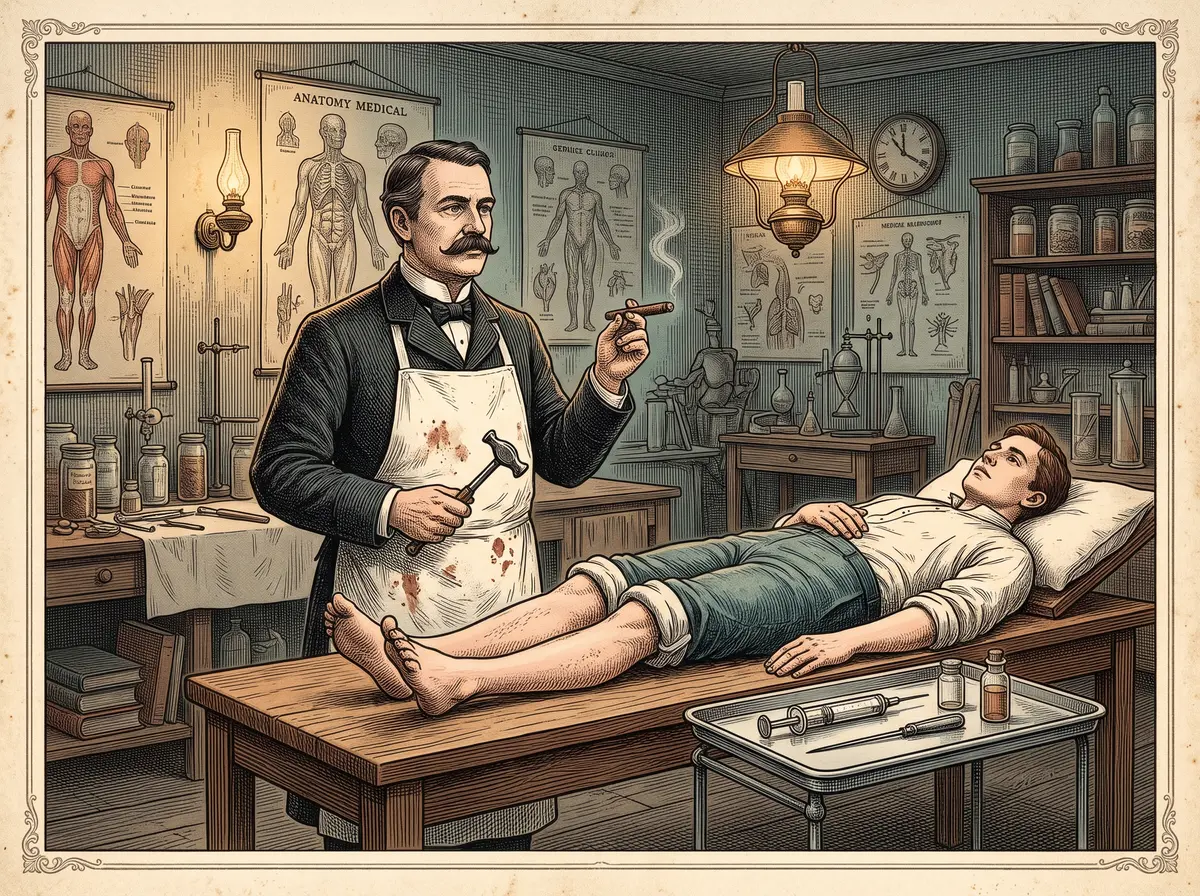
On the evening of August 24, 1898, in a surgical clinic in Kiel, Germany, a young doctor lay with his legs stretched out while his boss pushed a needle into his thigh, pressed a lit cigar against his skin, and swung an iron hammer at his shin. The young doctor, August Hildebrandt, felt none of it. When the tests were over, the two men went off to celebrate with wine and cigars.
By the Curiosities Desk · · 5 min read · Filed under Medicine · Today’s round
What happened: Bier's Spinal Anesthesia
August Bier was a 36-year-old surgeon at the Royal Surgical Hospital of the University of Kiel, and he was looking for a gentler way to operate. In the 1890s, the main option for big operations was general anesthesia with chloroform or ether, which put patients fully under and carried real risks. Cocaine, recently discovered to numb tissue, offered another path. Bier wondered: what if a small dose were injected straight into the fluid around the spinal cord? Could it numb the whole lower body while the patient stayed awake?
On August 16, 1898, he tried it on a patient facing surgery on a tuberculosis-damaged ankle. Bier injected about 15 milligrams of cocaine into the cerebrospinal fluid (CSF), the clear liquid that cushions the brain and spinal cord. The patient stayed conscious and felt no pain. Bier repeated the technique on five more patients having surgery on their legs.
It worked, but Bier wasn’t satisfied. His patients had reported headaches and vomiting afterward, and he wanted to understand the method from the inside. As he later wrote, to reach a well-informed opinion he decided to try it on his own body.
So on August 24, Hildebrandt, his former assistant, attempted the injection on Bier. The needle went in correctly, but the syringe didn’t fit the needle’s hub. CSF dripped out, most of the cocaine was lost, and Bier’s legs stayed fully awake. The experiment had failed.
According to Bier’s own report, “Dr. Hildebrand immediately offered to have the same study performed on himself without delay.” At 7:38 p.m., Bier injected half a cubic centimeter of 1% cocaine into Hildebrandt’s spine. Within minutes, Hildebrandt’s legs went numb.
What followed was a test sequence that would never pass an ethics board today. Bier pricked Hildebrandt’s thigh with a needle, then pushed a long needle in until it reached the thigh bone. He held a lit cigar to his leg. He tickled the soles of his feet, struck his shin hard with an iron hammer, yanked out pubic hairs, and finally squeezed his testicles. Hildebrandt reported pressure, but no pain. The whole session took about 40 minutes.
Then came the celebration, and after that, the bill. Hildebrandt went to bed at 11 p.m. but couldn’t sleep. At midnight, a violent headache set in. He vomited during the night, felt ill for three or four days, and had bruises over his shins once the numbness wore off. Bier, whose spine had leaked more fluid, did even worse. He developed a pounding headache and dizziness whenever he stood up, and he spent nine days in bed.
Bier published the results in 1899 in the Deutsche Zeitschrift für Chirurgie, a German surgical journal, under the title “Experiments Regarding the Cocainization of the Spinal Cord.”
Why it was strange: Bier's Spinal Anesthesia
Most medical breakthroughs are tested on patients first and doctors never. Here, two surgeons volunteered as lab animals, and one ended up being poked, burned, and hammered by his colleague in the name of careful measurement. Their tools sound like a prank: a cigar, a hammer, a long needle. Yet the method underneath was sound. Each stimulus was a bit more painful than the last, so the men could map exactly how complete the numbness was.
The ending wasn’t tidy, either. American neurologist J. Leonard Corning had published on injecting cocaine near the spine back in 1885, and he later claimed credit for spinal anesthesia. A priority fight followed, and Hildebrandt himself eventually published statements favoring Corning’s side. Historians still debate whether Corning’s injection actually reached the spinal fluid.
Bier’s experiment belongs on a long shelf of researchers who tested ideas on themselves first: The Scientists Who Ran the Experiment on Themselves.
What scientists learned: Bier's Spinal Anesthesia
The first lesson was that spinal anesthesia, now also called a spinal block, works. A small amount of numbing drug placed in the CSF blocks nerve signals from the lower body, so a patient can stay awake through major surgery on the legs or abdomen.
The second lesson was the headache. Bier noticed that both men felt worse upright and better lying flat, and he suggested that losing CSF could cause the trouble. He was onto something. Doctors now call this a post-dural puncture headache: when fluid leaks out through the hole the needle leaves in the dura (the tough membrane around the spinal cord), pressure around the brain drops and the brain sags slightly, which is why sitting up makes it hurt. Bier’s syringe mishap, which let extra fluid escape, may explain why his own headache was the worse one.
Bier also recognized that cocaine was too risky for routine use and that the technique needed safer drugs and fewer side effects before it could catch on.
For how surgery got from early pain relief experiments to the modern operating room, read From Laughing Gas Parties to the Operating Room: A Short History of Anesthesia.
How it reaches us today: Bier's Spinal Anesthesia
Spinal anesthesia is now one of the most common techniques in surgery. It is widely used for cesarean births and for hip and knee replacements, among many other operations. Cocaine was replaced long ago by safer local anesthetics.
The headache problem shaped modern equipment. Today’s spinal needles are extremely thin, and many have a rounded “pencil-point” tip that parts the fibers of the dura instead of cutting them, which leaves a smaller leak. Bier’s prescription of strict bed rest, however, didn’t hold up: a Cochrane review, a large summary of clinical trials, found no good evidence that lying flat after the procedure prevents the headache.
Bier went on to invent another technique still taught today. In 1908 he introduced intravenous regional anesthesia, now called the “Bier block,” used for short operations on the hand and forearm.
For another surgeon who tested his ideas on himself, see The Country Surgeon Who Took Out His Own Appendix to Prove a Point.
Fun fact: Bier's Spinal Anesthesia
August Bier wasn’t only a surgeon. He nearly became a forester, and in later life he planted trees on his sandy estate at Sauen, east of Berlin, where he and his wife are buried.
A note on the subject: this story involves cocaine, which is addictive. If you or someone you know is struggling with substance use, talking to a doctor or a local support service is a good first step.
Sources: Bier's Spinal Anesthesia
- Bier, A. “Versuche über Cocainisirung des Rückenmarkes.” Deutsche Zeitschrift für Chirurgie 51 (1899): 361–369: Bier’s original report of the patients and the self-experiment
- Wulf, H. F. W. “The Centennial of Spinal Anesthesia.” Anesthesiology 89, no. 2 (1998): 500–506: dates, doses, symptoms, and the Corning priority dispute, quoting Bier’s paper
- Association of Anaesthetists Heritage Centre, “Cocaine and Self-experimentation”: the sequence of tests on Hildebrandt and the evening’s celebration
- Life in the Fast Lane, “August Bier”: the first spinal anesthetic of August 16, 1898, the syringe failure, and the 1908 Bier block
- Arevalo-Rodriguez, I., et al. “Posture and fluids for preventing post-dural puncture headache.” Cochrane Database of Systematic Reviews (2016): modern evidence that bed rest does not prevent the headache