The One Glass Bulb That Took Down 6,600 More in Japan's Giant Neutrino Tank
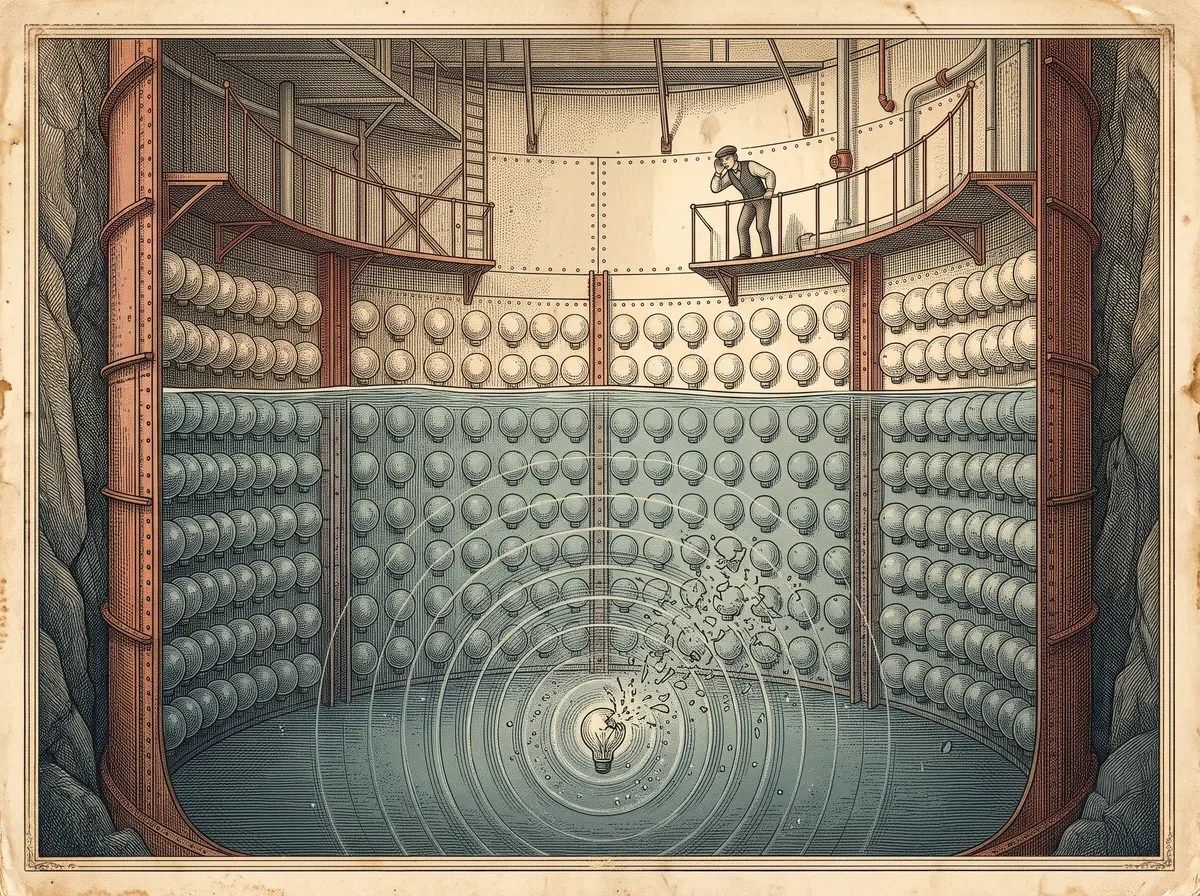
At about 11:01 a.m. on November 12, 2001, a technician deep inside a Japanese mountain heard a roar coming from a tank of water about as tall as a 13-story building. It grew louder for several seconds. Nine kilometers away, a seismograph twitched. Underwater, thousands of glass bulbs, each as wide as a beach ball and each worth about $3,000, were bursting one after another, all because one of them had given way first.
By the Curiosities Desk · · 5 min read · Filed under Physics · Today’s round
What happened: Super-Kamiokande
The tank was Super-Kamiokande, or “Super-K,” then the most sensitive neutrino detector in the world. Neutrinos are tiny, nearly massless particles that stream out of the Sun, exploding stars, and Earth’s own atmosphere. Trillions pass through your body every second without touching a thing, which makes them very hard to catch.
To catch a few anyway, Japanese physicists built an enormous trap 1,000 meters underground, in the Mozumi zinc mine beneath Mount Ikeno, near the town of Kamioka. The rock overhead blocks most of the cosmic-ray “noise” that would drown out a neutrino signal. The trap itself was a stainless-steel cylinder about 41 meters tall and 39 meters across, filled with 50,000 tonnes of ultrapure water. Lining its walls were 11,146 photomultiplier tubes (PMTs): 50-centimeter glass bulbs, hollow and pumped empty of air, so sensitive they can register a single particle of light.
Super-K began watching on April 1, 1996. In 1998 it made headlines around the world with the first strong evidence that neutrinos “oscillate,” changing from one type into another, which meant they must have a little mass.
In the summer of 2001, the team drained the tank for maintenance and replaced several hundred dead tubes. Then they began refilling it, a slow job that takes weeks. By the morning of November 12, the water stood 31.7 meters deep, about three-quarters of the way up.
At 11:01:29, the detector’s electronics suddenly went from recording about 10 events per second to more than a million. According to the official accident report, the trouble most likely began with a single tube on the floor of the tank, PMT number 10810, or one of its eight neighbors. It imploded. The pressure wave from that implosion cracked the tubes next to it, which imploded too, sending out waves of their own. The failure raced outward across the floor and up the walls.
When it was over, every one of the 1,748 tubes on the bottom of the tank was gone. So were 4,917 of the 7,650 on the side walls. Only the tubes above the waterline, including all of those on the ceiling, survived. In total, about 6,600 to 6,800 inner tubes were destroyed (the report’s own tables give slightly different counts), along with roughly 1,000 smaller tubes in the outer layer of the detector. Underwater video later showed twisted metal and shredded plastic where the light sensors had been.
What caused that very first tube to fail? The investigators never settled it for certain. Their list of suspects included stress from workers who had stood on Styrofoam boards resting on the bottom tubes during the upgrade, a badly set fastening band, and simple aging of the glass.
Losing about 60% of the eyes of the world’s leading neutrino detector could have ended the experiment. Instead, the observatory’s director, Yoji Totsuka, told reporters: “We will rebuild the detector. There is no question.”
Why it was strange: Super-Kamiokande
Super-K was designed to notice the faintest event imaginable: one neutrino out of trillions bumping into one particle in 50,000 tonnes of water. It was built to be calm, dark, and still. Yet the thing that undid it was one of the oldest problems in physics: what happens when a hollow glass bulb sits under a lot of water.
The detector’s tubes were packed tightly together so that no flash of light could slip between them. That same tight packing is what let one failure jump to the next.
Super-K isn’t the only physics experiment brought low by one small part. Read The Loose Cable That Made Neutrinos Outrun Light for Five Months.
What scientists learned: Super-Kamiokande
Water pushes harder the deeper you go: roughly one extra atmosphere of pressure for every 10 meters. At the bottom of a tank filled 31.7 meters deep, every square centimeter of a PMT was being squeezed by about three extra atmospheres, with only vacuum inside to push back.
Glass is very strong when it’s squeezed evenly, which is why the tubes could survive. But a tiny flaw, such as a scratch or a microscopic crack, concentrates that stress in one spot. When the glass finally fails, the surrounding water rushes into the empty bulb and slams together in the middle. That collision creates a sharp burst of pressure, a shock wave, that spreads out through the water. Because water barely compresses, the pulse travels fast and hits neighboring bulbs hard. If it’s strong enough to crack one, that one makes a new shock wave, and the chain continues, a bit like a line of dominoes.
The rebuild tackled exactly this. When Super-K restarted with about 5,200 tubes spread across its walls, each one sat inside a protective shell: a clear acrylic window over the front, and fiber-reinforced plastic around the rest. The shells are designed so that, even if a tube implodes again, it can’t send out a shock wave strong enough to start another chain.
Measuring a giant detector can go wrong in other surprising ways, too: The Particle Accelerator That Could Tell When the Train to Paris Left.
How it reaches us today: Super-Kamiokande
Super-K came back in stages. The half-strength version began collecting data on October 8, 2002. By June 2006, a full rebuild restored the inner detector to 11,129 tubes, all in their protective covers. The detector kept producing major results; in 2015, Super-K researcher Takaaki Kajita shared the Nobel Prize in Physics for the discovery of neutrino oscillations.
The accident also became a lesson for every experiment that puts thousands of glass sensors under water. Guarding against chain-reaction implosions is now a design question that builders of large underwater detectors, including the even bigger Hyper-Kamiokande under construction nearby, have to answer from the start.
For another precise instrument humbled by a tiny flaw, see The Flake of Chipped Paint That Made a $1.5 Billion Telescope Nearsighted.
One bulb undoing the whole tank belongs with The Missions Undone by One Small Thing.
Fun fact: Super-Kamiokande
Super-K’s half-rebuilt detector started taking data again on October 8, 2002, the very same day the Nobel Committee announced a physics prize for Masatoshi Koshiba. His award honored work with Super-K’s smaller predecessor, Kamiokande, which in 1987 caught 12 neutrinos from an exploding star.
Sources: Super-Kamiokande
- Super-Kamiokande Collaboration, “Official report on the accident” (November 22, 2001) — the investigating committee’s timeline, water level, tube counts, and list of possible causes
- Kamioka Observatory (ICRR, University of Tokyo), “Research History” — official dates for the start of operation, the accident, the 2002 restart, and the 2006 full reconstruction
- Fermilab, “Super-K Accident,” FermiNews (November 23, 2001) — contemporary reporting with comments from physicists and the rebuild plan
- CERN Courier, “Super-Kamiokande resumes operation” — the October 8, 2002 restart and the new acrylic and fiber-reinforced plastic shells
- Nobel Prize, “Press release: The Nobel Prize in Physics 2002” (October 8, 2002) — Koshiba’s prize and Kamiokande’s 12 supernova neutrinos