The Opera Singer Who Serenaded a Catfish — and the Whistle That Proved Fish Can Hear
In 1921, when Karl von Frisch took over the zoology institute at Rostock, the story waiting for him was an opera singer who had performed for an audience of one: a small catfish in a tank. The fish did not react at all. To the ear doctor who had arranged the concert, that settled it — fish were deaf. Then a young zoologist down the hall stepped into another room, whistled, and watched the same kind of fish swim out of hiding for its dinner.
By the Curiosities Desk · · 5 min read · Filed under Biology · Today’s round
Part of The Version Everyone Remembers
What happened: Von Frisch
In 1921, Karl von Frisch, an Austrian zoologist then in his mid-thirties, took over the zoology institute at the University of Rostock in northern Germany. He was already known for a habit of picking fights with received wisdom. A few years earlier he had shown that honeybees can see color, against the view of the senior eye researcher Carl von Hess, who held that fish and invertebrates were color-blind.
At Rostock he found a new question waiting for him. One of the university’s most distinguished professors was Otto Körner, head of what was billed as Germany’s first university clinic dedicated to ear, nose, and throat diseases. Körner was convinced that fish could not hear. According to the account von Frisch later gave, Körner had once tested this in style: he brought in an opera singer to perform for a dwarf catfish. The fish carried on as if nothing had happened.
Von Frisch wasn’t persuaded that a fish ignoring a song meant a fish couldn’t hear one. An animal that has no reason to care about a sound may simply not respond to it. So he gave his fish a reason.
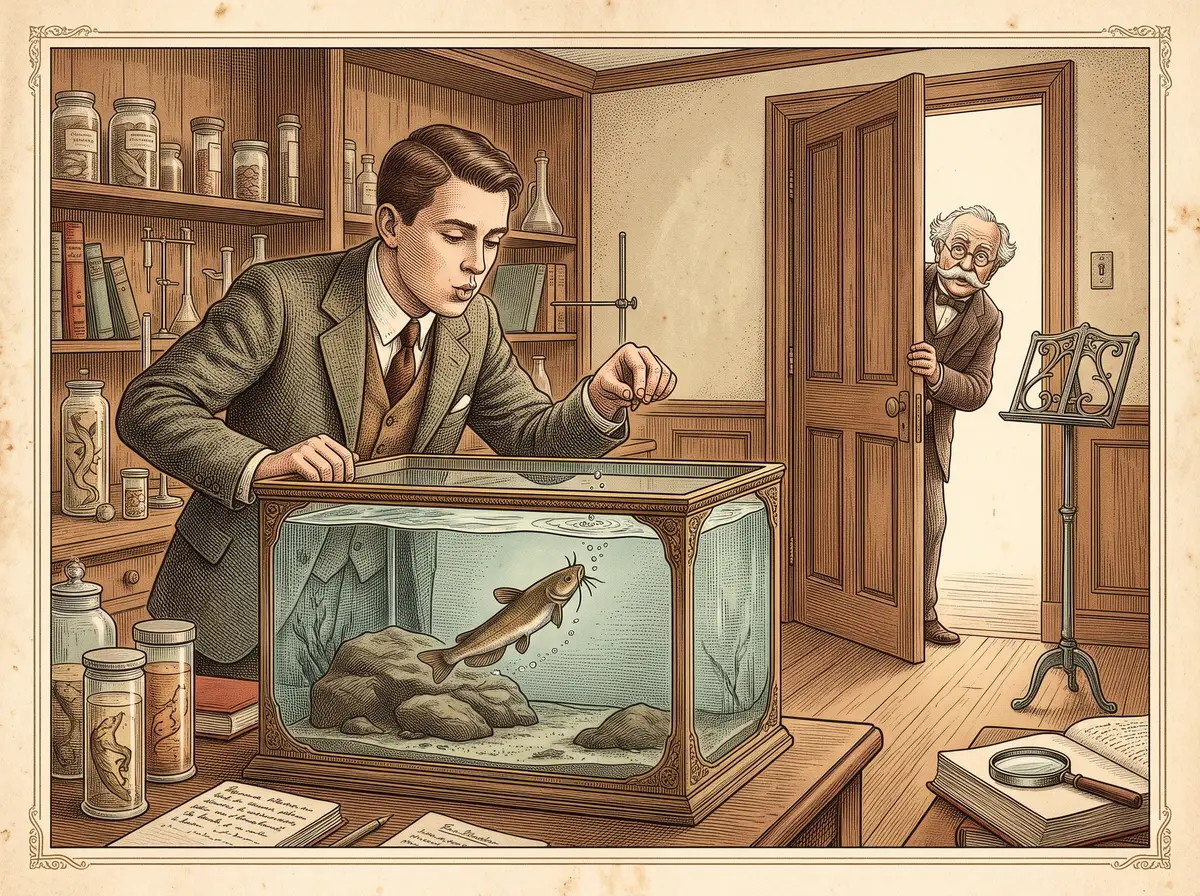
His subject was a North American dwarf catfish, Ameiurus nebulosus, known in the United States as the brown bullhead. The fish, which he nicknamed “Xaverl” (a Bavarian pet form of the name Xaver), lived in a tank and liked to hide. Von Frisch’s method was simple: every time he fed it, he whistled first. Over time, the catfish learned that the whistle meant food was coming, and it began emerging from its hiding place at the sound alone.
He was careful about the obvious objection. A fish might be reacting to the sight of a person approaching, or to vibrations from footsteps. The catfish von Frisch worked with had been blinded, which ruled out vision, and the decisive demonstration had him whistling from another room.
The deciding moment came when Körner himself came to watch. Von Frisch whistled out of view, and the catfish came out looking for food. Körner, to his credit, accepted what he saw. As von Frisch remembered it, the ear specialist said: “Truly, he can hear.”
Von Frisch published the result in 1923, the year he left Rostock for Breslau. The title of the paper is about as plain as a scientific title gets: in English, roughly “A dwarf catfish that comes when you whistle for it.”
Why it was strange: Von Frisch
The belief that fish were deaf wasn’t silly. Fish have no outer ear and no eardrum, and they lack the snail-shaped cochlea that does the hearing in mammals. Their inner ears were well known to help with balance, so it seemed natural that balance was all they did. Writing in Nature in 1938, von Frisch opened by noting that “there is an old dispute as to whether fish are able to hear or not.”
There was also a physical reason the opera test was harder than it looked. Most of the energy in a sound traveling through air bounces off the surface of water rather than passing into it. A singer in the room is a quiet signal by the time it reaches a fish below.
So the catfish wasn’t just proving a point. It was showing that a question everyone thought they had answered had been tested the wrong way. A song with no meaning got no reaction; a whistle that meant food got a fish. If you want to know what an animal can sense, you have to ask in a way that matters to the animal.
That lesson echoes another animal story about hidden cues: Clever Hans: The Horse That Could ‘Do Math’.
What scientists learned: Von Frisch
Catfish turned out to be an especially good choice. They belong to a large group of freshwater fish, along with carp and minnows, that have a set of tiny bones called the Weberian apparatus. These bones link the swim bladder, a gas-filled sac in the body, to the inner ear. When sound waves hit the fish, the swim bladder vibrates like a drum, and the little bones pass that vibration along. It works a bit like the bones of our own middle ear.
Von Frisch and his students kept going. Working with minnows, he and his colleague R. Stetter published a 1932 study tracking down which parts of the fish inner ear were responsible for hearing. Later researchers measured how faint a sound a dwarf catfish could detect and studied the physics of the Weberian apparatus in detail. A 2023 review in the journal Fish and Fisheries traced two centuries of research on catfish hearing, a field that still builds on questions von Frisch first put to a whistle-trained fish.
Another case of scientists proving an animal could sense what experts thought it couldn’t: The Blind Bats That Flew Perfectly in the Dark.
How it reaches us today: Von Frisch
The idea that fish hear — and can learn what a sound means — is now put to practical use. In Japan and China, researchers working on “marine ranching,” which means raising fish and releasing them into managed coastal areas, use acoustic conditioning: they pair a tone with feeding so the fish gather when the sound plays. A 2022 study trained juvenile red sea bream to respond to a 400-hertz tone, much as von Frisch trained his catfish to answer a whistle.
Knowing that fish hear also changed how scientists think about human noise underwater. Ship engines, sonar, and construction all add sound to rivers and oceans, and researchers now study how that noise affects fish that use hearing to find mates, avoid predators, and stay in their schools.
For another tale of an animal “fact” that didn’t hold up: The Bumblebee That Science Supposedly Proved Couldn’t Fly.
The deaf-fish verdict that a song seemed to prove belongs on the shelf of The Version Everyone Remembers.
Fun fact: Von Frisch
The zoologist who whistled for a catfish is far better known for another animal: he decoded the honeybee’s “waggle dance” and shared the 1973 Nobel Prize in Physiology or Medicine with Konrad Lorenz and Nikolaas Tinbergen.
Sources: Von Frisch
- Karl von Frisch, “The Sense of Hearing in Fish,” Nature 141: 8–11 (1938)
- Menzel and Daumer, “Karl von Frisch: Experimental behavioral ecologist, ethologist” (2025), Freie Universität Berlin
- A. Heyd and W. Pfeiffer, “Über die Lauterzeugung der Welse,” Revue suisse de Zoologie 107(1): 165–211 (2000)
- Friedrich Ladich, “Hearing in catfishes: 200 years of research,” Fish and Fisheries (2023)
- Huarong Yuan, Yanbo Zhou, and Pimao Chen, “Research on the Acoustic Conditioning Taming on Fish and Application in Marine Ranching,” Water 15(1): 71 (2022)