The Pub Egg Timer That Became the Lava Lamp — and the Inventor Who Said You Wouldn't Need Drugs
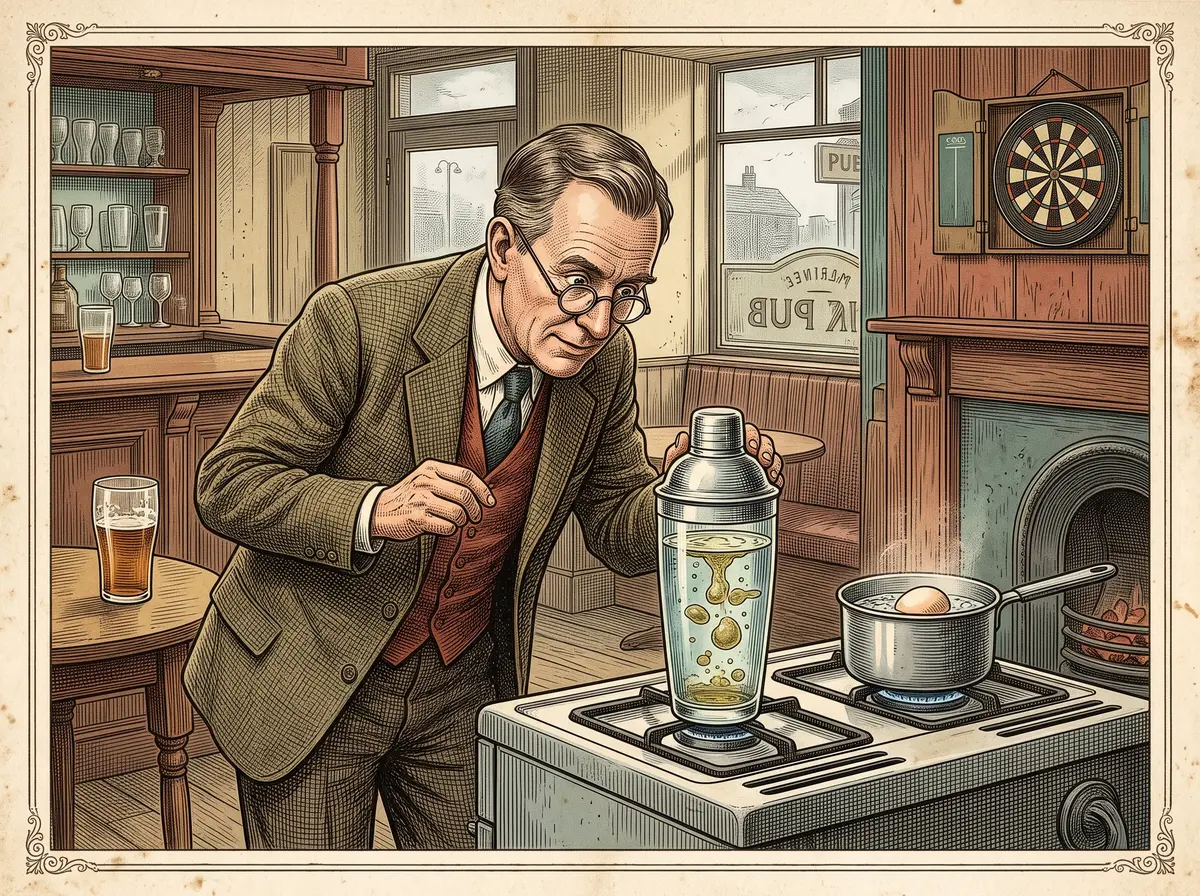
In a British pub sometime after the Second World War, a former wartime reconnaissance pilot named Edward Craven Walker noticed something odd warming on the stove. It was a homemade egg timer built from a glass cocktail shaker, and inside it, blobs of oily liquid were slowly rising and falling through water. When the blobs got going, so the story goes, your egg was done. Walker couldn't stop staring at it. Fifteen years later, he was selling it as a lamp.
By the Curiosities Desk · · 5 min read · Filed under Physics · Today’s round
What happened: The Pub Egg Timer That Became the Lava Lamp — and the Inventor Who Said
Edward Craven Walker was born in Singapore in 1918 and flew photo-reconnaissance Mosquito aircraft over Germany during the war. Afterward he became the kind of entrepreneur who tried several unrelated things at once. He worked in accounting, and he also made naturist films, including Travelling Light (1959), which was the first naturist film to get a general public release in Britain.
The device that caught his eye is usually traced to a man named Donald Dunnet, an engineer who designed it himself. Here the tidy pub legend and the paper trail diverge a little. Dunnet’s British patent, number 703,924, was filed in December 1951 (with a priority date of December 1950) and describes “changing display devices”: two liquids that don’t mix, sealed in a transparent container and heated from below by a lamp, so that bubbles of the lower liquid float up, cool, and sink again. The patent doesn’t call it an egg timer. Most retellings say Walker saw the contraption in a pub in the late 1940s (History.com gives the year as 1948) and later bought the rights from Dunnet’s widow after Dunnet died. The broad outline is consistent across sources. The exact pub, year, and egg-boiling routine are best treated as the story as it’s usually told.
What isn’t in doubt is that Walker spent years tinkering. The trick was finding a blob that would behave: heavy enough to sit at the bottom when cold, light enough to rise when warm, and stable enough not to break into a cloudy mess. With his wife Christine he founded a company called Crestworth, set up a workshop in a boatyard in Poole, Dorset, and in 1963 launched the result in Britain as the Astro lamp. The smaller Astro Mini, sold from 1964, had a body shaped by an unlikely source: a bottle of Tree Top orange squash, a sweet fruit cordial. Early on, according to the company that succeeded Crestworth, the couple delivered lamps from an old postal van they nicknamed “Smokey.”
Crestworth’s 1965 patent filing, credited to inventor David George Smith and issued in the United States in 1968, spells out the recipe in broad strokes. Dyed water filled the bottle. The blob was a blend of mineral oil, paraffin wax, carbon tetrachloride (a dense liquid solvent), and dye, mixed so that it turned fluid at roughly 45–50 °C (113–122 °F). A coil of wire at the bottom helped stray droplets merge back into the main blob.
That same year, two American businessmen, Adolph Wertheimer and Hy Spector, saw the lamp at a trade show in Germany and bought the US rights. They sold it as the “Lava Lite,” and the lamp became a fixture of the late 1960s and 1970s. By one estimate, about seven million were sold worldwide each year in the mid-1970s. Then the fashion faded. By the late 1980s, Crestworth was making only around a thousand lamps a year.
Why it was strange: The Pub Egg Timer That Became the Lava Lamp — and the Inventor Who Said
A household lamp is supposed to help you see. The Astro barely did. It gave off a dim, colored glow and took a long while to warm up before anything moved. Its whole appeal was the slow, unpredictable show of blobs stretching, splitting, and sinking. Walker sold a lamp that was really a tiny, permanent physics experiment you plugged into the wall.
He was also unusually frank about what he was selling. The company attributes this line to him: “If you buy my lamp, you won’t need drugs.” It was a sales pitch, not a scientific claim, but it captured why people bought it. You didn’t read by it. You watched it.
Another toy that turned plain physics into something people couldn’t stop watching: The Slinky: The Walking Spring That Fell Off a Navy Workbench.
What scientists learned: The Pub Egg Timer That Became the Lava Lamp — and the Inventor Who Said
The lava lamp runs on density, which is how much mass is packed into a given volume. Things less dense than the liquid around them float, and denser things sink. Ordinary wax is less dense than water and would simply float, so the blend has to be weighted (originally with carbon tetrachloride) until it is just slightly heavier than the water at room temperature.
The bulb does the rest. As the wax at the bottom heats up, it expands. The same mass now takes up more room, so its density drops below the water’s and a blob rises. Near the cooler top, it contracts, gets denser, and sinks back toward the heat. That loop of warm material rising and cool material falling is called convection, the same process that drives weather and stirs the rock deep inside the Earth.
The shapes come from something physicists call the Rayleigh–Taylor instability: when a lighter fluid sits beneath a heavier one, any small bump in the boundary between them grows into fingers and mushroom-shaped plumes. Because the lamp’s temperatures and densities never settle into a perfect balance, the pattern never quite repeats.
How it reaches us today: The Pub Egg Timer That Became the Lava Lamp — and the Inventor Who Said
The lamp survived its slump. In 1989 Cressida Granger became managing director of Crestworth, and in 1992 the company was renamed Mathmos. Nostalgia did the rest, and by around 1999 it was selling roughly 800,000 lamps a year. Walker stayed on as a consultant on the mix until his death in 2000. Carbon tetrachloride, which is toxic, was later dropped from US lamps.
The strangest afterlife is in computer security. Computers are bad at producing true randomness, which is what good encryption keys need. In 1997, Silicon Graphics built “Lavarand,” which generated random numbers from photos of lava lamps. Since 2017, the internet company Cloudflare has kept a wall of lava lamps in its San Francisco office lobby. A camera photographs it regularly, and the unpredictable blobs feed into, alongside other sources, the randomness its servers use for encryption.
For another bright little gadget that turned into a full-blown craze, see The Kaleidoscope Craze That Sold 200,000 in Three Months — and Barely Paid Its Inventor.
Fun fact: The Pub Egg Timer That Became the Lava Lamp — and the Inventor Who Said
The name Mathmos comes from the 1968 science-fiction film Barbarella, where it’s the name of a bubbling lake of liquid energy beneath the city of Sogo.
Sources: The Pub Egg Timer That Became the Lava Lamp — and the Inventor Who Said
- US Patent 3,387,396: Display Devices — Crestworth Ltd, filed 1965, issued 1968 (primary source: blob composition, melting range, wire coil)
- GB Patent 703,924: Changing Display Devices — Donald Dunnet’s earlier patent (primary source)
- Mathmos Timeline, 1963 to Date — company history (1963 launch, Poole workshop, “Smokey,” Walker quote, Barbarella name)
- The History of the Lava Lamp — Smithsonian Magazine, 2013 (cocktail-shaker egg timer, carbon tetrachloride, sales slump and revival)
- Harnessing Chaos in Cloudflare Offices — Cloudflare blog (LavaRand, SGI’s 1997 Lavarand)