Accidental Discoveries · Biology
The Pus-Soaked Hospital Bandages Where DNA Was First Found — in a Castle Kitchen
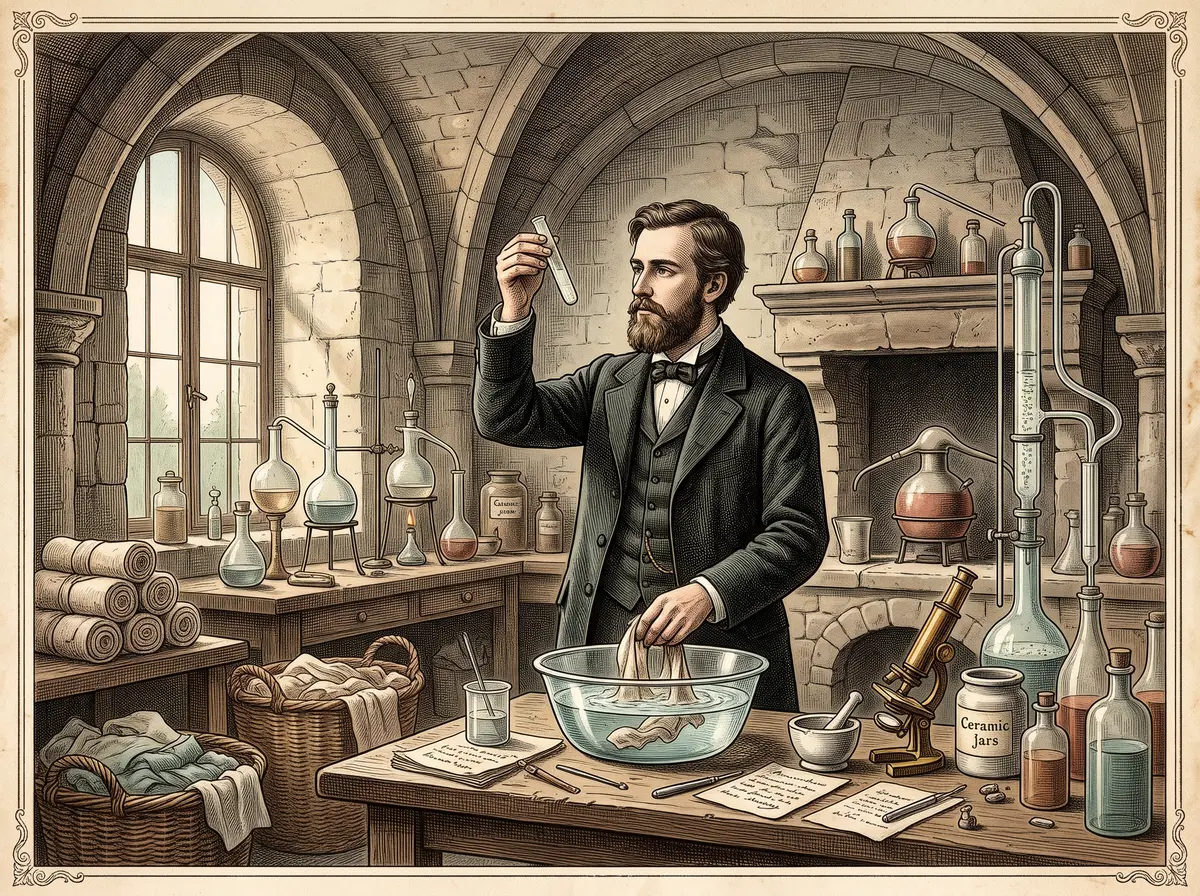
In the winter of 1869, a young Swiss doctor stood in the old kitchen of a German castle, rinsing pus out of used hospital bandages. He was hunting for the proteins that make a cell alive. Instead, a strange substance kept settling out of his solutions, one that didn't behave like any protein he knew. He had just become the first person to isolate DNA, and he gave his report one of the least exciting titles in the history of science.
By the Curiosities Desk · · 5 min read · Filed under Biology · Today’s round
What happened: DNA in Hospital Bandages
Friedrich Miescher was born in Basel, Switzerland, in 1844, into a family of physicians. He trained as a doctor, and to satisfy his father’s wish that he have a practical skill, he specialized in ear medicine. There was a catch: a childhood ear infection had left Miescher hard of hearing himself, which made examining patients difficult. He was more drawn to what he called the “theoretical foundations of life,” and in 1868 he moved to Tübingen, Germany, to work in the laboratory of the biochemist Felix Hoppe-Seyler.
That laboratory sat in Schloss Hohentübingen, a castle above the town, in its former kitchen. Converted in 1818, it was one of the best-equipped chemistry labs of its day.
Miescher wanted to understand the chemistry of the simplest cells he could find. He first tried lymphocytes, a kind of white blood cell, from lymph nodes, but they were hard to purify and he couldn’t collect enough of them. Hoppe-Seyler suggested a different white blood cell, the leukocyte, and pointed him to an abundant local supply: pus.
Before antiseptic surgery was widespread, infected wounds were common, and pus is packed with leukocytes. Miescher collected fresh bandages from the clinic and was choosy about them. According to the historian and biologist Ralf Dahm, he threw out any that smelled bad, looked decomposed under the microscope, or had turned acidic.
He washed the cells out of the cloth with a dilute salt solution, then rinsed them with warm alcohol to strip away fats. When he treated the cells with weak alkali, something came out of solution that surprised him. It precipitated (separated out as a solid) when he added acid and dissolved again in alkali. It wasn’t a fat, and it didn’t behave like a protein.
To get a cleaner sample, he needed to separate the cell nuclei — the small central compartments of cells — from everything around them. His tool for that was pepsin, a digestive enzyme, which he extracted himself by washing pig stomachs with dilute hydrochloric acid. Left to digest for 18 to 24 hours at roughly body temperature, the pepsin ate away the surrounding protein and left the nuclei, in his words, “completely naked.”
From those nuclei he pulled out the mystery substance and named it nuclein, after the nucleus. When he analyzed its elements, it held something proteins didn’t: a lot of phosphorus, and no sulfur at all. He mentioned the phosphorus in a letter to his parents in August 1869.
Miescher sent his manuscript to Hoppe-Seyler in December 1869. His mentor was skeptical and decided to repeat the experiments himself before publishing anything. That took about a year. The paper finally appeared in early 1871 in Hoppe-Seyler’s own journal, alongside a confirming article by Hoppe-Seyler. Its title, translated into English: “On the Chemical Composition of Pus Cells.”
Why it was strange: DNA in Hospital Bandages
The 1860s were the great age of protein. Many chemists thought proteins were the essential stuff of life, and Miescher went looking for them. He found something else entirely, in a source most people would rather throw away — in a castle’s former kitchen.
Even more striking, he couldn’t have known what he had. Nobody yet understood that nuclei carried hereditary instructions, and nobody would know DNA’s shape for another 80 years. As Dahm told National Geographic, “DNA at Miescher’s time was an abstract concept.” Miescher had found the molecule of heredity without anyone, including him, having a reason to call it that.
The dry title didn’t help. The historian Kersten Hall, also quoted by National Geographic, noted: “It’s not a title that has you on the edge of your seat.”
It’s one of several great discoveries that started on a completely different errand, gathered at The Finds That Started on the Wrong Errand.
What scientists learned: DNA in Hospital Bandages
Miescher kept going. Back in Basel from 1871, he found a better source than pus: salmon sperm. Salmon swam up the Rhine through the city to spawn, and the heads of their sperm cells are almost entirely nucleus. That gave him much purer nuclein. His measurement of its phosphorus content, about 22.5 percent as phosphorus pentoxide, was very close to the modern figure of 22.9 percent.
He also wondered about heredity. In an 1892 letter he suggested that hereditary information might be written in the arrangement of atoms in large molecules, much as an alphabet of 24 to 30 letters can spell out every word in many languages. It was a remarkably modern idea. But he didn’t settle on his own nuclein as the carrier, and like most scientists of his era, he leaned toward proteins.
Others carried the work on. His student Richard Altmann coined the term “nucleic acid” in 1889. In 1944, Oswald Avery and colleagues showed that DNA, not protein, could transfer a hereditary trait between bacteria, and in 1953 James Watson and Francis Crick proposed its double-helix structure. Miescher didn’t live to see any of it. He died of tuberculosis in 1895, at age 51.
The long road from his nuclein to genetics today is traced in From Mendel’s Peas to CRISPR: A Short History of Genetics.
How it reaches us today: DNA in Hospital Bandages
Every DNA test traces back to Miescher’s basic move: break open cells, strip away the protein, and collect what’s left. Modern kits use detergents and purified enzymes instead of pig-stomach pepsin, but the logic of separating DNA from protein is the same one he worked out at a castle lab bench. Paternity tests, crime-scene forensics, ancestry kits, and the genome sequencing behind modern medicine all begin with getting DNA out of cells.
Today the old castle kitchen is part of the University of Tübingen’s museum, with a plaque honoring Miescher where he worked. Another discovery that came from an unpromising bodily fluid is The Head Cold That Showed Alexander Fleming Your Tears Kill Germs — and the Lab Staff Paid Threepence to Cry.
Fun fact: DNA in Hospital Bandages
A small glass tube of nuclein from salmon sperm, labeled in Miescher’s own handwriting and probably prepared around 1871, still survives. It’s on display in the Tübingen castle laboratory, almost exactly where he first found the substance in pus.
Sources: DNA in Hospital Bandages
- Dahm, R. (2005). “Friedrich Miescher and the discovery of DNA.” Developmental Biology 278(2): 274–288. PubMed
- Dahm, R. (2008). “Discovering DNA: Friedrich Miescher and the early years of nucleic acid research.” Human Genetics 122(6): 565–581. PubMed
- Museum of the University of Tübingen (MUT). “The Discovery of Nucleic Acid” — Castle Laboratory exhibition
- Smithsonian Magazine. “Visit the German Castle Where DNA Was First Discovered”
- National Geographic. “The discovery of DNA started with this overlooked scientist”