Accidental Discoveries · Archaeology
The Roman Silver a Suffolk Family Piled With Fruit at Christmas — Because It Was Only 'Pewter'
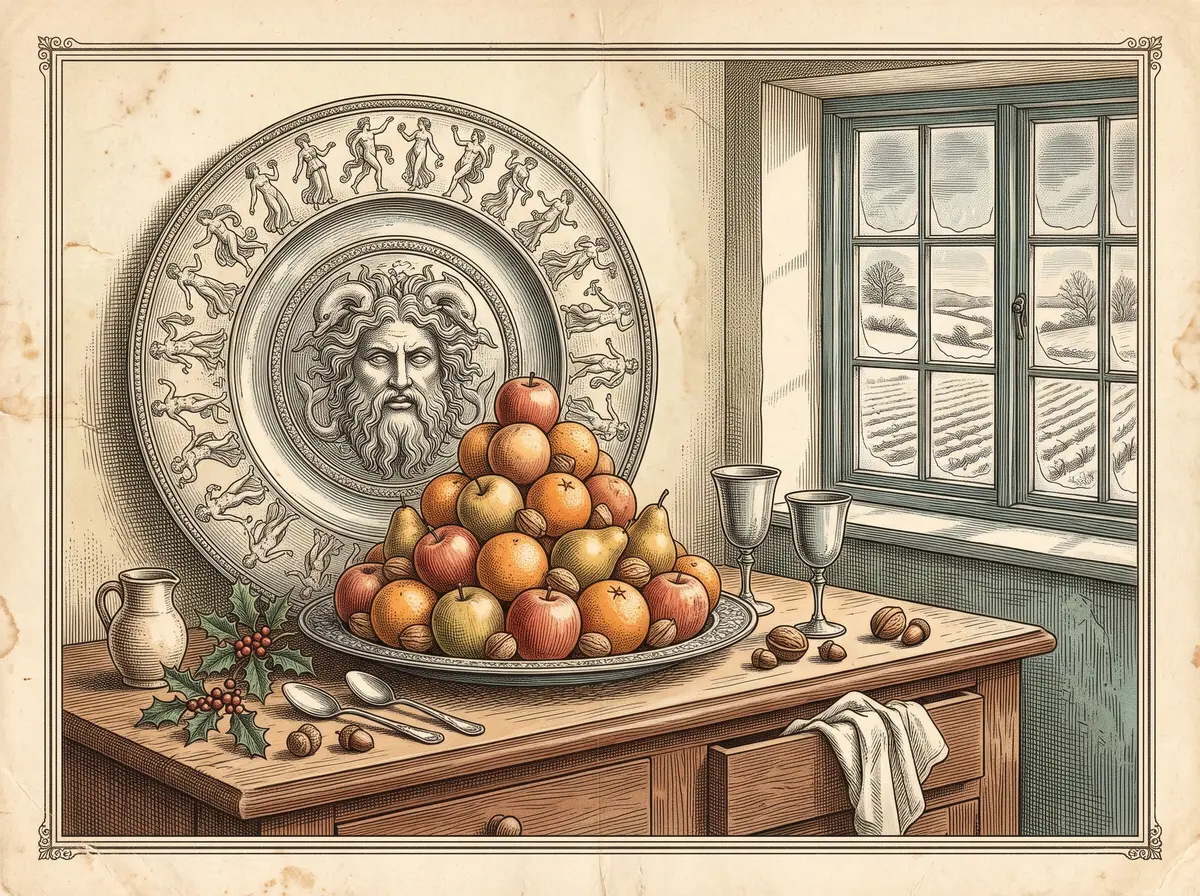
Picture a farmhouse sideboard in wartime Suffolk. On it sits a heavy, two-foot-wide platter, and at Christmas someone heaps it into a pyramid of apples, oranges, pears and nuts. Look past the fruit and you can see a sea god glaring up from the middle, dolphins tangled in his hair, while a crowd of dancers, satyrs, and a wobbly Hercules parade around the rim. The family called it pewter. It was 1,600-year-old Roman silver, and one of the finest pieces ever found in Britain.
By the Curiosities Desk · · 5 min read · Filed under Archaeology · Today’s round
What happened: The Mildenhall Treasure
In January 1942, Gordon Butcher was ploughing a field at West Row, a village near Mildenhall in Suffolk, England. Butcher drove a tractor for Sydney Ford, an agricultural engineer who did contract ploughing and, on the side, collected local antiquities. The field was being prepared for sugar beet, so Butcher had been asked to plough deeper than usual. The plough struck metal.
Butcher suspected it was unusual and fetched his boss. According to the accounts that survive, snow was falling as the two men pulled piece after piece out of the dark, peaty soil. There were large dishes, bowls, goblets, a covered bowl, and a set of spoons. The local Mildenhall Museum counts 34 pieces in all. Everything was black with tarnish. In the words of the museum’s own retelling, “they looked like pewter or lead.”
Ford took the whole lot home. Over the war years he cleaned it himself, scraping off the black crust with methods that, as one later historian noted, would alarm a modern conservator. He had bent pieces straightened by a workman and put the silver on display. Some of it was used at the table, and the biggest platter, now called the Great Dish, came out on special occasions. Ford’s grandson later told the BBC that at Christmas the dish served as a fruit bowl.
That quiet arrangement ended around Easter 1946. Dr. Hugh Fawcett, a local amateur antiquarian and a friend of Ford’s, visited the house and was shown some of the pieces. Ford insisted they were pewter. Fawcett did not believe him. He carried samples to the British Museum, where the archaeologist Christopher Hawkes confirmed they were Roman silver and sent Fawcett back to urge Ford to report the find. Ford, by every account, was not keen. The police were informed, and Ford later grumbled in a letter that they “came along and pinched the lot.”
On 1 July 1946, an inquest held at Mildenhall police station heard the story. Ford told the jury, “I thought they were pewter.” The twelve local men decided the hoard was treasure trove, which made it Crown property. The British Museum acquired it, and Butcher and Ford were each awarded £1,000. Because the find had been kept quiet for four years, that was less than they might otherwise have received.
Why it was strange: The Mildenhall Treasure
The pewter claim was more than a mix-up. Under the old English law of treasure trove, only gold or silver buried by someone who meant to come back for it belonged to the Crown. A pile of old pewter could simply be kept. So whether Ford truly believed the metal was cheap, or hoped others would, mattered a great deal. Historians still argue about it. Richard Hobbs of the British Museum, who dug deep into the archives, thinks Ford probably knew what he had and could not bear to give it up.
The doubts went further. The hoard was so splendid that some scholars questioned whether it had really come out of a Suffolk field at all, and some suggested the silver might have been looted from Italy during the war. Some archaeologists who investigated the case concluded that Ford had not told the full truth about where it came from. Most scholars now accept the West Row findspot, partly because later Suffolk discoveries showed that Roman Britain really did hold silver this fine.
The author Roald Dahl interviewed Butcher and wrote it up for The Saturday Evening Post in 1947. Dahl was cheerfully upfront that he had dramatised it: “The fact that my story may not be at all accurate doesn’t worry me in the least.” Some popular details of the tale trace back to his version, so they’re best read as a good story rather than a record.
Another hoard that turned up while someone was busy with something else is The Lost Hammer That Led to 14,865 Roman Coins — and Got Its Own Museum Number.
What scientists learned: The Mildenhall Treasure
Once cleaned and studied, the treasure turned out to date to the 4th century AD, the late Roman period, probably buried sometime in that century. No coins were found with it, so the date rests on the style of the decoration. The Great Dish is 605 millimetres (just under 2 feet) across and weighs about 8.3 kilograms (roughly 18 pounds). Its centre shows Oceanus, a sea god, with dolphins in his hair and a beard of seaweed. Around him, sea nymphs ride sea creatures, and the outer ring shows Bacchus, the god of wine, with dancing followers.
Some of the spoons carry the chi-rho, an early Christian symbol made from the first two Greek letters of “Christ.” That detail helped narrow the dating, since such symbols became common only after Christianity was tolerated in the empire. Together, pagan wine gods and Christian monograms in one household’s silver show a late Roman Britain where old and new beliefs sat side by side on the same table.
For more finds that began with the wrong errand, see The Finds That Started on the Wrong Errand.
How it reaches us today: The Mildenhall Treasure
The Mildenhall Treasure has been on display at the British Museum since its acquisition, and replicas sit in the museum at Mildenhall. It also became a case study in why the old rules were a poor fit for real finds. Treasure trove hinged on guessing what an ancient owner intended and on whether a finder chose to speak up. In England and Wales, the Treasure Act 1996 replaced it with clearer rules based mainly on an object’s age and precious-metal content, and finders are now legally required to report possible treasure.
Farm work turning up history is a theme that runs far beyond Suffolk, as in The Buried Army Found by Farmers Digging a Well.
Fun fact: The Mildenhall Treasure
For several Christmases, a family table in Suffolk held a Roman platter decorated with Hercules so unsteady on his feet that two satyrs have to hold him up.
Sources: The Mildenhall Treasure
- British Museum, “Platter (the Mildenhall Great Dish), museum number 1946,1007.1”, collection database entry with curator’s comments.
- Richard Hobbs, “The Secret History of the Mildenhall Treasure”, The Antiquaries Journal 88 (2008): 376–420 (Cambridge abstract).
- “The Mildenhall Treasure: a secret history”, Current Archaeology.
- Mildenhall Museum, “The Mildenhall Treasure”.