Accidental Discoveries · Archaeology
The Sponge Diver Who Reported 'Metal Biscuits With Ears' — and Found a 3,300-Year-Old Treasure Ship
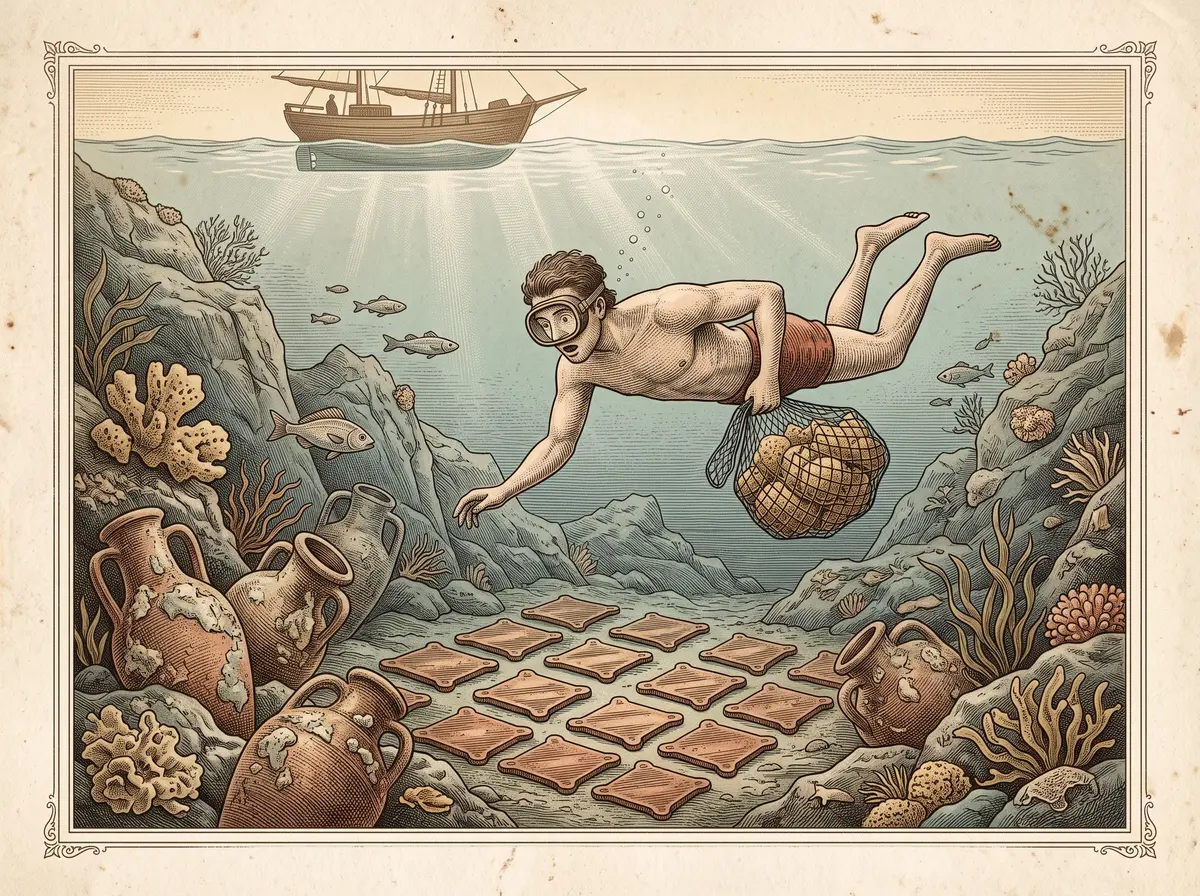
In the summer of 1982, a young Turkish sponge diver named Mehmet Çakır came up from the seabed off Uluburun, a rocky cape near Kaş on Turkey's southern coast, with an odd report. Down there, he said, were "metal biscuits with ears." His captain knew exactly what that meant, because an archaeologist had passed a drawing of one around the sponge boats. The biscuits were copper ingots, and they had been sitting on the bottom of the Mediterranean for about 3,300 years.
By the Curiosities Desk · · 5 min read · Filed under Archaeology · Today’s round
What happened: The Uluburun Shipwreck
The captain’s knowledge was no lucky accident. For years, archaeologists from the Institute of Nautical Archaeology (INA), founded in 1973 and based in Bodrum, had courted Turkey’s sponge divers. These crews spent months working the seabed and saw more of it than any scientist could. INA’s Donald Frey and his Turkish colleagues gave slide-illustrated lectures in the divers’ villages each winter, explaining what an ancient wreck looks like, and Frey circulated a drawing of a Bronze Age copper ingot among the sponge boats. When Çakır described his biscuits, his captain recognized them from that drawing.
The ingots had a distinctive shape: flat, roughly rectangular slabs with a projecting “handle” at each corner, the ears in Çakır’s description. Archaeologists call them oxhide ingots, after their resemblance to a stretched animal hide. In autumn 1982, a team from INA and the Bodrum Museum of Underwater Archaeology dived on the site and found several dozen ingots still lying in four neat rows, just as the ship’s crew had stacked them.
Excavation began in July 1984 under George Bass, the pioneer of underwater archaeology. From 1985 his former student Cemal Pulak took over as director. The wreck lay on a steep, rocky slope at depths of roughly 42 to 61 meters (about 140 to 200 feet), deep enough that divers could go down only twice a day, with about 20 minutes on the bottom each time. Over eleven seasons, ending in 1994, the team logged more than 22,400 dives and recovered nearly 17 tons of artifacts.
What came up was astonishing. The ship carried about 10 tons of copper in 354 oxhide ingots, most of it from Cyprus, plus roughly a ton of tin. Mixed at the usual ratio of about ten parts copper to one part tin, that was enough raw metal for about 11 tons of bronze. There were around 175 ingots of raw glass in cobalt blue and turquoise, logs of African ebony, an elephant tusk and 14 hippopotamus teeth for carving, about 150 Canaanite jars, many filled with terebinth resin (a tree sap likely used as incense), gold jewelry, and a small gold scarab bearing the name of the Egyptian queen Nefertiti. Divers even found folding wooden writing boards, whose wax writing surfaces had long since dissolved.
Tree rings, radiocarbon dating, and pottery styles place the sinking at the end of the 14th century BC, with one statistical analysis settling on about 1320 BC, give or take 15 years. That was the age of the pharaohs of the Amarna period, and of the Mycenaean palaces in Greece.
Why it was strange: The Uluburun Shipwreck
One of the most important archaeological discoveries in the Mediterranean was first described in the language of a snack. That wasn’t a misunderstanding. Çakır’s phrase was exactly the kind of field report the INA team had hoped for: a sharp-eyed working diver, with no training in archaeology, describing a shape he’d never seen before.
It had happened once before. In 1954 a Bodrum sponge diver named Kemal Aras came across a pile of copper slabs off Cape Gelidonya, also on Turkey’s south coast, and considered dynamiting them to sell the metal as scrap. Instead he described them to the American journalist Peter Throckmorton, who suspected they were ancient and relocated the site in 1959. In 1960 Bass, then a graduate student with no previous diving experience, directed the excavation, the first shipwreck excavation carried all the way to completion on the seabed, recorded as carefully as a dig on land. Uluburun was the payoff of the friendship between archaeologists and sponge crews that grew out of it.
The Uluburun ship belongs to the shelf of The Finds That Started on the Wrong Errand, next to The Runaway Goat That Led to the Dead Sea Scrolls.
What scientists learned: The Uluburun Shipwreck
Before Uluburun, Bronze Age long-distance trade was known mostly from scattered objects on land and from royal letters. The Amarna Letters, clay tablets from Egypt, record kings exchanging lavish gifts of gold, copper, and glass. The ship turned those lists into a real cargo, frozen at a single moment.
Its contents came from at least nine or ten cultures, from Cyprus, Canaan, and Egypt to the Aegean and beyond. Personal belongings on board suggest a crew of Canaanite merchants traveling with two people of high status from Mycenaean Greece. Pulak has argued that the ship was sailing west from the Levant toward the Aegean, probably carrying a royal or elite shipment rather than ordinary market goods.
The tin still keeps scientists busy. A 2022 study in Science Advances used isotopes, slightly different forms of the same element that act like a chemical fingerprint, and concluded that about a third of the tin came from the Mušiston mine in what is now Uzbekistan, thousands of kilometers away, with the rest from Anatolia. A 2023 paper by another team disputed the Central Asian link, so that question is still open.
Another sunken cargo rewrote what ancient people could do: The 2,000-Year-Old Computer Found in a Shipwreck.
How it reaches us today: The Uluburun Shipwreck
Uluburun showed that the Late Bronze Age Mediterranean was a connected trading world, and the excavation set standards for deep-water archaeology that later projects followed. The ship’s hull, built of Lebanese cedar fitted together edge-to-edge with pegged mortise-and-tenon joints, helped historians understand how ancient shipwrights built boats. Many of the finds are now on display at the Bodrum Museum of Underwater Archaeology. And the partnership that found the wreck still matters: much of what archaeologists know about the seabed starts with someone who works there and is willing to describe what they saw.
Fun fact: The Uluburun Shipwreck
Recovering the cargo took more than 22,400 dives, adding up to 6,613 hours underwater, in sessions so short that each diver got only about 20 minutes on the bottom at a time.
Sources: The Uluburun Shipwreck
- Cemal Pulak, “The Uluburun Shipwreck and Late Bronze Age Trade,” in Beyond Babylon: Art, Trade, and Diplomacy in the Second Millennium B.C. (Metropolitan Museum of Art, 2008)
- “Uluburun Late Bronze Age Shipwreck Excavation,” Institute of Nautical Archaeology
- Donald A. Frey, “Treasures of the Sponge Divers,” Saudi Aramco World, May/June 1993
- Wayne Powell et al., “Tin from Uluburun shipwreck shows small-scale commodity exchange fueled continental tin supply across Late Bronze Age Eurasia,” Science Advances 8 (2022)
- Daniel Berger et al., “Why Central Asia’s Mushiston is not a source for the Late Bronze Age tin ingots from the Uluburun shipwreck,” Frontiers in Earth Science (2023)