Strange Animals Scientists Studied · Engineering
The Scientist Who Told Europe to Make Paper Like Wasps — and Was Ashamed He Never Tried It
In 1719, the French naturalist René-Antoine Ferchault de Réaumur held up a wasp nest and told the Paris Académie des Sciences that the insects had solved a problem Europe's papermakers could not: they were making paper out of wood. Then, by his own embarrassed admission, he spent the next two decades not testing the idea himself.
By the Curiosities Desk · · 5 min read · Filed under Engineering · Today’s round
Part of Creatures That Changed Science
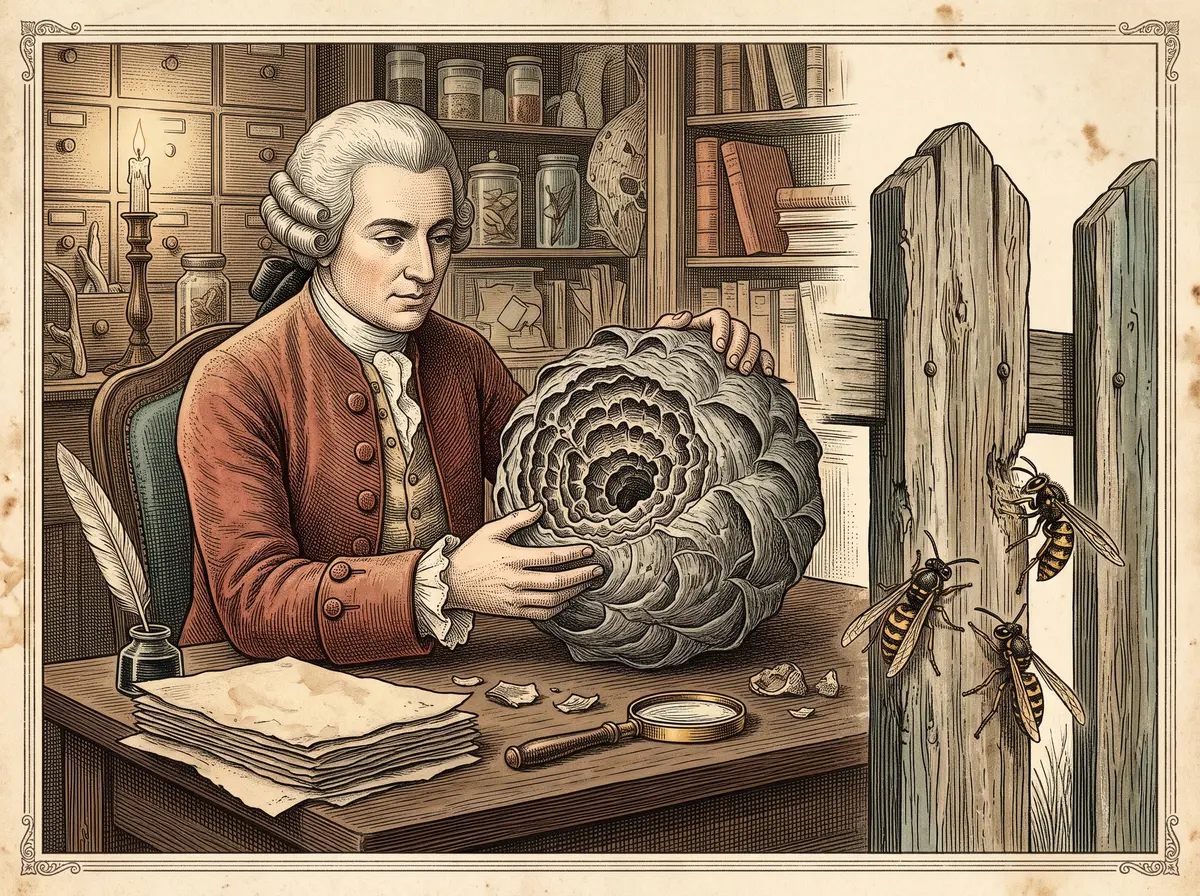
What happened: Rene Reaumur
Réaumur was one of the busiest minds of 18th-century France. Born in La Rochelle in 1683, he was elected to the Académie des Sciences in 1708, at just 24. He studied metals, invented a temperature scale, wrote about how spiders make silk, and filled six volumes with careful observations of insects.
Wasps were among his favorite subjects. Paper wasps, hornets, and yellowjackets build their nests by scraping fibers from weathered wood and plant stems, chewing them, and mixing them with saliva into a pulp. Spread thin and left to dry, that pulp becomes a gray, papery sheet. Réaumur looked at those nests and saw something more than biology.
In Europe at the time, paper was made from rags. Old linen and cotton cloth was soaked, beaten into fibers, and pressed into sheets. As printing spread, demand for paper kept climbing, and rags were always in short supply.
On November 15, 1719, Réaumur laid his observations on wasps before the Académie. In a well-known passage, translated in later histories of papermaking, he noted that American wasps “form very fine paper, like ours,” drawing the fibers from the common wood around them. The wasps, he argued, showed that paper could be made “without the use of rags and linen.” He even described a Canadian wasp whose nest covering looked so much like human paper that it was hard to tell the two apart. If Europeans could find woods like the ones those wasps used, he suggested, they might make the whitest paper of all.
Nobody, including Réaumur, followed it up right away. More than two decades later, in 1742, he returned to the subject in print. In the translation quoted by paper historians, he wrote: “I am ashamed that I have not yet tried this experiment.” It had been more than twenty years since he first saw its importance and announced it, he explained, but he had hoped someone else would make it their occupation.
Someone eventually did. Between 1765 and 1771, Jacob Christian Schäffer, a Protestant pastor and naturalist in Regensburg, published a six-volume work on making paper “without any rags, or with only a small addition of them.” Schäffer made sample sheets from an odd assortment of materials, including poplar, moss, and hops. One of the first specimens in his books was made from wasp nests. Most still needed some cotton rags to hold together.
The real breakthrough came in the 1840s. In Saxony, a machinist named Friedrich Gottlob Keller worked out how to grind wood against a stone to free its fibers, and in 1844 he produced a sheet of paper from ground wood. That same year, in Nova Scotia, the poet Charles Fenerty independently announced paper made from wood pulp. Keller sold his process to the paper specialist Heinrich Voelter, and a Saxon patent was granted in both their names in August 1845. Keller later could not afford to renew his share. Voelter built the business, and by 1852 ground-wood paper was being made regularly at a mill in Heidenheim.
Why it was strange: Rene Reaumur
Most ideas borrowed from nature arrive at the right moment. This one sat on the shelf for more than a century. Réaumur had the observation, the reputation, and the platform in 1719, yet the industry did not move to wood until the 1850s.
Part of the delay was practical. Seeing that wasps chew wood into paper is different from building a machine that can break down a log as finely as an insect’s jaws. Early attempts mostly produced brittle or coarse sheets that needed rags mixed in.
And there is the very human detail at the center of the story. One of the most productive scientists of his century admitted, in writing, that he had put off the one experiment he had urged everyone else to try. That honesty is part of why the episode is remembered at all.
The story fits a long line of inventions copied from animals, including The Kingfisher That Redesigned the Bullet Train.
What scientists learned: Rene Reaumur
Réaumur’s insight was that paper doesn’t depend on cloth at all. What matters is cellulose, the tough molecule that makes up plant cell walls. Linen and cotton rags were simply cellulose that had already been processed into thread. Wood is full of cellulose too, held together by a gluey compound called lignin. Wasps get around this by chewing; their saliva helps bind the loosened fibers into a felted mat.
Humans took two routes to the same result. Keller’s method, called mechanical or ground-wood pulping, tore fibers apart by grinding. Later in the 19th century, chemical pulping used heat and chemicals to dissolve much of the lignin, giving stronger, whiter paper.
Early wood paper had a serious flaw. As John Lienhard of the University of Houston has noted, the chemistry of 19th-century papermaking stayed crude for decades, and many books from that era are now crumbling. Some abandoned wasp nests, meanwhile, have held up remarkably well.
Réaumur’s habit of watching closely and describing honestly shows up again in The Ship-Sinking Clam That Taught an Engineer How to Dig Under the Thames.
How it reaches us today: Rene Reaumur
Most paper you touch today, from printer paper to pizza boxes, starts as wood pulp. The shift from rags to wood made paper cheap enough for mass-circulation newspapers, paperback books, and packaging on a scale Réaumur could not have imagined.
The episode is also an early example of what is now called biomimicry: studying how living things solve problems and adapting those solutions for human use.
Keller, for his part, is honored at a small museum in his former home in Krippen, Germany. According to the museum, he drew on two inspirations: watching wasps build their nests, and a childhood memory of grinding cherry stones.
For another case of an animal’s design borrowed for a building, see The Termite Mounds That Taught an Architect to Cool a Building — Using a Theory the Termites Didn’t Follow. The wasp nest belongs with the other creatures that changed science, in Creatures That Changed Science.
Fun fact: Rene Reaumur
The same Réaumur who urged Europe to copy wasps also gave his name to a temperature scale, still printed on some old thermometers, that puts water’s freezing point at 0 and its boiling point at 80.
Sources: Rene Reaumur
- Excerpt on Réaumur’s 1719 wasp memoir, translated in a history of papermaking (University of Utah Digital Library)
- Excerpt quoting Réaumur’s 1742 admission, “I am ashamed that I have not yet tried this experiment” (University of Utah Digital Library)
- Lienhard, J. H. “Of Wasps Making Paper.” The Engines of Our Ingenuity, No. 1052, University of Houston
- Norman, J. “Jacob Christian Schäffer Issues ‘The Most Interesting and Rarest Work’ on Papermaking.” HistoryofInformation.com (citing Dard Hunter, The Literature of Papermaking 1390–1800)
- Museum Friedrich Gottlob Keller, Krippen (Elbe-Labe tourism portal)