Impossible Inventions · Archaeology
The South-Pointing Chariot That Needed a Man Hidden Inside to Point South
In the year 417, a conquering Chinese general rolled home with one of the most celebrated machines of his age: a south-pointing chariot, a carriage topped by a little wooden figure whose outstretched arm was said to point south no matter which way the vehicle turned. It led imperial processions. It was a symbol of rightful rule. And, according to the official history, it had nothing inside. Every time it moved, someone had to sit inside the carriage and turn the figure by hand.
By the Curiosities Desk · · 5 min read · Filed under Archaeology · Today’s round
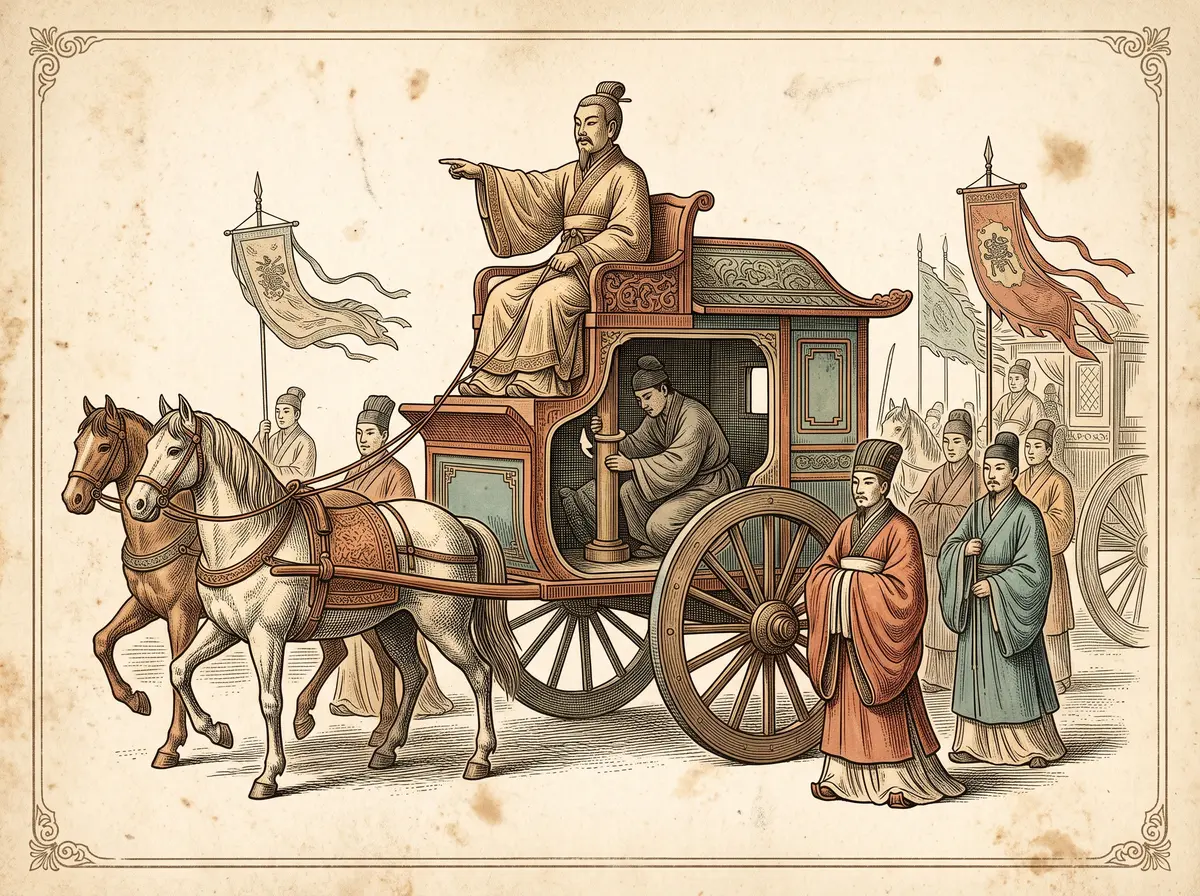
What happened: The South-Pointing Chariot That Needed a Man Hidden Inside to Point South
The south-pointing chariot is one of China’s oldest technology legends. Ancient tradition credited it to the Yellow Emperor, who supposedly used it to find his way through a magical fog in battle, or to the Duke of Zhou, who was said to have given one to foreign envoys so they could find their way home. Those stories are legend. No texts from before or during the Han dynasty describe the device.
The first builder we can actually name is Ma Jun, an engineer at the court of Cao Wei during the Three Kingdoms period. An essay by his contemporary Fu Xuan, preserved in the annotations to the Records of the Three Kingdoms, tells the story. In the 230s CE, two officials, Gaotang Long and Qin Lang, told Ma Jun at court that the ancients never had such a chariot and that the tale was nonsense. They even teased him with a pun on his own name, whose characters call to mind measuring and weighing. Ma Jun insisted the ancients had it; people simply hadn’t thought it through. By Fu Xuan’s own account, Ma Jun’s strength was skill, not speech, so he ended the argument the way he knew best: empty words, he said, were no match for a test. The two officials reported the dispute to Emperor Ming, who ordered Ma Jun to build one. He did, and it worked.
Then the design was lost. Over the next two centuries, several rulers of rival northern kingdoms had south-pointing chariots made. One was built for Yao Xing, ruler of the Later Qin state. In 417, the general Liu Yu, who would soon found the Liu Song dynasty and rule as its Emperor Wu, conquered the region around Chang’an and claimed the chariot as a prize.
That is where the Book of Qi, the official history of the Southern Qi dynasty, picks up the story in its biography of the mathematician Zu Chongzhi. The captured chariot, it says, “had the outward form but no mechanism.” Every time it moved, a person had to be put inside to turn it.
Around 477–479, the powerful minister Xiao Daocheng (soon to be the first emperor of Southern Qi) asked Zu Chongzhi to bring the old method back. Zu built new machinery of bronze. The Book of Qi says it could turn round and round without end and still point the same way, something not achieved since Ma Jun.
Then came a rival. A man from the north named Suo Yulin announced that he, too, could build a south-pointing chariot. Xiao Daocheng had each man build one and tested them against each other in Leyou Park, outside the capital at Jiankang (today’s Nanjing). The text is short and brutal: Suo’s chariot drifted noticeably off course, so it was broken up and burned.
Why it was strange: The South-Pointing Chariot That Needed a Man Hidden Inside to Point South
The chariot did something that sounds impossible: it kept track of south with no magnet and no view of the sky. It wasn’t a compass at all. Somebody set the figure pointing south at the start of the trip, and from then on gears tried to undo every turn the carriage made.
That makes the hidden-passenger version especially funny, and especially revealing. It shows how much the chariot was about ceremony. It rode near the front of the emperor’s procession, and a pointer that looked right mattered more than one that was automatic. Even the “real” ones had a problem: gears keep track of turns by counting how far each wheel rolls, so small errors pile up. If one wheel were just a tenth of a percent bigger than the other, the figure could drift by around 20 degrees per kilometer. Scholars doubt the chariots ever guided anyone over long distances.
Another machine that should not have worked: The Bronze Dragon That Spat Out a Ball Over an Earthquake Nobody Felt.
What scientists learned: The South-Pointing Chariot That Needed a Man Hidden Inside to Point South
The trick is in the wheels. When a carriage turns left, its right wheel rolls farther than its left. That difference in distance tells you exactly how much the carriage has turned. Gear the difference to the figure in the opposite direction, and the figure stays still while the carriage turns beneath it.
How the ancient builders actually did this is still argued over. Song dynasty records describe chariots built by Yan Su in 1027 and Wu Deren in 1107, with gear wheels and tooth counts, but they leave room for different readings. In the 20th century the British engineer George Lanchester argued that the chariot used a differential gear, a set of gears that responds to the difference in speed between two wheels. That idea became widely accepted, and working differential chariots have since been built. The historian of science Wang Zhenduo built a well-known model, now displayed at the National Museum of China.
Mathematicians found a deeper lesson. In 1992 the physicist M. Santander pointed out that a perfect south-pointing chariot carries out what geometers call parallel transport, keeping a direction “as unchanged as possible” while moving across a surface. On a flat plain, that means always pointing south. On a curved surface, it doesn’t.
More ancient engineering that outran its century: The 2,000-Year-Old Computer Found in a Shipwreck.
How it reaches us today: The South-Pointing Chariot That Needed a Man Hidden Inside to Point South
Every car on the road solves the chariot’s problem in reverse. When a car turns a corner, its outer wheels have to spin faster than its inner ones. A differential lets them do that while the engine drives both. The chariot used the same difference in wheel speed as information, to measure a turn.
The chariot also gave teachers a hands-on way to explain curvature, the idea at the heart of Gauss’s geometry and, later, Einstein’s general relativity, where gravity is described as curved space-time.
For more machines that did the impossible, visit Built to Do the Impossible.
Fun fact: The South-Pointing Chariot That Needed a Man Hidden Inside to Point South
A flawless south-pointing chariot still couldn’t keep its bearings on a round planet. Drive one in a giant triangle — up from the equator to the North Pole, back down to the equator a quarter of the way around the globe, then along the equator to the start — and its figure would end up turned a full 90 degrees. The Earth’s curvature does the turning.
Sources: The South-Pointing Chariot That Needed a Man Hidden Inside to Point South
- Xiao Zixian, Book of Qi (Nan Qi Shu), chapter 52, biography of Zu Chongzhi, original Chinese text via Wikisource. The primary source for Yao Xing’s empty chariot, Zu Chongzhi’s bronze rebuild, and the Leyou Park contest.
- Chen Shou, Records of the Three Kingdoms (Sanguozhi), chapter 29, original Chinese text via Wikisource, including Fu Xuan’s account of Ma Jun’s debate with Gaotang Long and Qin Lang.
- Stephen Sawin, “South Pointing Chariot: An Invitation to Differential Geometry” (2015), arXiv. Explains the chariot as parallel transport and the sphere example, building on M. Santander, American Journal of Physics 60 (1992): 782–787.
- Science and Technology Daily, “Southward-pointing Cart Mechanics” (2023), on Wang Zhenduo’s model at the National Museum of China.
- “South-pointing chariot,” Wikipedia, as a guide to Joseph Needham’s translations in Science and Civilisation in China, vol. 4, part 2, the Song dynasty builders, and the error estimate.