The Spoon That Supposedly Keeps Champagne Fizzy — and the Laser Chemist Who Tested It Blind
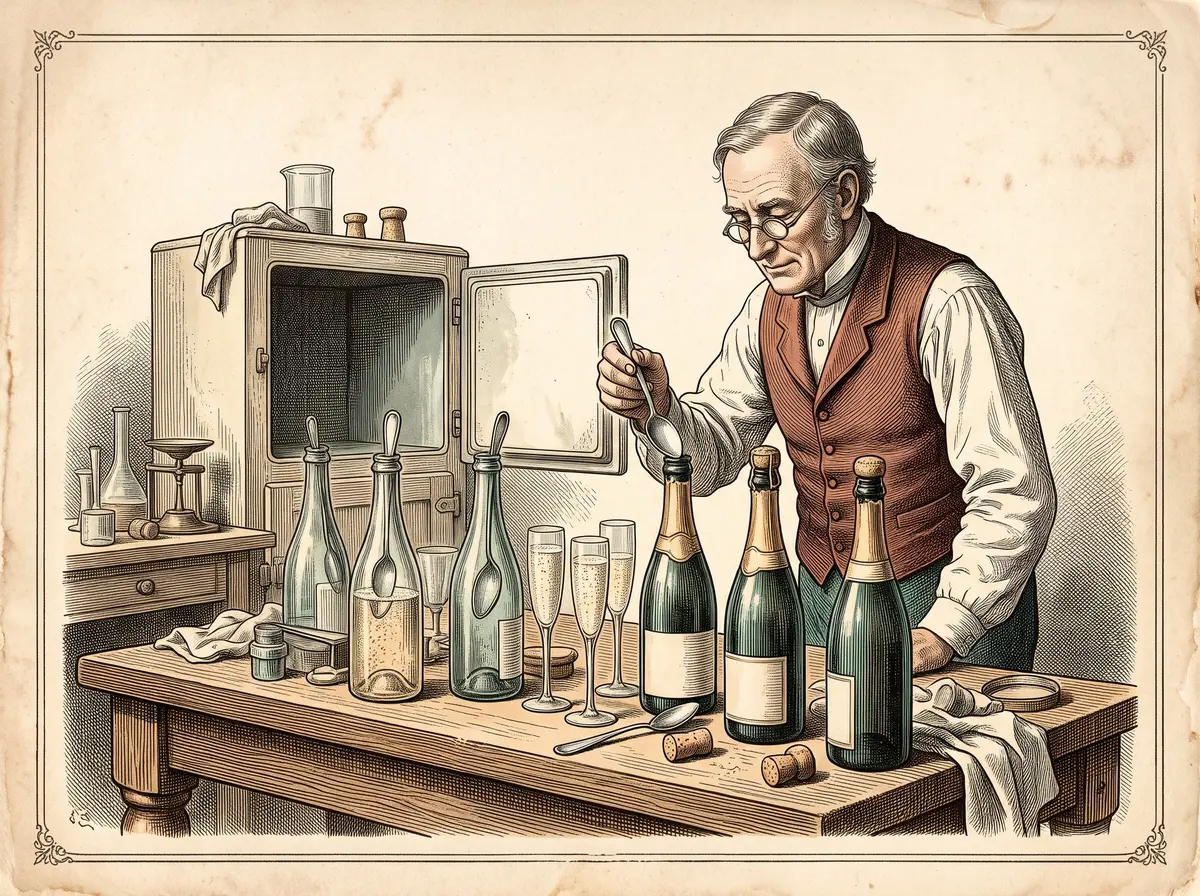
In 1994, laser chemist Richard Zare, who had won the National Medal of Science for work on lasers and molecules, opened several bottles of sparkling wine, dangled spoons into some of the necks, and put them all in a friend's brand-new refrigerator. Then he waited 26 hours. The question was one that dinner parties had argued over for generations: does a teaspoon hanging in the neck of an open bottle really keep the bubbles in?
By the Curiosities Desk · · 5 min read · Filed under Chemistry · Today’s round
Part of The Version Everyone Remembers
What happened: The Champagne Spoon Test
The chemist was Richard N. Zare of Stanford University, known for laser-induced fluorescence, a way of making molecules glow under laser light so they can be studied. He also loved the science of fizz, and so did a friend: Harold McGee, the food writer whose book On Food and Cooking is a standard reference on kitchen chemistry.
The spoon trick was everywhere, especially in Europe. Open a bottle of champagne, don’t finish it, slide a teaspoon (preferably silver) handle-first into the neck, and the wine will supposedly still sparkle the next day. The usual explanation is that the cold metal forms a chilly “plug” of air that holds the gas in. Nobody seems to know where the trick began.
So in 1994 Zare and McGee, joined by their wives and a few friends, ran a test. According to Scientific American’s later account, they used bottles from the same lot, uncorked them, and stored them side by side for 26 hours under different treatments: some with nothing in the neck, some with a silver spoon, some with a stainless steel spoon, and some with stoppers. McGee’s new refrigerator was a bonus: it was empty, so no leftovers could taint the wine.
Then came the important part: the tasting was blind. The tasters scored each wine’s sparkle without knowing which bottle had been spooned. Stanford put out a press release about the experiments, and that December Zare explained the results on the radio show Science Friday.
The spoons did nothing. The spooned bottles were no fizzier than the open ones. “We really tested it quite extensively,” Zare said. In a small twist, a recorked bottle did poorly in the taste scores.
Meanwhile, in France, the people with the most at stake were asking the same question with gauges instead of tongues. In 1994 Michel Valade and colleagues published a study in the Champagne trade journal Le Vigneron Champenois under a title that gave away the ending: “Le mythe de la petite cuillère,” or “The myth of the teaspoon.” They poured off part of each bottle, leaving either 500 or 250 milliliters, and stored the bottles at 12°C (about 54°F) five ways: left open, with a silver teaspoon, with a stainless steel teaspoon, with a cork stopper, and with a crown cap, the kind of metal cap found on beer bottles. Each setup was run three times.
They measured three things: the pressure inside the bottle, how much weight each bottle lost as gas escaped, and how lively expert tasters found the wine. After 48 hours, the open bottles and the spoon bottles had both lost about half their remaining pressure. The tightly sealed bottles had lost about 10 percent. The tasters agreed with the gauges. The verdict, in the paper’s translated words: “Clearly, the teaspoon effect is a myth.”
Why it was strange: The Champagne Spoon Test
The spoon trick sounds like science. It has a metal, a temperature, and a plausible-sounding mechanism. But a teaspoon handle doesn’t seal anything. Carbon dioxide molecules are tiny, and the neck of a bottle with a spoon in it is still a wide-open door.
Stranger still is how long it lasted when testing it was so easy. But a half-finished bottle is usually tasted the next day without anything to compare it to. If it still sparkles, the spoon gets the credit. If it’s flat, the bottle must have been open too long. Either way the trick survives, much like other myths that never got checked, including The Fizzing Candy That Supposedly Exploded Kids’ Stomachs. It belongs on the shelf of The Version Everyone Remembers.
What scientists learned: The Champagne Spoon Test
The fizz in champagne is carbon dioxide dissolved in the wine during a second fermentation inside the sealed bottle. Before opening, that gas pushes back hard. The Valade team’s bottles started at about 6 atmospheres, roughly six times the air pressure around us, or about two to three times the pressure in a car tire.
How much gas stays dissolved depends on two things. The first is the pressure of carbon dioxide in the space above the liquid. This relationship is called Henry’s law: the more of a gas pressing on a liquid, the more of that gas the liquid holds. Once the cork is out, the carbon dioxide above the wine drifts away, the pressure drops, and the gas starts leaving the wine. A spoon doesn’t stop that. Only a real seal does, because the escaping gas builds back up in the closed space and slows the loss.
The second is temperature. Carbon dioxide dissolves better in cold liquids than in warm ones. That’s why the spoon trick can seem to work: the spooned bottle goes back in the fridge, and cold wine holds its bubbles fairly well. Zare noted that some sparkling wines hold so much gas that they stay bubbly in the fridge for days even with no stopper at all. His advice was simple: “Keep it cold. In fact, never let it warm up.”
How it reaches us today: The Champagne Spoon Test
The spoon trick still turns up in kitchens and lifestyle columns, and wine writers still debunk it most holiday seasons. The practical lesson from both 1994 studies holds up: if you want leftover sparkling wine to stay lively, use a tight stopper made for sparkling wine and keep the bottle cold.
The bigger lesson is about method. Zare’s living-room experiment followed the same basic rules as a clinical trial: identical starting material, a control group, and judges who didn’t know which sample was which. The French study added instruments, so nobody had to rely on anyone’s tongue. Together they show how a few hours of careful testing can settle a question people had argued about for years. For another chemistry legend that grew bigger than the evidence, see The Chemist Credited With Perfecting Vodka — Who Said He’d Never Drunk It.
Fun fact: The Champagne Spoon Test
How many bubbles are in a glass of champagne? In 2014 the champagne physicist Gérard Liger-Belair worked it out for a standard flute and settled on about one million, far fewer than the 15 million figure often repeated by wine writers.
Sources: The Champagne Spoon Test
- Geoff Scollary, on whether a spoon stops champagne going flat, The Conversation, republished by Phys.org (January 2022), summarizing M. Valade et al., “Le mythe de la petite cuillère,” Le Vigneron Champenois (1994): https://phys.org/news/2022-01-spoon-bottle-champagne-doesnt.pdf
- “Fact or Fiction: Does a Spoon in the Bottle Keep Champagne Bubbly?” Scientific American: https://www.scientificamerican.com/article/sparkling-wine-teaspoon-myth/
- Zare Laboratory, Stanford University, “Bubbles” news and media archive (1994 Science Friday interview and Stanford press release on the silver-spoon experiments): https://web.stanford.edu/group/Zarelab/news_bubbles.html
- National Science Foundation, “Richard N. Zare,” National Medal of Science recipient (1983): https://www.nsf.gov/honorary-awards/national-medal-science/recipients/richard-n-zare
- “The science of champagne fizz: How many bubbles are in your bubbly?” Phys.org (April 2014), on Gérard Liger-Belair, “How Many Bubbles in Your Glass of Bubbly?” The Journal of Physical Chemistry B 118, no. 11 (2014): 3156–3163: https://phys.org/news/2014-04-science-champagne-fizz.html