The Chemist Credited With Perfecting Vodka — Who Said He'd Never Drunk It
On January 31, 2015, Russian newspapers wished vodka a happy 150th birthday. The date wasn't the anniversary of a distillery, a recipe, or a royal decree. It marked the day in 1865 when a young chemist named Dmitri Mendeleev defended his doctoral dissertation in St. Petersburg. The story goes that Mendeleev, the man who later built the periodic table, worked out that the perfect vodka is exactly 40 percent alcohol. There is one problem with the birthday party: his dissertation never mentions vodka, and Mendeleev reportedly said he had hardly ever tasted the stuff.
By the Curiosities Desk · · 5 min read · Filed under Chemistry · Today’s round
Part of The Version Everyone Remembers
What happened: The Chemist Credited With Perfecting Vodka — Who Said He'd Never Drunk It
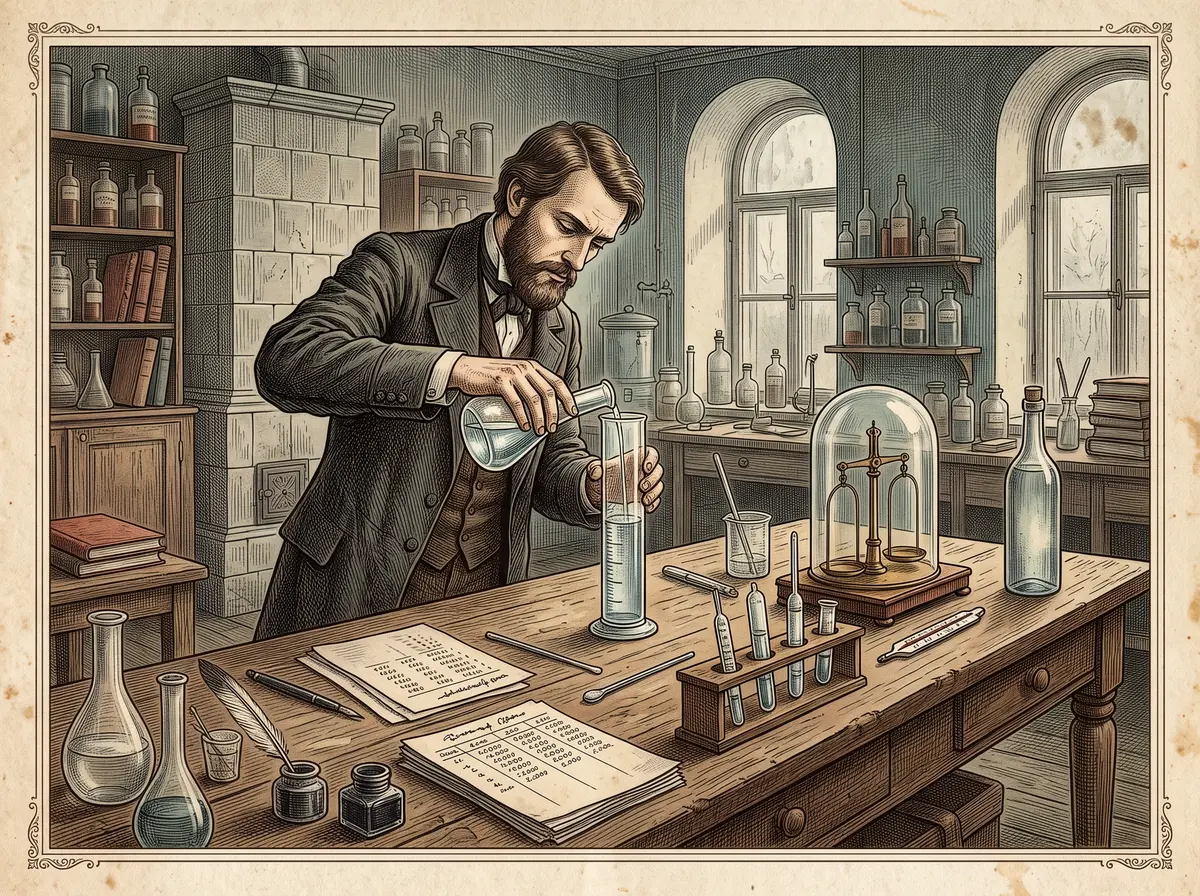
In 1865, Dmitri Ivanovich Mendeleev was a young chemistry lecturer at St. Petersburg University. On January 31 of that year, he defended his doctoral thesis before the university’s physics and mathematics faculty. Its title, in English translation, was A Discourse on the Combination of Alcohol and Water.
The subject sounds like a bartender’s question, but it was a physicist’s puzzle. If you pour 50 milliliters of pure alcohol into 50 milliliters of water, you get less than 100 milliliters of liquid. The mixture shrinks, an effect chemists call contraction. Mendeleev wanted to know why. He measured the density (how much mass is packed into a given volume) and the thermal expansion of alcohol-water mixtures at many different ratios, hunting for patterns that might reveal how the two kinds of molecules fit together.
Accounts of exactly which strengths he studied differ. Some summaries say the dissertation focused on strong mixtures above 70 percent alcohol; one Russian account notes a chapter on where the shrinkage is greatest, a point it puts near 46 percent alcohol by weight. On the part that matters for the legend, sources agree: the dissertation does not name 40 percent as ideal, and it does not discuss vodka at all.
So where did the 40 come from? Not from Mendeleev. The Russian government had already fixed vodka’s standard strength in 1843, when he was nine years old. The reason was taxes. Spirits were taxed by strength, and some sellers watered their product down after the tax was paid while still charging full price. A decree required vodka to reach drinkers at 40 degrees, with 38 as the legal minimum.
Mendeleev did eventually brush up against the vodka business. In the 1890s, the finance minister Sergei Witte was pushing a state monopoly on alcohol, and Mendeleev took part in a government commission on alcohol excise taxes. According to the Russian newspaper Pravda’s review of the record, he spoke there about taxation, not about any ideal strength.
The legend took off anyway. Physicist Vladimir Shiltsev, writing in Physics Today, traces it to early-20th-century Russia, when the idea of a great national scientist perfecting a national drink was appealing. It spread through books and television, including food historian William Pokhlebkin’s 1991 History of Vodka. Pravda suggests the year 1894 crept into the story because Pokhlebkin wrote that Mendeleev joined a commission “30 years after” his dissertation, and someone did the arithmetic from the wrong starting year. Today, at least one major brand prints on its bottles that Mendeleev set the imperial vodka standard in 1894.
Why it was strange: The Chemist Credited With Perfecting Vodka — Who Said He'd Never Drunk It
The myth credits a scientist with the one thing his research wasn’t about. Mendeleev’s dissertation asked a deep question about how liquids mix. The legend turned it into a recipe card.
There is also a personal twist. Igor Dmitriev, director of the Mendeleev Museum-Archive at St. Petersburg State University, has said that Mendeleev preferred wine and showed little interest in vodka. Dmitriev quotes him as saying that in his whole life he had never drunk vodka and barely knew its taste.
It is a myth that sits comfortably on The Version Everyone Remembers, alongside The Brandy Barrel St. Bernards Never Carried — and Why It Would Have Made Things Worse.
What scientists learned: The Chemist Credited With Perfecting Vodka — Who Said He'd Never Drunk It
The real science is about solutions, mixtures in which one substance spreads evenly through another. Alcohol and water shrink when mixed because their molecules attract each other strongly through hydrogen bonds, weak links that form between a hydrogen atom on one molecule and an oxygen atom on another. The molecules pack together more snugly than they did on their own, so the total volume drops.
Mendeleev interpreted his measurements as evidence that alcohol and water form loose chemical associations in specific proportions. Chemists no longer describe solutions quite that way, but his careful data on density helped push forward the study of how liquids combine. It also showed his signature habit: gathering precise numbers, then looking for a hidden order in them. Four years later, that habit produced something far more famous — see The Blank Squares That Predicted Three Undiscovered Elements.
How it reaches us today: The Chemist Credited With Perfecting Vodka — Who Said He'd Never Drunk It
Contraction still matters to anyone who blends spirits. Because the volumes don’t simply add up, producers measure strength with hydrometers and density tables rather than by counting cups, a practice that relies on exactly the kind of measurements Mendeleev made.
The myth matters, too. Russia still marks January 31 as vodka’s unofficial birthday, and Mendeleev’s face sells bottles. It’s a reminder that a famous name can attach itself to a story it doesn’t belong in, and that a museum archivist’s correction travels much more slowly than a label. For more science legends that refuse to die, browse The Version Everyone Remembers.
Fun fact: The Chemist Credited With Perfecting Vodka — Who Said He'd Never Drunk It
Mendeleev had a reputation for another invented sideline: a well-known Russian anecdote calls him a famous “suitcase maker.” It has a grain of truth. He glued together his own sturdy cardboard boxes to carry his mountains of files.
If drinking is affecting your health or your life, you don’t have to sort it out alone. A doctor, a trusted person, or a local support line can help.
Sources: The Chemist Credited With Perfecting Vodka — Who Said He'd Never Drunk It
- Dmitri Mendeleev and the Science of Vodka — Vladimir Shiltsev, Physics Today, August 22, 2019 (dissertation content; origin of the myth; Pokhlebkin; excise commission)
- Dmitry Mendeleev and 40 Degrees of Russian Vodka — Pravda (1843 decree, 38-degree minimum; 1890s commission; the “1894” date)
- Откуда появился миф о создании водки Менделеевым — Rambler (January 31, 1865 defense; statements of Igor Dmitriev, Mendeleev Museum-Archive, St. Petersburg State University)
- Русской водке исполнилось 150 лет — Rossiyskaya Gazeta, January 31, 2015 (the “150th birthday” of Russian vodka)
- The Suitcase Maker’s Dream — Russian Life, January/February 2014 (Mendeleev myths, 1843 standard, cardboard suitcases)