The Brandy Barrel St. Bernards Never Carried — and Why It Would Have Made Things Worse
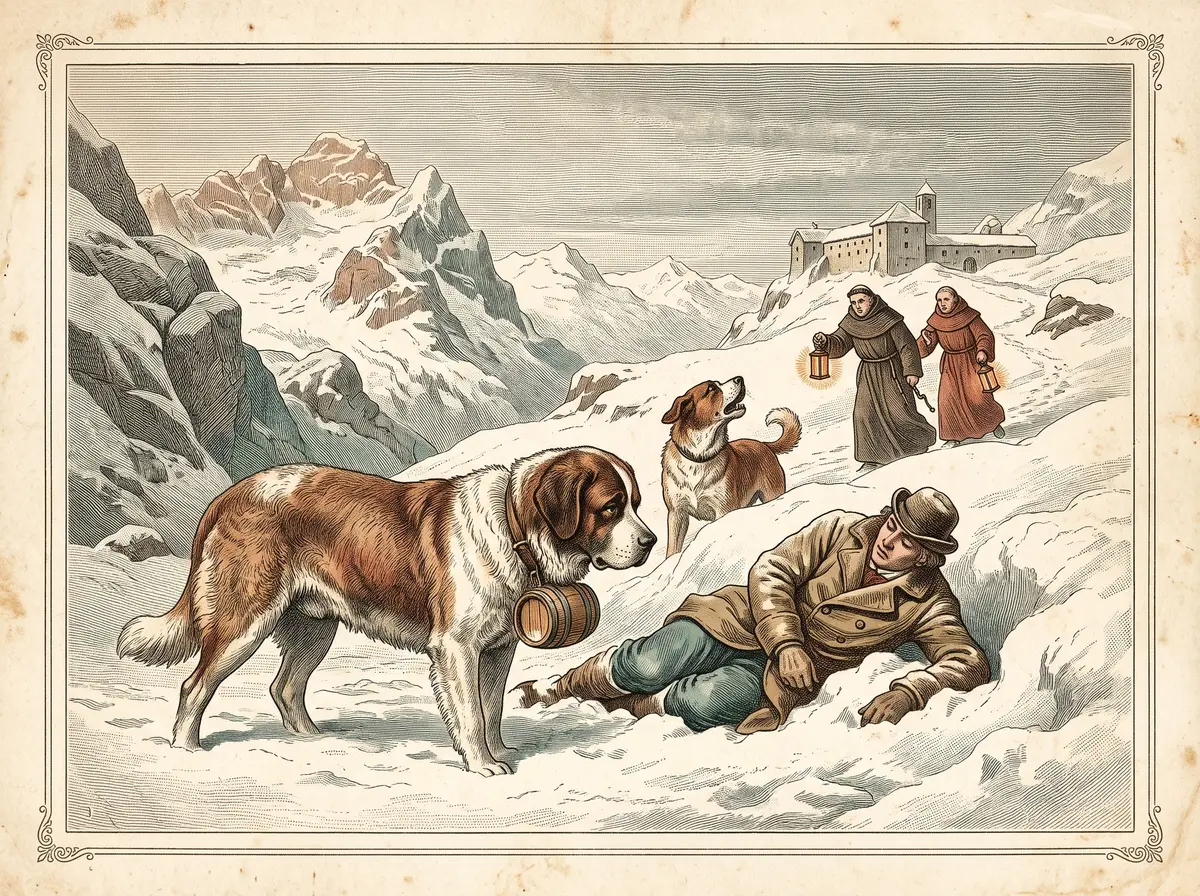
Picture the scene everyone knows: a traveller lies half-buried in Alpine snow, and a huge, kindly St. Bernard plods up with a tiny wooden barrel of brandy hanging from its collar, ready to pour the poor soul a warming nip. It's on postcards, in cartoons, and on souvenir key rings across Switzerland. In 1956, a chaplain from the very hospice where those dogs worked put it plainly: "At no point in time did the dogs carry such barrels."
By the Curiosities Desk · · 5 min read · Filed under Medicine · Today’s round
What happened: The Brandy Barrel St. Bernards Never Carried — and Why It Would Have Made
The real story starts at the Great St Bernard Pass, a route through the Alps between what is now Switzerland and Italy. By tradition, a monk named Bernard of Menthon founded a hospice there in the 11th century to shelter travellers crossing on foot. It sits at nearly 2,500 metres (about 8,100 feet) above sea level, where snow can fall in any month and storms erase the path in minutes.
The canons who ran the hospice kept dogs. According to the Natural History Museum of Bern, which has studied their history closely, the dogs were originally guard dogs. Sometime around the mid-1600s, the hospice’s guides, called marronniers, began taking them on patrols. The dogs found snow-covered paths, broke trail through deep drifts, and barked to alert the guides when they came across someone in trouble. Over roughly two centuries, the men of the hospice and their dogs were credited with saving more than 2,000 lives.
The most famous of these dogs was Barry, born at the hospice in 1800. He is credited with saving more than 40 people. Legends grew around him fast. One says he carried a half-frozen boy to safety on his back. Another says a Napoleonic soldier mistook him for a wolf and killed him with a bayonet. The Bern museum, where Barry’s preserved body is still on display, says the boy story is unconfirmed and the bayonet story is simply false: Barry retired to Bern and died there peacefully in 1814.
Notice what’s missing from all these stories: brandy.
So where did the barrel come from? Many popular accounts point to a painting. In 1820, an 18-year-old English artist named Edwin Landseer exhibited Alpine Mastiffs Reanimating a Distressed Traveller at the British Institution in London. It shows two big dogs finding an unconscious man in the snow on the St Bernard Pass, one licking his hand to revive him, the other barking to call the monks hurrying up behind. The picture was a hit. In 1831, Landseer’s father, the engraver John Landseer, published a print of it, along with a little book about the dogs of the pass.
Landseer’s painting is often described as showing a small cask on one dog’s collar, and it’s frequently named as the birthplace of the myth. But the Bern museum offers a different timeline: barrels, it says, first appear in pictures of the dogs only at the end of the 19th century. Either way, the barrel was an artist’s and illustrator’s invention, not a rescue tool. The museum notes the dogs may sometimes have carried supplies in small packsaddles, but the barrels “belong to the realm of fantasy.”
Why it was strange: The Brandy Barrel St. Bernards Never Carried — and Why It Would Have Made
The barrel feels like it should be true. It’s a tidy, satisfying detail: a rescue dog that brings first aid with it. And it fits a belief many people still hold, that a stiff drink warms you up when you’re cold.
That’s the twist. Even if the dogs had carried brandy, it would have been close to the worst thing to give a freezing traveller. The myth isn’t just historically wrong. It’s medically backwards.
It’s not the only time a picture fixed a false image in everyone’s head: The Opera Costume Designer Who Put Horns on the Vikings.
What scientists learned: The Brandy Barrel St. Bernards Never Carried — and Why It Would Have Made
The danger at the top of the pass was hypothermia, a drop in the body’s core temperature (normally about 37°C, or 98.6°F) to the point where the heart, brain, and other organs stop working properly.
Your body fights the cold in two main ways. First, it narrows the blood vessels in your skin, a process called vasoconstriction, which keeps warm blood in your core and away from the chilly surface. Second, it shivers, using rapid muscle contractions to generate heat.
Alcohol undermines both. A major 1983 scientific review of ethanol and body temperature, published in the journal Pharmacology & Therapeutics, found that in the cold, alcohol commonly inhibits shivering, which cuts the body’s heat production. It also widens the blood vessels in the skin (vasodilation), sending warm blood to the surface, where it loses heat faster. The result is a cruel trick: you feel warmer and more comfortable, while your core temperature falls faster. The review noted that reports of accidental hypothermia in people who had been drinking in the cold were “largely supported” by the experimental evidence.
So the warm glow of a sip of brandy is real, but it’s the feeling of heat leaving you.
Old rescue methods often aimed at the right goal with the wrong tool: The Rescue Kits That Tried to Revive the Drowning by Blowing Smoke Up Their Backsides.
How it reaches us today: The Brandy Barrel St. Bernards Never Carried — and Why It Would Have Made
Modern cold-weather safety advice says the opposite of the postcard: avoid alcohol if you’ll be out in the cold, and warm a hypothermic person gradually with dry layers, blankets, and shelter, while getting medical help.
The real dogs have retired from rescue work. Helicopters and trained avalanche teams now do the job on the pass, and in 2005 a Swiss foundation named after Barry took over breeding the hospice dogs from the canons. The barrel, meanwhile, never retired. The Bern museum describes it as a success story from the early days of marketing, and it still hangs from the necks of plush toys and tourist-photo dogs in Swiss mountain towns.
Another wartime-era health myth that outlived the truth: The Night-Fighter Ace Whose Secret Radar Got Blamed on Carrots.
Fun fact: The Brandy Barrel St. Bernards Never Carried — and Why It Would Have Made
Barry wasn’t the giant St. Bernard of the cartoons. The hospice dogs of his day were a mixed, lighter working type. The bulkier, heavy-headed St. Bernard we picture now gradually took over only around 1900.
Sources: The Brandy Barrel St. Bernards Never Carried — and Why It Would Have Made
- Barry: The Legendary St. Bernard — exhibition brochure, Natural History Museum of Bern (primary source: the barrel legend, the 1956 chaplain quote, Barry’s life and legends, the dogs’ real role, more than 2,000 lives)
- Alpine Mastiffs Reanimating a Distressed Traveler, Sir Edwin Landseer, 1820 — National Gallery of Art (the painting, Landseer’s age, John Landseer’s 1831 book)
- Alpine Mastiffs Reanimating a Traveller, engraving after Landseer, 1831 — The Metropolitan Museum of Art (the 1831 print and its 1820 British Institution origin)
- Effects of ethanol on thermoregulation — Pharmacology & Therapeutics, 1983, via PubMed (shivering, skin vasodilation, and faster core cooling)
- A Brief History of the St. Bernard Rescue Dog — Smithsonian Magazine (no historical records of the cask practice; helicopters on the pass today)
If you’re heading out in serious cold, skip the hip flask and pack an extra layer instead. And if alcohol is becoming hard to step away from, talking with a doctor or a local support service is a good first step.