The MSG Panic a Surgeon Confessed to Starting on a $10 Bet — Over a Letter He Probably Didn't Write
Half a century after the fact, a retired orthopedic surgeon in his nineties named Howard Steel picked up the phone and confessed to a prank. He said he was the man behind one of the most famous letters in medical history, the one that gave the world the phrase "Chinese restaurant syndrome." He had written it, he said, to win a $10 bet. He had signed it with a joke name. And his friend never paid up. It was a perfect story. It also appears to have been wrong.
By the Curiosities Desk · · 5 min read · Filed under Chemistry · Today’s round
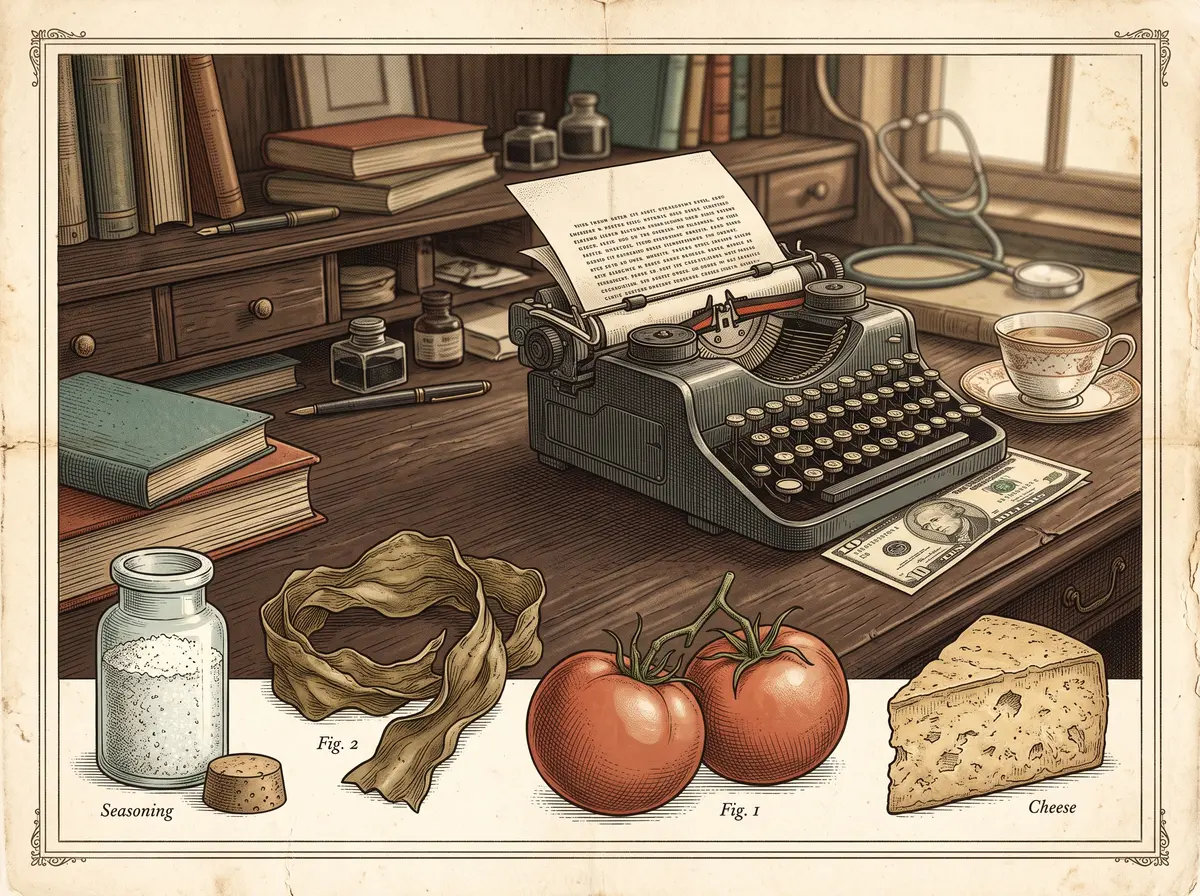
What happened: The MSG Panic a Surgeon Confessed to Starting on a $10 Bet — Over a Letter
On April 4, 1968, the New England Journal of Medicine printed a short letter from a “Robert Ho Man Kwok, MD,” at the National Biomedical Research Foundation in Silver Spring, Maryland. The writer, who said he had lived in the United States for several years, described an odd reaction he’d had when he ate at Chinese restaurants, especially ones serving northern Chinese food. About 15 to 20 minutes after the first dish, the back of his neck went numb. The numbness spread down both arms and into his back, and he felt weak and noticed his heart racing. It all faded after about two hours.
He didn’t claim to know the cause. He floated several guesses: the soy sauce (though he used the same kind at home with no trouble), the cooking wine, the high salt content, or monosodium glutamate, known as MSG, a seasoning many restaurants used generously. He ended by inviting colleagues to look into it.
The journal ran the letter under the heading “Chinese-Restaurant Syndrome.” Doctors wrote in with their own stories, and a month later the journal printed a batch of replies. Newspapers picked up the catchy name. Within a few years, MSG had become a household villain, and “No MSG” signs began appearing in restaurant windows across the country.
Fifty years later, a rhetoric researcher named Jennifer LeMesurier was studying how the phrase spread. She published a paper on it in 2017. Some time later, she got a voicemail from Howard Steel, a Colgate University graduate of the class of 1942. Steel told her, and then a reporter for Colgate Magazine, that the letter was his. His colleague, Dr. Bill Hanson, had bet him $10 that he couldn’t get published in the New England Journal of Medicine. So Steel invented a doctor, invented an institute, and chose a name that, he said, was a pun on “human crock.” The magazine ran the story in early 2019, and it spread fast.
Then the radio program This American Life went looking for Dr. Kwok, and found him. Robert Ho Man Kwok was real. He was a Maryland pediatrician and researcher who had died in 2014. The research foundation Steel claimed to have made up was real too, and Kwok had worked there. His children told producer Lilly Sullivan they were certain their father wrote the letter. A former colleague, and the son of Kwok’s old boss, said the same thing. Ho Man Kwok is also an ordinary Cantonese name, not a pun.
Steel died a few months after those interviews, at 97. Nobody can say for certain why he told the story. Even his daughter, Anna, allowed that the evidence seemed to point against him. Perhaps an old joke about a bet had blurred, over five decades, into a memory of having done it.
Why it was strange: The MSG Panic a Surgeon Confessed to Starting on a $10 Bet — Over a Letter
The story of the MSG scare is itself a story about a story that felt true. A single doctor’s personal observation, offered as a question, hardened into a named “syndrome” before anyone had tested it. Then, half a century later, the tale of how it began got its own too-good-to-check twist, and that one spread just as quickly.
Both times, the version that traveled was the one with the better punchline. And both times, the person who got lost was Dr. Kwok, a real physician who had simply described something he noticed and asked others to help figure it out.
Other popular science myths have taken a similar path: The Misplaced Decimal Point That Made Spinach Famous — and Never Existed.
What scientists learned: The MSG Panic a Surgeon Confessed to Starting on a $10 Bet — Over a Letter
MSG is the sodium salt of glutamate, an amino acid (one of the building blocks of proteins). Glutamate occurs naturally in tomatoes, aged cheeses, mushrooms, and seaweed. Around 1908, the Japanese chemist Kikunae Ikeda pulled it out of kombu, the kelp used in the soup stock called dashi. He named its savory taste “umami,” and in 1909 a seasoning he developed went on sale as Ajinomoto.
Once the panic started, researchers ran test after test. The most careful was a multicenter study published in 2000 in the Journal of Allergy and Clinical Immunology. It recruited 130 people who believed they reacted to MSG and gave them 5 grams of MSG or a placebo in a drink, without food, without telling them which. In the first round, 38.5% reacted only to MSG, but 13.1% reacted only to the placebo. When responders were retested, the results didn’t hold up. Two people reacted to MSG in every round of one stage, yet each of them reacted to only one of three MSG doses when it was given with food.
The researchers concluded that large doses of MSG taken on an empty stomach may cause more symptoms than placebo in people who believe they’re sensitive. They found no persistent or serious effects, and the reactions weren’t consistent on retesting.
How it reaches us today: The MSG Panic a Surgeon Confessed to Starting on a $10 Bet — Over a Letter
The U.S. Food and Drug Administration classifies MSG as “generally recognized as safe.” A 1990s review the FDA commissioned found that some sensitive people might get brief, mild symptoms after 3 grams or more of MSG without food. A typical serving of food with added MSG contains less than half a gram.
The myth still shapes grocery labels and menus, and the name “Chinese restaurant syndrome” has drawn criticism for pinning a vague complaint on one cuisine. Meanwhile, glutamate keeps turning up in parmesan, ketchup, and yeast extract without much fuss.
For another snack panic that refused to die, see The Fizzing Candy That Supposedly Exploded Kids’ Stomachs — and the 50,000 Letters Sent to Say It Didn’t.
If you notice symptoms you think are tied to a food, a doctor or allergist can help you work out what’s really going on.
Fun fact: The MSG Panic a Surgeon Confessed to Starting on a $10 Bet — Over a Letter
Kwok’s letter said his strange numbness was milder than his reaction to a far more ordinary substance: aspirin.
Sources: The MSG Panic a Surgeon Confessed to Starting on a $10 Bet — Over a Letter
- Robert Ho Man Kwok, “Chinese-Restaurant Syndrome”, New England Journal of Medicine 278:796, April 4, 1968.
- “The Long Fuse,” Act One, This American Life, episode 668.
- Michael Blanding, “The Strange Case of Dr. Ho Man Kwok”, Colgate Magazine, February 6, 2019 (with later editor’s note).
- R. S. Geha et al., “Multicenter, Double-Blind, Placebo-Controlled, Multiple-Challenge Evaluation of Reported Reactions to Monosodium Glutamate”, Journal of Allergy and Clinical Immunology 106(5):973–980, 2000.
- U.S. Food and Drug Administration, “Questions and Answers on Monosodium Glutamate (MSG)”.