The Super Ball: The Kids' Toy That Named the Super Bowl — and Baffled Physicists Under a Table
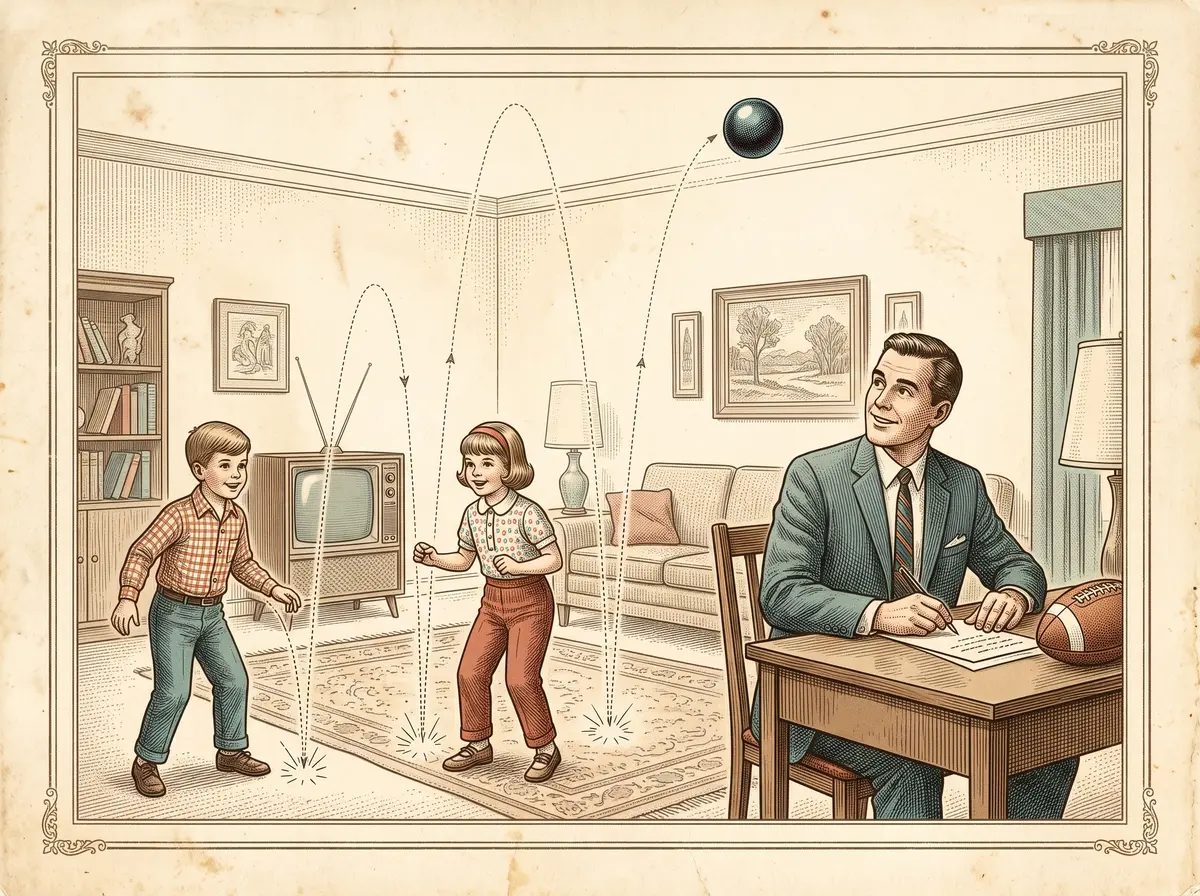
In the summer of 1966, the owner of the Kansas City Chiefs had a problem: pro football was about to stage its first championship between two rival leagues, and the game didn't have a catchy name. Lamar Hunt's children, meanwhile, were bouncing a little black ball around the house that leapt back almost as high as it was dropped. On July 25, Hunt wrote to the commissioner of the National Football League that he had "kiddingly" been calling the game the "Super Bowl." The joke stuck. The ball that inspired it had been on sale for barely a year.
By the Curiosities Desk · · 5 min read · Filed under Physics · Today’s round
What happened: The Super Ball: The Kids' Toy That Named the Super Bowl — and Baffled
The ball began with a chemist named Norman Stingley. In 1964, while experimenting with polybutadiene, a hard synthetic rubber used mostly in tires, he found a recipe that produced something unusually springy. Most accounts say he first offered it to his employer, the Bettis Rubber Company of Whittier, California, which turned it down because the material was too fragile and tended to break apart.
Stingley took it instead to Wham-O, the California toy company that had already made fads out of the Hula Hoop and the Frisbee. Wham-O agreed to make it if he could make it tougher. According to Wham-O’s own history, co-founder Arthur “Spud” Melin was intrigued but unconvinced until he saw what the company calls the “Table Trick”: throw the ball at the floor so it bounces up under a table, and instead of continuing away from you, it comes back toward you.
Stingley reworked the formula. His patent, filed on August 25, 1965, and granted on March 22, 1966, describes a solid sphere of polybutadiene cured with an unusually large dose of sulfur, the ingredient that links rubber’s long molecules together in a process called vulcanization. The patent’s preferred recipe adds hydrated silica as a filler, plus zinc oxide and stearic acid, and molds the ball at about 320 °F (160 °C) and 1,000 pounds per square inch. Popular retellings often say 3,500 psi; the patent itself gives a range of roughly 500 to 3,000. Wham-O marketed the material under a space-age name, “Zectron,” and the product as the Super Ball.
It went on sale in 1965 for 98 cents, and it took off. By December 1965 more than six million had been sold, and production peaked at around 170,000 balls a day. Wham-O later estimated that more than 20 million were sold between 1965 and 1970. Its executives boasted that each bounce was 92 percent as high as the last.
The company was also fond of stunts. The most famous one involves a giant Super Ball, roughly the size of a bowling ball, dropped from the 23rd floor of a hotel — in most tellings, in Australia — that supposedly wrecked a parked convertible on its second bounce. Wham-O’s own history calls a version of this story possibly apocryphal, so it’s best enjoyed as legend.
Which brings us back to Lamar Hunt. His wife, Norma, had bought Super Balls for their children. When Hunt, founder of the American Football League, needed a name for the planned championship against the NFL, the toy was on his mind. “Subconsciously, I may have been thinking about the Super Ball,” he later said. NFL Commissioner Pete Rozelle reportedly disliked the nickname; one former league publicity director said Rozelle thought “super” was a lightweight word, like “neat” or “gee-whiz.” The first two games were officially the “AFL-NFL World Championship Game.” But newspapers and fans kept saying “Super Bowl,” and the name became official with Super Bowl III in January 1969.
Why it was strange: The Super Ball: The Kids' Toy That Named the Super Bowl — and Baffled
Toys usually borrow their names from big events, not the other way around. Here, a 98-cent fad ended up naming one of the most-watched sporting events on Earth, through a dad’s offhand joke in a business letter he expected to be “improved upon.”
The physics was strange, too. A ball that bounces back to nearly its full height feels like it’s breaking a rule. And the Table Trick seems to break a different one: the ball appears to reverse course on its own, as though it remembers where it came from.
Another toy that turned simple physics into a national obsession is The Slinky: The Walking Spring That Fell Off a Navy Workbench.
What scientists learned: The Super Ball: The Kids' Toy That Named the Super Bowl — and Baffled
Physicists measure bounciness with a number called the coefficient of restitution: how fast an object leaves a collision compared with how fast it arrived. A perfectly elastic ball, which loses no energy, scores 1. Measurements in physics journals put a Super Ball at roughly 0.8 to 0.85 on hard surfaces, which is why it seems to defy gravity on the rebound. The heavy sulfur cross-linking is the reason. The tightly tied-together polymer chains spring back quickly instead of sliding past each other and wasting the impact energy as heat.
The Table Trick took a serious physicist to explain. In 1969, Richard Garwin of IBM published “Kinematics of an Ultraelastic Rough Ball” in the American Journal of Physics. He used the Super Ball as a cheap, real-world stand-in for an idealized ball that is both very bouncy and very grippy. Because the surface grips instead of skidding, each bounce trades motion between the ball’s spin and its forward travel, and the spin flips direction. Garwin showed that after three collisions, with the floor, the underside of a table, and the floor again, such a ball heads back toward the hand that threw it. Physics teachers still use the Super Ball to show that bounces depend on spin and friction, not just on how hard you throw.
The toy fits neatly on The Ordinary Object With the Strange Origin.
How it reaches us today: The Super Ball: The Kids' Toy That Named the Super Bowl — and Baffled
Every February, more than 100 million viewers tune in to a game named, in part, after a child’s toy. The original isn’t lost, either: a Hunt family Super Ball has been displayed in a Chiefs exhibit alongside a note from Wham-O to Hunt.
The toy itself never really went away. Wham-O revived it in the late 1970s and again in 1998, and cheap high-bounce balls in gumball machines are its direct descendants. In physics classrooms, the Super Ball remains a go-to demonstration of elastic collisions and spin.
For another Wham-O-era toy with a surprising backstory, see The Frisbee Salesmen Who Charged a Dollar for an Invisible Wire.
Fun fact: The Super Ball: The Kids' Toy That Named the Super Bowl — and Baffled
The physicist who wrote the definitive paper on how a Super Ball bounces under a table, Richard Garwin, was the same scientist who had drawn up the working design for the first hydrogen bomb test in 1952.
Sources: The Super Ball: The Kids' Toy That Named the Super Bowl — and Baffled
- US Patent 3,241,834: Highly Resilient Polybutadiene Ball — Norman H. Stingley, assigned to Wham-O; filed 1965, issued 1966 (primary source: composition, molding conditions, resilience)
- Gridiron Glory at Union Station: From Super Ball to Super Bowl — Kansas City Chiefs (Hunt’s July 25, 1966 letter, Norma Hunt’s purchase, the displayed ball)
- Kinematics of an Ultraelastic Rough Ball — Richard L. Garwin, American Journal of Physics, 1969 (the under-the-table bounce)
- Super Forever — Inventors Digest (Stingley, Bettis Rubber, sales figures, patent dates)
- Why Is It Called the Super Bowl? — CBS Sports (Rozelle’s dislike of the name, Super Bowl III)