Science Through Time · Medicine
From a King's Gout Chair to a Folding Frame Built in a Garage: A Short History of the Wheelchair
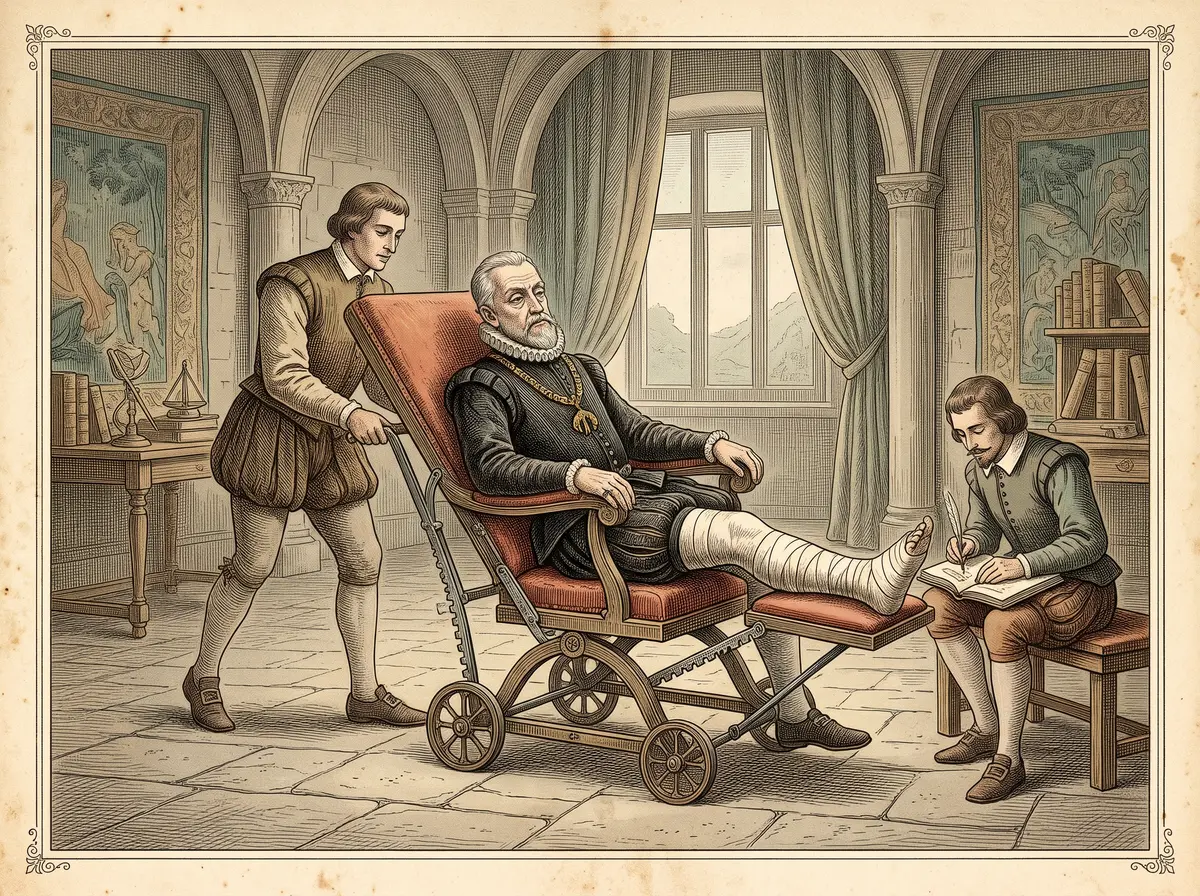
Around 1595, King Philip II of Spain ruled an empire that stretched across four continents, and gout had made it hard for him to cross his own room. So his court built him a chair with four little wheels, a back that tilted down until it became a bed, and a footrest that rose to meet his swollen legs. A servant pushed. The king's valet drew it in his memoir and gave it a plain, honest name: the "chair for the gout."
By the Curiosities Desk · · 5 min read · Filed under Medicine · Today’s round
What happened: The Wheelchair
People were wheeling the sick and injured around long before anyone wrote down a design. A carving on a Chinese stone sarcophagus from around 525 CE is often cited as the oldest picture of a person seated in a wheeled chair, though almost nothing is known about who sat in it or why. In medieval and Renaissance Europe, the usual answer was a wheelbarrow.
Philip II’s chair is the first one documented in real detail. Our best picture of it comes from Jehan Lhermite, a Flemish gentleman who served the king as a valet of the chamber and kept an illustrated memoir of court life. His drawing shows a padded seat on four small wheels, with a reclining back and a raised rest for the king’s legs. Notched metal bars held the back at different angles, so the king could sit up to read his papers or lie flat to sleep. Philip had suffered from gout since the 1580s, and by the 1590s it had spread to his hands. In the summer of 1598, a few months before he died, he was carried from Madrid to his palace at El Escorial in a wheeled chair.
The king’s chair had one big limitation. Someone else had to push it. Sixty years later, a young man in Bavaria fixed that. Stephan Farffler was born in 1633 in Altdorf, near Nuremberg. According to the 18th-century Nuremberg historian Johann Gabriel Doppelmayr, a childhood accident left him unable to use his legs. Farffler became a clockmaker, and in 1655, at about 22, he built himself a sturdy wooden chair on a three-wheeled frame. He drove it by turning hand cranks connected through gears to a toothed front wheel. It was, in effect, a hand-powered tricycle, usually counted as the first wheelchair its rider could move alone. An engraving published around 1730 shows him in his 50s, still sitting in it.
The next leap happened in a spa town. From the mid-1700s, sick and disabled visitors poured into Bath, England, to drink and soak in its mineral waters. Rented wheeled chairs became part of the scenery. The design that won out, usually credited to a local maker named John Dawson around 1783, had two wheels under the seat and a small pivoting wheel in front. The rider steered with a long curved handle, while an attendant pushed from behind. (Some histories name an earlier Bath maker, James Heath, so the “inventor” title is shared.) “Bath chairs” spread across Britain. The Science Museum Group still has one made for Queen Victoria in 1893.
In the United States, Civil War hospitals used heavy wooden “invalid chairs” on carriage-style spoked wheels, some with hand rims riders could push themselves. Through the late 1800s, patents added wicker seats, iron and then rubber tires, and better hand rims. But the chairs stayed bulky. They worked in a house or a ward, and not much farther.
That’s the problem Herbert Everest ran into. A mining engineer, he was paralyzed in a mining accident (usually dated to 1918) and found the wheelchairs of the time clunky and confining. In the early 1930s he complained about it to his friend Harry Jennings, a mechanical engineer. In 1933, the two built a lighter chair out of metal tubing in Jennings’s garage in Los Angeles. Its side frames were joined by crossed braces under a fabric seat, so the whole chair folded flat, narrow enough to slide into a car. They filed for a patent in 1936. U.S. Patent 2,095,411, “Folding Wheel Chair,” was granted on October 12, 1937.
Why it was strange: The Wheelchair
For most of history, the wheelchair was built for whoever pushed it, not for whoever sat in it. Philip II’s chair was a moving bed. Bath chairs were essentially rickshaws for invalids, steered from the seat but powered by a hired attendant.
The people who changed that were mostly people who used the chairs themselves. Farffler built his for himself. Everest wanted a chair he could load into a car and take to work. Other inventions with a winding road are on the shelf of From the First Spark to the Thing You Still Use.
What scientists learned: The Wheelchair
Each design solved a mechanics problem. Farffler’s cranks and gears used leverage, the principle that a small push on a long handle produces a stronger turn at the wheel. That let his arms do work his legs couldn’t. The Bath chair’s pivoting front wheel, a caster, made a heavy chair easy to steer.
Everest and Jennings’s patent shows how carefully they thought about real ground. The two side frames were joined loosely, so the chair could twist slightly over bumps and keep both drive wheels on the ground. The fabric back could come off, so a rider could slide in from behind. The cross-brace folding frame they patented is often called the “X-frame,” and it has barely changed in nearly 90 years. A noisier ancestor of the self-propelled chair appears in The Inventor Who Roller-Skated Into a Masquerade Playing the Violin — and Forgot to Invent the Brakes.
How it reaches us today: The Wheelchair
The folding chair turned a piece of hospital furniture into a way of getting around. Everest & Jennings dominated the American market for decades. In 1943, John Counsel of the Canadian Paraplegic Association talked Canada’s government into buying 200 of the chairs for veterans, one of the company’s largest early orders.
Today, the World Health Organization treats access to a suitable wheelchair as essential for the people who need one. Lightweight aluminum, titanium, and carbon-fiber sports chairs descend from the same idea of a chair built for the rider’s life. Another tool that kept getting smaller is traced in From a Lion-Headed Throne to the Cochlear Implant: A Short History of the Hearing Aid.
Fun fact: The Wheelchair
The first wheelchair a rider could drive alone was built by a clockmaker, using clockwork thinking: Stephan Farffler’s 1655 chair ran on hand cranks and toothed gears.
Sources: The Wheelchair
- Herbert A. Everest and Harry C. Jennings, “Folding Wheel Chair,” U.S. Patent 2,095,411 (1937), Google Patents
- Johann Gabriel Doppelmayr, Historische Nachricht von den Nürnbergischen Mathematicis und Künstlern (Nuremberg, 1730), p. 302, on Stephan Farffler
- “The History of the Wheelchair,” Science Museum Group blog
- Mary C. Slawson, “Wheelchairs through the Ages,” The Surgeon’s Call, National Museum of Civil War Medicine
- Dorothy J. Smith, “Getting Going with Everest & Jennings,” The Wheelchair in Canada exhibit, Mobility Histories