Science Through Time · Archaeology
From Horse Bones to Hinged Blades: A Short History of the Ice Skate
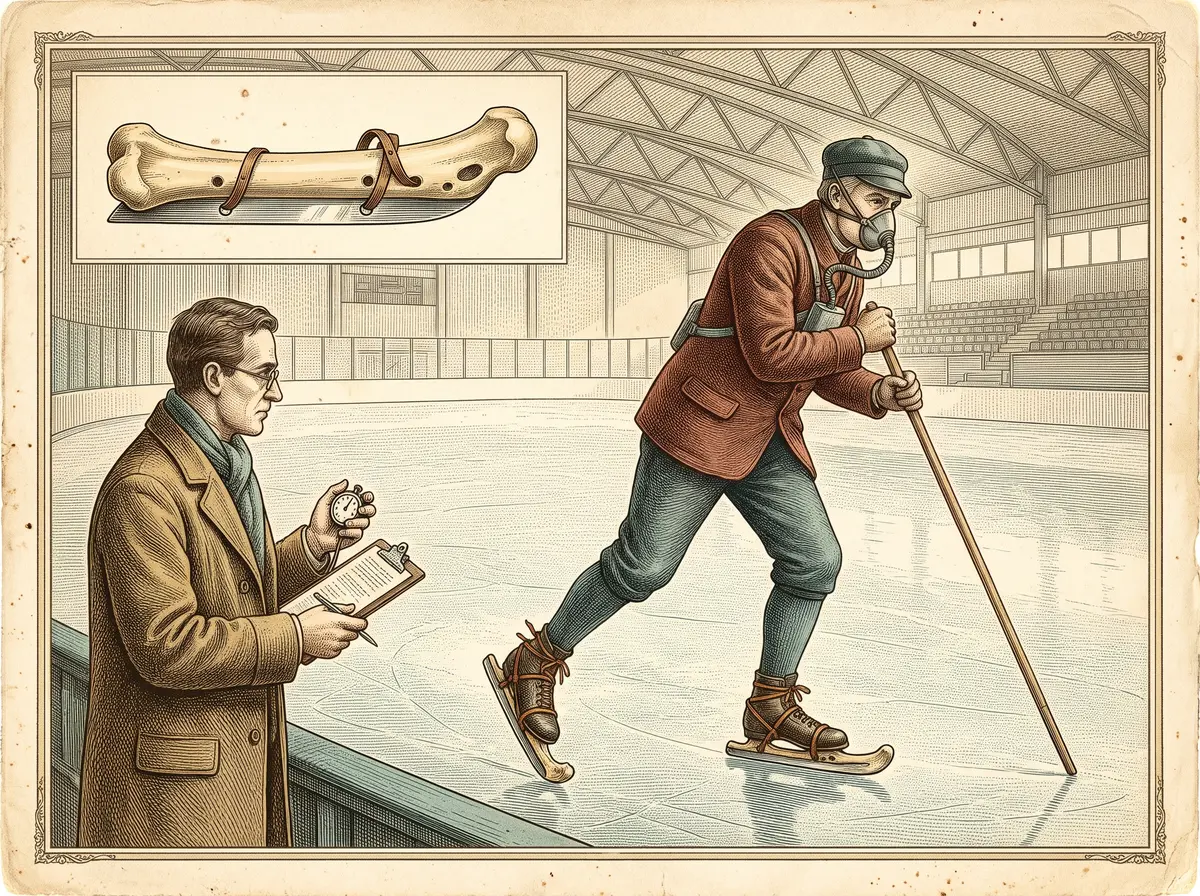
For a study published in 2007, five former professional short-track speed skaters laced up their walking boots in an indoor rink in Bormio, Italy, strapped a pair of polished horse bones to their feet, picked up a pole, and pushed off. Athletes who had once raced for a living now shuffled along at about 4 kilometers per hour, roughly a brisk walk. They said going any faster felt unsafe. Nearby, the scientists were recording every breath.
By the Curiosities Desk · · 5 min read · Filed under Archaeology · Today’s round
What happened: The History of Ice Skates
Long before anyone carved a blade, people in northern and central Europe made skates out of animal bones. A common choice was a horse’s metatarsal, the long bone between the ankle and the hoof. One side was ground flat and smooth, holes were bored through the ends for leather straps, and the skater tied it under a shoe. Bone skates turn up at sites across Europe; the oldest are often said to be around 5,000 years old, though dating many of these finds precisely is difficult.
Bone skates don’t grip the ice, so you can’t push off sideways the way modern skaters do. Instead, people stood fairly upright and shoved themselves along with a pole, a bit like cross-country skiing on two slippery sticks.
We have an eyewitness to how this looked. Around 1173, William FitzStephen, a clerk and biographer of Thomas Becket, wrote a description of London that includes winter on Moorfields, a marsh just north of the city walls. When it froze, young men tied bones to their feet and drove themselves across the ice with iron-tipped poles, moving, as the London Museum renders his words, “as fast as a flying bird or a bolt from a catapult.” Some of them also jousted. Two skaters would charge at each other from far apart, poles leveled like lances. FitzStephen reports that one or both usually fell, often with a broken arm or leg. He put it down to youth being eager for glory. The London Museum holds 12th-century bone skates from the City of London, one with its underside worn very flat from use.
Around the 13th century, a new design appeared, especially in the Low Countries: a wooden platform with a narrow iron blade set into it. A blade has an edge. An edge can bite into the ice, which means a skater can push sideways off one foot and glide on the other. That is the stride every skater uses today, and it made the pole optional. By the 14th century, wood-and-iron skates were the most common kind in the Netherlands, where frozen canals made skating a serious way to get around in winter. Steel blades followed, and much later came the boots, fiberglass, and carbon fiber of modern racing skates.
Why it was strange: The History of Ice Skates
It’s easy to assume that bone skates were a toy and that “real” skating began with metal. Federico Formenti, then at the University of Oxford, and Alberto Minetti of the University of Milan wanted numbers instead of assumptions. So they built a small time machine of footwear: real horse bones prepared for the test, plus replicas of wood-and-iron skates from about 1200 and 1400, a birch-and-steel model from about 1700, and a modern racing skate.
Their volunteers skated on each pair at a comfortable pace and a harder one, while a portable device measured oxygen use and heart rate. On bone, the skaters averaged about 1.1 meters per second, and they managed only the slow pace. On modern skates, their harder pace averaged about 6.7 meters per second, more than five times faster.
The surprise was the friction. Bone, it turned out, slides very well. In their tests, the bone skate slid more easily than the iron blade from around 1200. What held bone skaters back wasn’t drag from the ice. It was having no edge to push against.
What scientists learned: The History of Ice Skates
Formenti and Minetti reported in the Journal of Experimental Biology in 2007 that the energy needed to skate a given distance fell steadily over the centuries. Modern skating costs about a quarter of what bone skating does. At the same effort, a modern skater goes about four times as fast.
Then they asked a second question: was bone skating ever worth the trouble? Using the measurements, they simulated 240 winter journeys of 10 kilometers each across Finland, Norway, Sweden, the Netherlands, and Germany. They reported in the Biological Journal of the Linnean Society that only in southern Finland, with its dense maze of lakes, would bone skates have saved a meaningful amount of energy, about 10 percent compared with walking. Elsewhere the saving was about 1 percent. They suggested skating probably began there, as a way to cross frozen lakes instead of trudging around them. That is a reasoned hypothesis, not a proven fact; nobody has found a bone skate labeled “first.”
The question of why ice is slippery at all is older and still open. The familiar textbook answer, that the pressure of a blade melts the ice, has fallen out of favor; calculations show a skater doesn’t press nearly hard enough. In 2018, a team led by brothers Daniel and Mischa Bonn reported that ice’s surface carries loosely bound water molecules that roll around and act like a lubricant, and that ice is most slippery at about −7 °C. In 2025, researchers at Saarland University in Germany proposed that sliding itself scrambles the ice’s crystal surface into a disordered layer. Physicists are still debating how these explanations fit together.
Bone skates have a cousin on wheels, too: The Inventor Who Roller-Skated Into a Masquerade Playing the Violin — and Forgot to Invent the Brakes.
How it reaches us today: The History of Ice Skates
Every skate in a rental booth descends from that medieval edge. Engineers are still squeezing out efficiency. In the mid-1990s, long-track racers adopted the “klapskate,” a hinged blade first patented in the 1890s that stays on the ice longer during each push. Formenti and Minetti note it raised speeds by 3 to 5 percent.
The study also showed a useful method for archaeology: if you want to know how people used an ancient object, sometimes the best approach is to rebuild it, strap it on, and measure.
Archaeologists have used everyday games and gear to read the past before: From Sheep’s Ankle Bones to the Rule of Seven: A Short History of Dice.
From horse bones to carbon fiber, the ice skate belongs with the other long histories in From the First Spark to the Thing You Still Use.
Fun fact: The History of Ice Skates
Medieval London’s ice jousters didn’t always stop when they lost. FitzStephen noted that after two skaters crashed and fell, the sheer speed often carried them sliding a long way apart across the frozen marsh.
Sources: The History of Ice Skates
- Formenti, F., & Minetti, A. E. (2007). “Human locomotion on ice: the evolution of ice-skating energetics through history.” Journal of Experimental Biology 210: 1825–1833
- “Where And Why Humans Made Skates Out Of Animal Bones” — ScienceDaily (on Formenti & Minetti, Biological Journal of the Linnean Society)
- “Skate,” 12th-century bone skate and William FitzStephen’s account — London Museum
- “Why is ice slippery?” (Bonn et al., Journal of Physical Chemistry Letters, 2018) — ScienceDaily
- “Why Is Ice Slippery? A New Hypothesis Slides Into the Chat” — Quanta Magazine