Science Through Time · Archaeology
From a Comb Carved With a Plea Against Lice to Nit Glue That Saved a Mummy's DNA: A Short History of the Lice Comb
In December 2021, Madeleine Mumcuoglu was photographing a small, battered ivory comb from Tel Lachish in Israel, an object excavated five years earlier, when she noticed tiny scratches on it. They turned out to be letters, each only 1 to 3 millimeters wide. Once deciphered, the 17 letters became one of the oldest complete sentences known in the alphabet, and it was not a prayer to a god or a king's boast. It was about lice: "May this tusk root out the lice of the hai[r and the] beard."
By the Curiosities Desk · · 5 min read · Filed under Archaeology · Today’s round
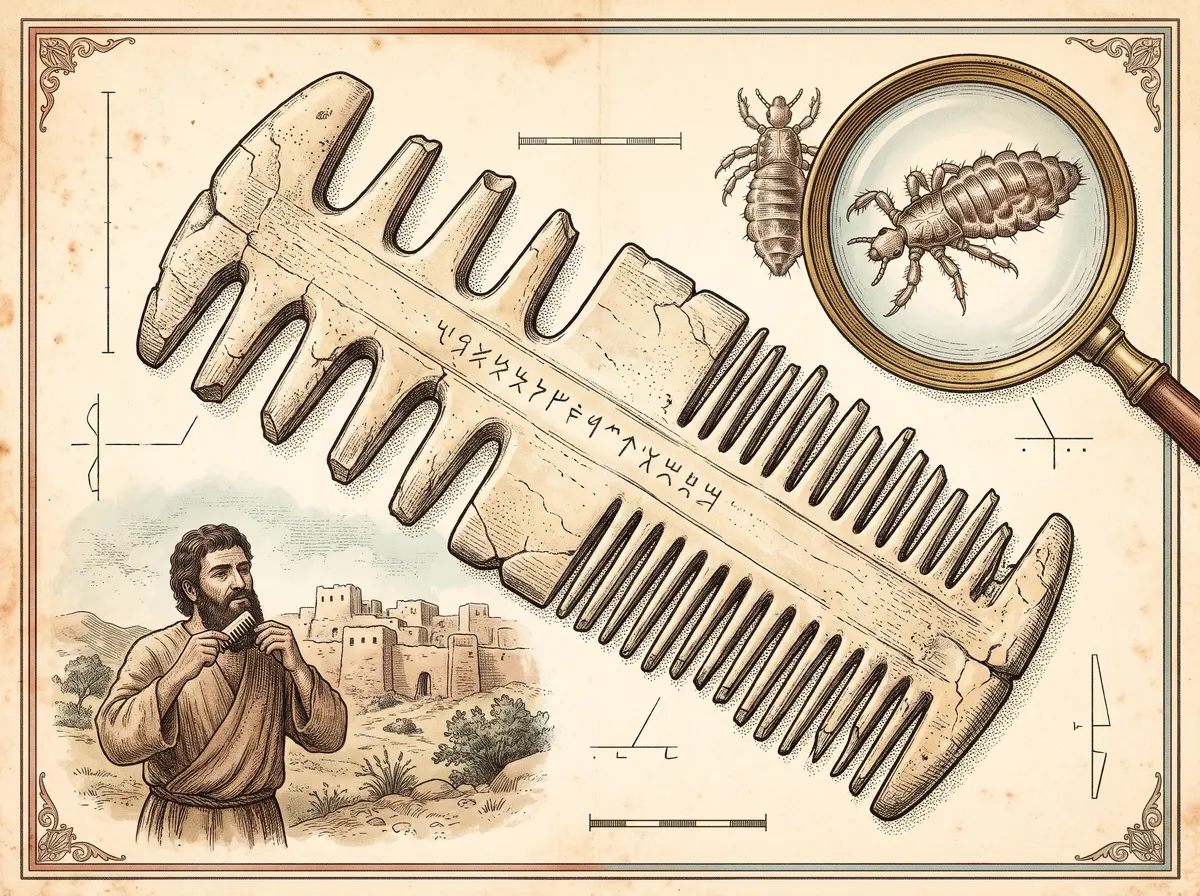
What happened: The Lachish Lice Comb
The Lachish comb, published in 2022 in the Jerusalem Journal of Archaeology by epigrapher Daniel Vainstub and colleagues, is about 3.5 centimeters wide, smaller than a matchbox. Like most combs of its era, it is double-sided: six thick teeth on one side for untangling, and 14 fine teeth on the other for the real work of dragging out lice and their eggs. All the teeth were broken in antiquity, but their stumps remain.
It is made of elephant ivory, a luxury in Canaan, which had no elephants of its own; the material was likely imported, probably through Egypt. The team couldn’t radiocarbon-date it, because too little carbon survived, and it was found in a pit filled roughly a thousand years after it was made. So its date, around 1700 BCE, rests mainly on the shapes of its letters. The authors argue the inscription is the first “complete reliable sentence in a Canaanite dialect,” written in the early alphabet that would eventually give rise to the Phoenician, Hebrew, Greek, and Latin scripts.
Then came the second surprise. Under a digital microscope, the researchers found remains of a head louse on the comb’s second tooth: the empty outer shell of a nymph, a young louse, just 0.5 to 0.6 millimeters long. Roughly 3,700 years later, the comb had done exactly what its owner asked.
Lice on old combs were not a new idea. In a 1988 study in the Journal of Medical Entomology, parasitologist Kosta Mumcuoglu and archaeologist Joseph Zias examined 24 combs from the Judean and Negev deserts, dating from the first century BCE to the eighth century CE. Twelve of them still held lice or louse eggs, known as nits, trapped between the teeth. As far as the authors knew, they were the oldest head lice yet found on personal combs.
Lice were a constant of ancient life, and people fought back. Writing in the fifth century BCE, the Greek historian Herodotus reported that Egyptian priests shaved their entire bodies every other day so that no lice would be on them while they served the gods. Most people couldn’t keep up that routine, so they combed.
Why it was strange: The Lachish Lice Comb
We tend to picture the earliest writing as grand: laws, kings, gods, battles. The oldest full sentence in this alphabet, at least among those found so far, is closer to a label on a pharmacy shelf. Someone paid for imported ivory and then had it engraved with a wish about personal grooming. It is a reminder that writing has always served ordinary worries as well as big ones.
It is also strange that the pest outlasted almost everything else. Ivory decays, carbon fades, and the comb lost every tooth, yet a sliver of louse shell less than a millimeter long survived to be photographed.
People have been reading the remains of ordinary bodies in ancient artifacts for years; see The 5,700-Year-Old Chewing Gum That Held an Entire Human Genome.
What scientists learned: The Lachish Lice Comb
Lice turn out to be excellent record keepers. A female head louse glues each egg to a hair with a protein-based cement, which hardens into a tight sleeve. In 2021, a team led by Mikkel Pedersen and Alejandra Perotti reported in Molecular Biology and Evolution that this glue traps skin cells from the person whose hair it is. Working with nits from mummified people buried in the Calingasta caves of San Juan Province, Argentina, roughly 1,500 to 2,000 years ago, they recovered genome-wide human DNA from the cement.
The glue preserved DNA surprisingly well. The team found it yielded about as much human DNA as a tooth and about twice as much as the petrous bone, the dense part of the skull that ancient-DNA researchers usually prefer. The DNA suggested ancestry from northwest Amazonia, and one person carried the oldest known trace of Merkel cell polyomavirus, a common skin virus. The team even suggested that some nits glued unusually close to the scalp might mean those individuals were exposed to bitter cold near death, since lice lay eggs closer to warm skin when it’s cold. That last point is an interpretation, not a certainty.
Lice also help date human habits. Body lice live in clothing, not hair, so they could only evolve after people started dressing. In 2011, Melissa Toups, David Reed, and colleagues compared louse DNA and estimated that body lice split from head lice around 170,000 years ago, and probably no later than about 83,000 years ago. The uncertainty is wide, but it implies modern humans in Africa were wearing clothes before they spread into colder parts of the world.
The study of past diseases has also leaned on humbler objects; see The 2,000-Year-Old Toilet Sticks That Proved the Silk Road Spread Disease.
How it reaches us today: The Lachish Lice Comb
The fine-toothed comb never went away. In 2005, a randomized trial in the BMJ led by Nigel Hill followed 133 young people aged 2 to 15 with head lice. Those who wet-combed with a fine-toothed “Bug Buster” kit were cured 57 percent of the time, compared with 13 percent for over-the-counter insecticide treatments, which made the plain comb about four times as effective. Health services still recommend careful combing of wet, conditioned hair as one option for treating lice.
So the tool in a modern nit kit does the same job as the Lachish comb: thin teeth, patience, and a strong wish to be rid of them.
From ancient ivory to plastic nit combs, this story sits with the other long histories in From the First Spark to the Thing You Still Use.
Fun fact: The Lachish Lice Comb
Lachish has produced 10 inscriptions in the early Canaanite alphabet, more than any other site in Israel. Of all of them, the one that spells out a complete sentence is the one about lice.
If lice show up in your household, it’s common and isn’t a sign of poor hygiene. A pharmacist or doctor can help you choose a treatment.
Sources: The Lachish Lice Comb
- Vainstub, D., Mumcuoglu, M., et al. (2022). “A Canaanite’s Wish to Eradicate Lice on an Inscribed Ivory Comb from Lachish.” Jerusalem Journal of Archaeology 2: 76–119
- “First Sentence Ever Written in Canaanite Language Discovered” — Hebrew University of Jerusalem via ScienceDaily
- Pedersen, M. W., et al. (2021). “Ancient Human Genomes and Environmental DNA from the Cement Attaching 2,000-Year-Old Head Lice Nits.” Molecular Biology and Evolution
- Toups, M. A., Kitchen, A., Light, J. E., & Reed, D. L. (2011). “Origin of Clothing Lice Indicates Early Clothing Use by Anatomically Modern Humans in Africa.” Molecular Biology and Evolution
- Hill, N., et al. (2005). “Single blind, randomised, comparative study of the Bug Buster kit and over the counter pediculicide treatments against head lice in the United Kingdom.” BMJ 331: 384