Weird Medical History · Archaeology
The 2,000-Year-Old Toilet Sticks That Proved the Silk Road Spread Disease
Two thousand years ago, at a desert rest stop on the Silk Road, someone finished up in the latrine and reached for the ancient equivalent of toilet paper: a wooden stick with a scrap of cloth wrapped around one end. They tossed it away and moved on. Twenty centuries later, that used stick landed under a microscope at the University of Cambridge — and the dark crust still clinging to its cloth gave archaeologists something they had been looking for: proof that the world's most famous trade route carried not just silk and ideas, but disease.
By the Curiosities Desk · · 5 min read · Filed under Archaeology · Today’s round
Part of Medicine, Before It Was Sure
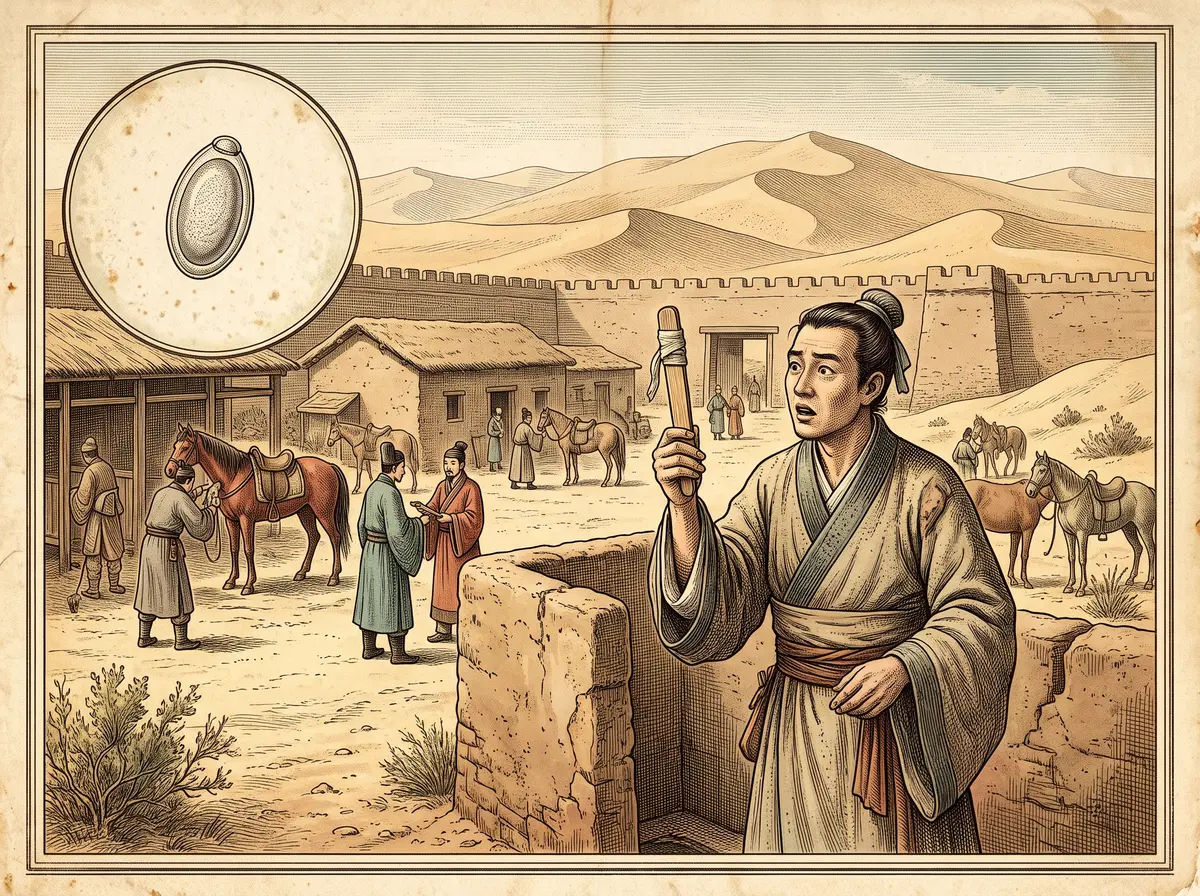
What happened: The 2,000-Year-Old Toilet Sticks That Proved the Silk Road Spread Disease
The rest stop was Xuanquanzhi, an official relay station near the oasis of Dunhuang in what is now Gansu Province, northwestern China. It sat on the eastern edge of the Tarim Basin, a dry region bordering the Taklamakan Desert. Built in 111 BC under the Han dynasty, it stayed in use until about AD 109.
Xuanquanzhi worked something like a cross between a post office and a highway motel. Travelers stayed the night, and government officials stopped to change horses and pass along letters. It was busy and well-documented. When the Gansu Provincial Institute of Cultural Relics and Archaeology excavated the site between 1990 and 1992, it recovered more than 70,000 objects, including written records on strips of wood and bamboo, silk, paper, tools, and animal bones. In 2014 the station became part of a UNESCO World Heritage listing for the Silk Roads.
Among the less glamorous finds from the latrine were the sticks. Each was a length of wood with cloth wrapped around one end, and Chinese texts from the period describe sticks like these being used to wipe after going to the toilet. Some still had dark material stuck to the cloth.
Archaeologists Ruilin Mao and Hui Wang, from the Gansu institute, teamed up with Hui-Yuan Yeh and Piers Mitchell of the University of Cambridge to take a closer look. Under a high-powered microscope, the dark material turned out to be exactly what everyone suspected: ancient human feces. And it held something more interesting than dirt.
Intestinal worms shed eggs that leave the body in feces, and those eggs are tough enough to survive thousands of years in the ground. The team identified eggs from four species: roundworm, whipworm, a tapeworm of the genus Taenia, and the Chinese liver fluke, Clonorchis sinensis.
The first three were no great surprise. Roundworm and whipworm spread through food or hands contaminated with feces, and Taenia tapeworms come from eating undercooked meat. They could have been picked up almost anywhere.
The liver fluke was different. “When I first saw the Chinese liver fluke egg down the microscope I knew that we had made a momentous discovery,” Yeh said when the study was published in July 2016 in the Journal of Archaeological Science: Reports.
Why it was strange: The 2,000-Year-Old Toilet Sticks That Proved the Silk Road Spread Disease
The Chinese liver fluke cannot live in a desert. To complete its life cycle it needs well-watered, marshy country: its eggs must reach fresh water, infect a particular kind of snail, and then move into freshwater fish. People catch it by eating that fish raw or undercooked.
There is no such marshland around Dunhuang. According to the researchers, the nearest region where the fluke is found today is about 1,500 kilometers (roughly 930 miles) away, and the province where it is most common, Guangdong, is about 2,000 kilometers away. So whoever used that stick had almost certainly caught the parasite somewhere far wetter and then carried it, inside their own body, across a large part of China to a desert latrine.
Historians had long assumed that the Silk Road spread infections. It is often suggested as a route for plague, leprosy, and anthrax. But assumptions aren’t evidence. “Until now there has been no proof that the Silk Road was responsible for the spread of infectious diseases,” Mitchell said. The study’s authors describe their result as the earliest archaeological evidence of travelers carrying infectious disease along the route. It’s an odd sort of proof: a single traveler’s bad luck, preserved on a single bit of cloth.
For more on how people have dealt with their waste over the centuries, see From a Sponge on a Stick to the Flush Toilet: A Short History of the Toilet.
What scientists learned: The 2,000-Year-Old Toilet Sticks That Proved the Silk Road Spread Disease
The study is a showcase for paleoparasitology, the study of parasites from the past. Parasite eggs are small, hardy, and often shaped distinctively enough that a trained eye can identify the species. The liver fluke egg from Xuanquanzhi measured about 29 by 16 micrometers (thousandths of a millimeter). Because these eggs survive where soft tissue doesn’t, latrines, cesspits, and even used hygiene sticks can work as records of who was sick and where they had been.
The finding also hints at who traveled the road. The authors suggest the infected person may have come from eastern or southern China on trade or government business. Since Xuanquanzhi was an official relay station, that fits: the Silk Road was not only a highway for merchants, but a working network of messengers, officials, and envoys, any of whom could carry a parasite thousands of kilometers.
Latrine archaeology has cracked other cases, too: see The Founding Father’s Laxative That Found Lewis and Clark’s Toilet.
How it reaches us today: The 2,000-Year-Old Toilet Sticks That Proved the Silk Road Spread Disease
The Chinese liver fluke is still with us. The World Health Organization lists clonorchiasis, the disease it causes, as a neglected tropical disease. Long-term infection inflames and damages the bile ducts, and it is linked to cholangiocarcinoma, a deadly cancer of the bile ducts. It is treatable with the drug praziquantel and preventable by cooking freshwater fish thoroughly and keeping human waste out of fish ponds and waterways.
The bigger lesson is one the modern world keeps relearning. Wherever people travel, their microbes and parasites travel with them. Airplanes now do in hours what took Han dynasty travelers weeks, and public-health agencies track how diseases move along trade and travel routes. The stick at Xuanquanzhi is a 2,000-year-old reminder that this is not a new problem, just a faster one.
The Xuanquanzhi study is one of many where a dig turned up a medical story: see The 3,000-Year-Old Wooden Toe Scientists Test-Drove in Replica Egyptian Sandals.
A latrine stick that carried a diagnosis belongs with the other uncertain medicine in Medicine, Before It Was Sure.
Fun fact: The 2,000-Year-Old Toilet Sticks That Proved the Silk Road Spread Disease
The liver fluke egg that proved the Silk Road carried disease was about 29 micrometers long — less than half the width of a typical human hair.
If you’re worried about parasites or digestive symptoms after travel or eating raw fish, a doctor can test for them; most are easy to treat.
Sources: The 2,000-Year-Old Toilet Sticks That Proved the Silk Road Spread Disease
- H.-Y. Yeh, R. Mao, H. Wang, W. Qi, and P. D. Mitchell, “Early evidence for travel with infectious diseases along the Silk Road: Intestinal parasites from 2000 year-old personal hygiene sticks in a latrine at Xuanquanzhi Relay Station in China,” Journal of Archaeological Science: Reports 9 (2016) — the primary study (open-access copy).
- University of Cambridge, “Ancient faeces provides earliest evidence of infectious disease being carried on Silk Road,” July 22, 2016.
- Piers Mitchell, “How we discovered infectious diseases in 2,000-year-old faeces from the Silk Road,” University of Cambridge.
- “Reviving the glory of millennia-old posthouse ruins in Dunhuang,” China Daily, August 9, 2023 — excavation history and finds at Xuanquanzhi.
- World Health Organization, “Neglected tropical diseases: Clonorchiasis.”