The Founding Father's Laxative That Found Lewis and Clark's Toilet
In the summer of 2002, archaeologists in western Montana went looking for the most famous camping trip in American history. They didn't find it with a journal entry or a carved signature. They found it by testing old dirt for mercury, a chemical fingerprint left behind by a Founding Father's favorite laxative, nearly two centuries after the Corps of Discovery stopped there to use the latrine.
By the Curiosities Desk · · 5 min read · Filed under Medicine · Today’s round
What happened: The Founding Father's Laxative That Found Lewis and Clark's Toilet
In 1803, President Thomas Jefferson sent Meriwether Lewis to Philadelphia to cram for a cross-continent expedition with the young nation’s best scientific minds. One was Dr. Benjamin Rush, signer of the Declaration of Independence and America’s most famous physician.
Letters record Lewis meeting Rush on May 17, 1803. On June 11, Rush wrote out a short list of “rules” for keeping the expedition healthy. Some were sensible enough: wear flannel, wash your feet in cold water every morning, go easy on the liquor. But the first two were about bowels. At the first sign of illness, Rush advised gently “opening the bowels” with “one, two or more of the purging pills.” And because he believed that “unusual costiveness” (constipation) was often a warning of approaching disease, the pills were the answer to that, too.
The pills were Rush’s own formula, sold as Dr. Rush’s Bilious Pills. Despite the name, they were meant to drive out supposed excess bile. Each dose reputedly held about 10 grains of calomel (mercury chloride, a mercury compound then used as a powerful purgative) plus 10 to 15 grains of jalap, a plant-based laxative. Lewis packed 50 dozen of them: 600 pills. Later writers nicknamed them “Rush’s Thunderbolts,” a name that, according to the historians at Discovering Lewis & Clark, came long after the expedition, not from the men who swallowed them.
The Corps of Discovery lived on a diet that was mostly meat (by one National Park Service estimate, roughly nine pounds a day per person), and constipation was a constant complaint. Both captains handed out purges freely, and Lewis dosed himself on the way down the Ohio River.
In September 1805, the expedition camped for several days beside Lolo Creek, south of present-day Missoula, Montana, resting before a brutal crossing of the Bitterroot Mountains. The spot became known as Travelers’ Rest. They camped there again on the way home, from June 30 to July 3, 1806.
Two centuries later, nobody knew exactly where on the creek they had camped. The journals record more than 600 stopping places along the route, by one Smithsonian count, and only a handful have ever been physically confirmed.
Travelers’ Rest was different because historians had a hunch about how the camp was laid out. Lewis and Clark were former Army officers, and the U.S. Army of their day organized camps according to Baron von Steuben’s military regulations, a manual that spelled out where the fires, tents, and latrine (the “sink”) should go. If you could find one piece of the camp, the manual told you where to look for the others.
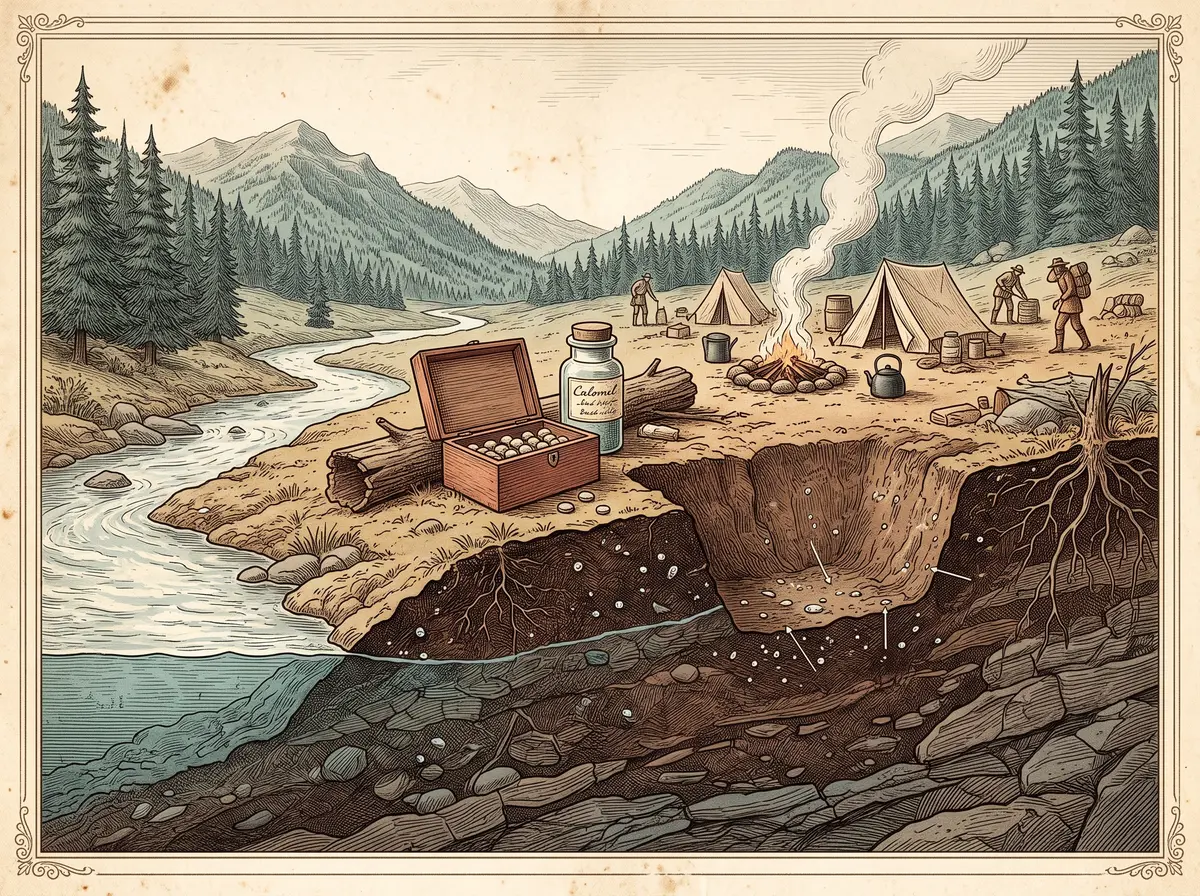
After years of narrowing by local researchers, historical archaeologist Dan Hall’s team surveyed the area with magnetometers, which detect tiny disturbances in the ground’s magnetism, and excavated in the summer of 2002. They found a hearth that radiocarbon dating placed between 1785 and 1855, a puddle of melted lead near it (likely from gun repairs), a military button, and a blue trade bead. And, where von Steuben’s layout said it should be, a shallow trench.
Mercury doesn’t break down, and much of a calomel dose passes straight through the body. The team tested 214 soil samples from the trench for mercury vapor; 27 came back positive, at depths of roughly 22 to 29 inches. Something in that trench had been laced with the expedition’s medicine.
Why it was strange: The Founding Father's Laxative That Found Lewis and Clark's Toilet
Because the clue that finally pinned down the Corps of Discovery was a medical mistake.
Rush was no quack by the standards of his time; he was a celebrated professor and reformer. But he practiced what historians now call “heroic medicine”: aggressive bleeding and purging, pushed to extremes, most famously during Philadelphia’s yellow fever epidemic of 1793. Calomel didn’t cure the illnesses it was given for, and mercury is a poison that can damage the kidneys and nervous system.
The expedition carried a medicine that probably did more harm than good, and that harm proved remarkably durable. A tent leaves no trace. A trench full of mercury-dosed waste is still chemically readable 200 years later.
Rush’s purges belong to a long line of cures that outlasted their evidence, like The Everlasting Pill That Families Fished Out of the Chamber Pot and Passed Down.
What scientists learned: The Founding Father's Laxative That Found Lewis and Clark's Toilet
The physicians of Rush’s day believed many illnesses came from an imbalance or buildup in the body that had to be forced out, through the bowels, the veins, or the stomach. Mercury compounds were valued precisely because they produced dramatic effects: heavy purging and, at higher doses, drooling, which doctors read as proof the treatment was working. In fact those were signs of poisoning. As medicine began testing treatments against outcomes rather than theory, calomel fell out of favor.
For archaeologists, the lesson ran the other way. Travelers’ Rest showed that chemistry can find what shovels can’t. Mercury in soil works as a marker of human activity because it is rare in that setting and stays put for centuries. Combined with the military manual, radiocarbon dates, and that melted lead, it turned a hunch into physical proof.
For another remedy that turned out to be the hazard, see The Radioactive Tonic That Dissolved a Millionaire’s Jaw.
How it reaches us today: The Founding Father's Laxative That Found Lewis and Clark's Toilet
The campsite is now Travelers’ Rest State Park, a National Historic Landmark where visitors can stand near the excavated camp and read about the latrine that helped confirm it.
Researchers have suggested that other expedition campsites might be found the same way, by testing for the mercury the men left behind.
Calomel, meanwhile, has long vanished from medicine cabinets, and the international Minamata Convention now works to phase mercury out of everyday products.
Rush’s faith in bleeding had cousins across the Atlantic, as The Doctor Who Prescribed 30 Leeches for Everything — and the Paris Dresses Embroidered in His Honor shows.
Fun fact: The Founding Father's Laxative That Found Lewis and Clark's Toilet
Of the 214 soil samples taken from the Travelers’ Rest trench, only 27 tested positive for mercury, and those 27 were enough to help put the expedition’s camp on the map.
Mercury is still toxic today. If you break an old mercury thermometer or think someone has been exposed, don’t vacuum it up; call Poison Control (1-800-222-1222 in the U.S.) for guidance.
Sources: The Founding Father's Laxative That Found Lewis and Clark's Toilet
- Benjamin Rush, “Dr. Rush to Capt. Lewis for preserving his health,” June 11, 1803 (Jefferson’s copy of the original), via Discovering Lewis & Clark.
- Discovering Lewis & Clark, “Rush’s Bilious Pills” and “Philadelphia Meeting”.
- National Park Service, “Historic Latrines Help Archeologists Retrace the Lewis and Clark Trail”.
- Historic Montana (Montana Historical Society), “Travelers’ Rest”.
- “How to Reconstruct Lewis and Clark’s Journey? Follow the Mercury-Laden Latrine Pits,” Smithsonian.