The 20 Beavers Argentina Flew to the End of the World to Start a Fur Trade — Who Built 70,000 Dams Instead
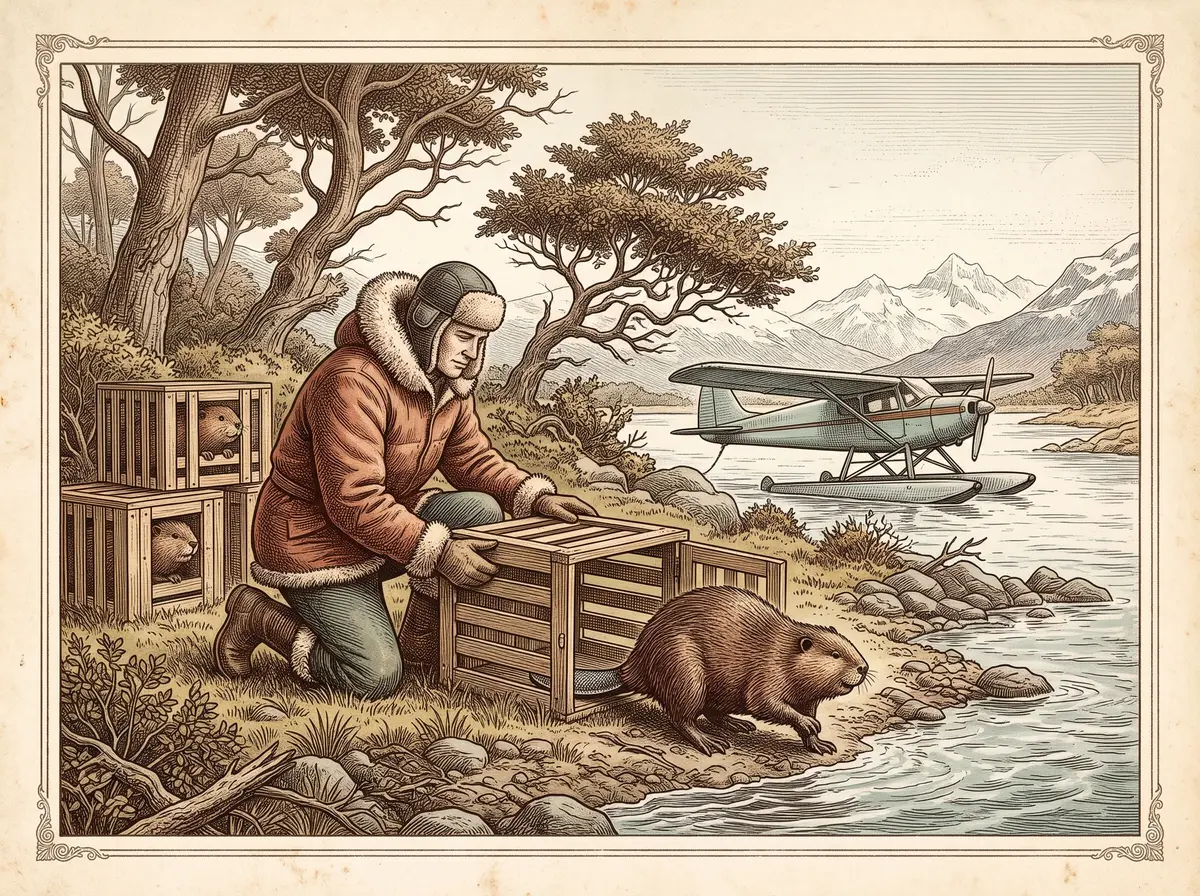
In the autumn of 1946, a Manitoba bush pilot named Tom Lamb loaded 20 live beavers onto a train, then a plane, then a flying boat, and sent them more than 10,000 kilometers south to the bottom of the Americas. The Argentine Navy wanted a fur industry. What it got, eight decades later, was tens of thousands of beavers, more than 70,000 dams, and a binational plan to get rid of every last one.
By the Curiosities Desk · · 5 min read · Filed under Biology · Today’s round
Part of The Animals Hired for a Job
What happened: Tierra del Fuego's Beavers
The story starts with a request. In September 1945, Argentine officials asked Thomas Lamb, a bush pilot and fur-country entrepreneur from Moose Lake, Manitoba, for 50 live beavers. Lamb was a natural pick. He had grown up in his family’s fur trading business, founded his own air company in 1935, and had spent years trying to bring back trapped-out muskrat populations in the marshes near home. Manitoba’s own beavers had nearly vanished from overtrapping by the 1930s and 1940s, and moving live beavers around to restock streams was routine work there.
Argentina’s idea was simple on paper. Tierra del Fuego, the windswept island at the southern tip of South America, has cold rivers, forests, and long winters. It looked a lot like Canadian beaver country, but it had no beavers. The Navy’s stated goals were to “enrich” the island’s native wildlife and to start a profitable fur trade.
Catching the animals did not go to plan. In a letter written in 1969, Lamb recalled that trapping at Caroline Lake, Devils Portage, and Big Creek lasted only three or four days before an early freeze set in. By late October 1946, his crew had 20 beavers — less than half the order — and the ice was closing fast.
So 20 it was. A Schenectady Gazette story from October 25, 1946, ran under the headline “Twenty beavers migrate to Argentina.” It reported that Lamb and his passengers had traveled by rail to New York, then by air to Miami, and were about to leave on a clipper (a long-range flying boat) bound for Argentina. In November 1946, the Argentine Navy released the beavers near the Claro River, northeast of Lake Fagnano, in the heart of the island. An Argentine newsreel, Sucesos Argentinos, filmed the release. According to National Geographic’s account of the footage, its announcer even fretted that because beavers pair for life, the colony might struggle if one partner died.
That worry turned out to be misplaced. With no wolves, bears, or other natural predators on the island, the beavers spread through stream after stream. They reached the Chilean side of the island by the 1960s and were confirmed on the Chilean mainland, across the Strait of Magellan, in 1997. Today estimates run from roughly 70,000 to 110,000 beavers across Tierra del Fuego and southern Patagonia, and one 2019 survey counted 70,682 dams on the Argentine part of the main island alone.
The fur trade, meanwhile, never took off. Pelts from Tierra del Fuego have sold for around $10 each, too little to make trapping worthwhile.
Why it was strange: Tierra del Fuego's Beavers
It was a plan that worked almost too well. The beavers did exactly what beavers do. The problem was the setting.
In North America, beavers and trees have been sparring for millions of years. Willows, aspens, and alders can resprout from a gnawed stump, and many tolerate soggy ground. Tierra del Fuego’s southern beech forests (trees in the genus Nothofagus) had never met a beaver. When the dams went up and the valleys flooded, those trees mostly just died, leaving gray stands of standing trunks that locals call ghost forests.
There is also a small mystery in the paperwork. For decades, books and papers repeated that 25 pairs — 50 beavers — were released in 1946. In 2014, biologists Alejandro Pietrek and Laura Fasola dug through newspapers, the newsreel, and Lamb’s own letter and found evidence of only one release, of 20 animals. The likely source of the “25 pairs” figure, they suggest, is the original order for 50 that Lamb never managed to fill. It’s a reminder that even a story about counting animals can get the count wrong. It also belongs on the same shelf as The Toad Australia Released to Fight a Pest — and Turned Into a Bigger One.
What scientists learned: Tierra del Fuego's Beavers
Beavers are what ecologists call ecosystem engineers: animals that physically rebuild their surroundings. Researchers now describe them as the most dramatic reshapers of Tierra del Fuego’s landscape since the last Ice Age. Their dams turn fast streams into still ponds, change how water and sediment move, kill streamside forest, and open the ground to other plants, including some that are not native either.
The island became an unplanned natural experiment in “predator release,” the idea that an introduced species can explode in numbers when it leaves behind everything that used to eat it. Genetic studies of the population also suggest the 20 founders were more genetically varied than earlier researchers had assumed. And the beavers showed how one introduced animal can affect even infrastructure: in 2017, beavers gnawed through fiber-optic cables near Ushuaia, knocking out internet and phone service. For more animals whose assignment went sideways, see The Animals Hired for a Job.
How it reaches us today: Tierra del Fuego's Beavers
In 2008, Argentina and Chile agreed to try something rare: not just controlling the beavers, but removing them entirely. Pilot projects since then have tested whether it’s possible. In one, published in The Journal of Wildlife Management in 2024, ten trappers working seven areas of Argentine Tierra del Fuego between 2015 and 2018 removed 1,012 beavers from 505 colonies. The authors concluded eradication is feasible with the right traps and placement, but estimated it would cost about $31 million over 17 years for the Argentine side alone.
The Tierra del Fuego beavers are now a standard case study in why moving animals to a new continent needs more than a good climate match. For a smaller-scale version of the same lesson, read The Four Hedgehogs Let Loose to Eat a Gardener’s Slugs — Whose Descendants Went for the Birds’ Eggs Instead.
Fun fact: Tierra del Fuego's Beavers
By Lamb’s own account, he charged $650 per beaver, plus expenses, to get them from Montreal to Ushuaia, and was paid $13,000 for the 20 animals that ended up remaking an entire island.
Sources: Tierra del Fuego's Beavers
- Alejandro G. Pietrek and Laura Fasola, “Origin and history of the beaver introduction in South America,” Mastozoología Neotropical 21(2): 355–359, 2014
- Pablo Jusim, Andrea P. Goijman and Adrián Schiavini, “A leap in scale for invasive species management: a medium-scale beaver eradication pilot project,” The Journal of Wildlife Management, 2024 (INTA repository record)
- Charles Choi, “Tierra del Fuego: the beavers must die,” Nature 453: 968, 2008
- “A landscape altered by beavers in Tierra del Fuego, Argentina,” National Geographic, July 2019
- “Thomas Lamb,” Canada’s Aviation Hall of Fame