Weird Medical History · Archaeology
The 2,000-Year-Old Pills That Stayed Dry at the Bottom of the Sea — and Briefly Tested Positive for Sunflower
Some time around 130 BC, a ship went down off the coast of Tuscany with a doctor's medicine chest on board. More than two thousand years later, archaeologists pried open a small tin box from that chest and found six gray tablets inside, flat as coins and completely dry. The sea had spent twenty centuries trying to get in and failed. Then the scientists who analyzed the pills got a surprise of their own: one early DNA test said they contained sunflower, a plant that would not reach Europe for another 1,600 years.
By the Curiosities Desk · · 5 min read · Filed under Archaeology · Today’s round
Part of Medicine, Before It Was Sure
What happened: The Pozzino Pills
The wreck sits about 18 meters (60 feet) down in the Gulf of Baratti, near the ruins of the Etruscan port city of Populonia. Divers first located it in 1974. Underwater archaeologists from the Archaeological Superintendency of Tuscany explored it in the early 1980s and excavated it from 1989. It is now known as the Relitto del Pozzino, the Pozzino wreck. The ship was small, roughly 15 to 18 meters (50 to 60 feet) long, and it sank sometime between about 140 and 120 BC.
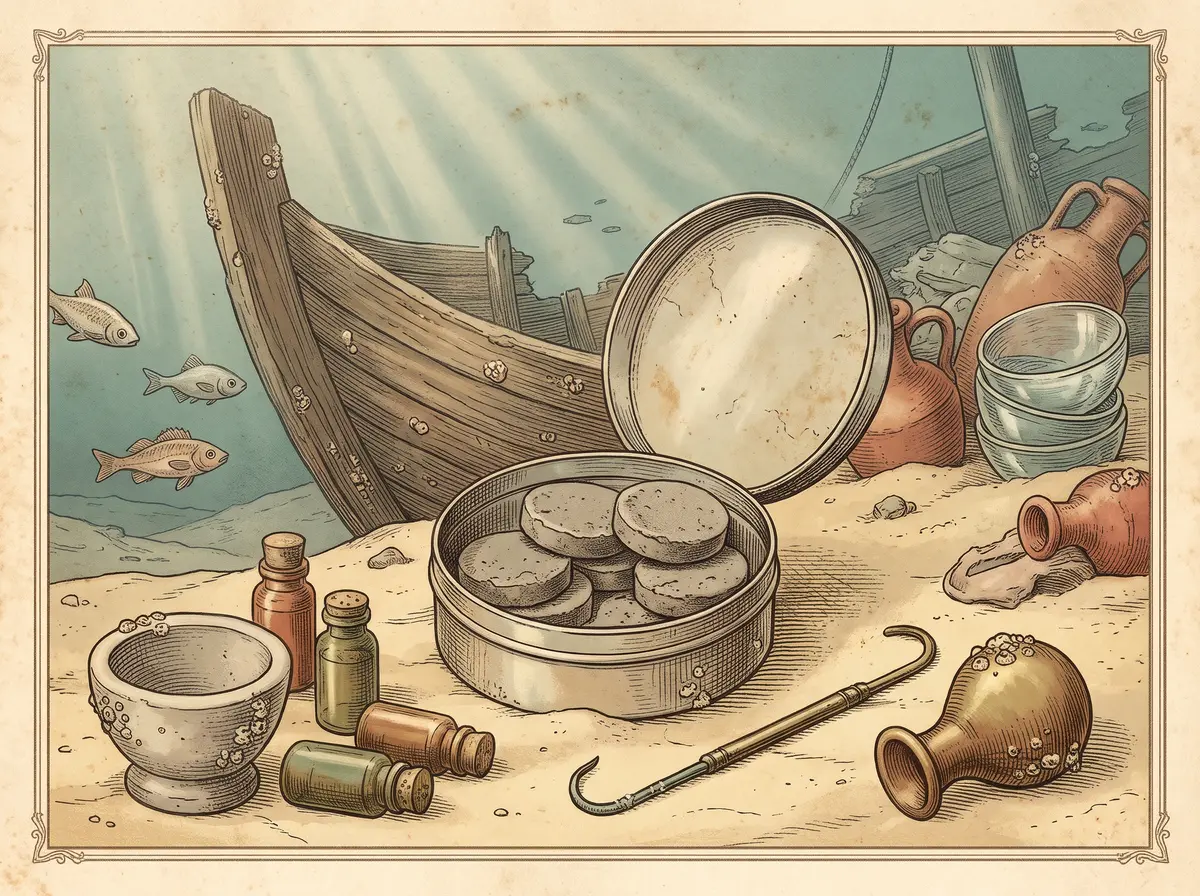
Its cargo pointed east. There were wine jars, stacks of glass bowls from the Syrian-Palestinian coast, lamps from Ephesus in Asia Minor, tin and bronze jugs, and an inkwell. Clustered together on the seabed was something far rarer: what looked like the contents of a physician’s kit. The wooden chest had rotted away, but its contents survived. They included a surgical hook, a mortar, a bronze cup probably used for bloodletting, 136 small boxwood drug vials, and several cylindrical tin boxes. Archaeologists call boxes like these pyxides (singular pyxis).
At least one pyxis was still sealed. Inside were six flat, round, gray tablets, each about 4 centimeters (1.6 inches) across and roughly 1 centimeter thick. Because the tin had kept seawater out, the tablets were intact.
The first scientific look came from the Smithsonian. Historian Alain Touwaide received fragments in 2004, and geneticist Robert Fleischer sequenced DNA extracted from two of them. In September 2010 Fleischer presented preliminary results at a biomolecular archaeology symposium in Copenhagen. The plant DNA read like a kitchen garden: carrot, radish, parsley, celery, wild onion, cabbage, alfalfa, yarrow, and hibiscus. It also turned up Helianthus, the genus that includes the sunflower. Sunflowers come from the Americas, so the team flagged that result as almost certainly modern contamination and said more work was needed. They had only recovered short DNA fragments, not complete sequences.
In January 2013, a team of Italian chemists led by Gianna Giachi published a full chemical, mineral, and botanical analysis in the Proceedings of the National Academy of Sciences. That study found that about 80 percent of a tablet was inorganic, and roughly three-quarters of that was zinc, in the form of two zinc carbonate minerals called hydrozincite and smithsonite. There was also iron oxide. The organic remainder held starch, a mix of plant and animal fats (possibly including olive oil), pine resin, and beeswax. Linen fibers ran through the material, and one tablet carried the imprint of fabric, as if it had been wrapped in cloth to keep it from crumbling.
Why it was strange: The Pozzino Pills
Ancient medical writers left us plenty of recipes, but the medicines themselves almost never survive. Pills are made to be used up, and the ones that are left behind dissolve, rot, or get thrown away. Finding a doctor’s tablets still dry inside their original container, at the bottom of the sea, is close to unheard of.
The two studies also told different stories. The DNA pointed to garden herbs. The chemistry pointed to a mineral medicine built around zinc. These are not necessarily contradictory, since a few herbs could be a small part of a mostly mineral pill. But the comparison shows how hard it is to read a 2,000-year-old sample, and how a single stray result, like the sunflower, can sneak into the data.
What scientists learned: The Pozzino Pills
The zinc was the key clue. The Roman naturalist Pliny the Elder wrote about cadmia, a zinc-rich material scraped from the walls of copper furnaces, and described its use for eyes and skin sores. The tablets’ flat, round shape also matched a known ancient product: the collyrium. In Latin, this meant an eye remedy. The word comes from a Greek term for small round loaves of bread. Collyria were often sold dry as little cakes, then wet and dabbed on the eye.
On that basis, the Italian team proposed that the Pozzino tablets were probably an eye medicine. Touwaide urged some caution. He noted that there were several kinds of cadmia, and only some were used for eyes; others went on wounds. So “eyewash” is the leading interpretation, not a settled fact.
The study also showed what the binding ingredients were doing. Starch and fat held the powder together, and pine resin may have helped preserve the fats and fight microbes. Pollen in the beeswax, mostly olive, wheat, nettle, and alder, hints at where the ingredients came from.
The ship’s eastern cargo suggests a physician traveling from the Greek world with his equipment. For another ancient wreck that held a scientific surprise, see The 2,000-Year-Old Computer Found in a Shipwreck.
How it reaches us today: The Pozzino Pills
Zinc never left the medicine cabinet. Zinc oxide is the main ingredient in calamine lotion, many diaper-rash creams, and mineral sunscreens. The word “calamine” itself once referred to zinc ores, including the same smithsonite found in the Roman tablets. “Collyrium” is still used in medicine as a formal word for an eye lotion.
The Pozzino tablets have also become a test case for archaeometry, the use of laboratory science on archaeological material. They showed what a full chemical workup can reveal, and how easily contamination can confuse ancient DNA results. Researchers now treat both methods as complementary checks on each other.
For a medicine that was meant to be reused rather than used up, see The Everlasting Pill That Families Fished Out of the Chamber Pot and Passed Down. Another set of ancient finds that turned out to hold medical evidence is in The 2,000-Year-Old Toilet Sticks That Proved the Silk Road Spread Disease. The tablets belong with the other treatments from before medicine was sure, in Medicine, Before It Was Sure.
Fun fact: The Pozzino Pills
Because “collyrium” comes from a Greek word for small round loaves, the doctor on the Pozzino ship was, in a sense, carrying a box of tiny zinc bread rolls for people’s eyes.
Sources: The Pozzino Pills
- Giachi, G., Pallecchi, P., Romualdi, A., Ribechini, E., Lucejko, J. J., Colombini, M. P., & Mariotti Lippi, M. “Ingredients of a 2,000-y-old medicine revealed by chemical, mineralogical, and botanical investigations.” Proceedings of the National Academy of Sciences 110: 1193–1196 (2013). https://doi.org/10.1073/pnas.1216776110 (primary source)
- Smithsonian Insider, “DNA sequencing reveals simple vegetables in ancient Roman medicines” (2010). https://insider.si.edu/2010/10/dna-sequencing-reveals-simple-vegetables-in-ancient-roman-medicines/
- Nature News Blog (Ewen Callaway), “Ancient DNA reveals ingredients of Roman medicine” (2010). https://blogs.nature.com/blog/roman_pills/
- Live Science (Charles Q. Choi), “Ancient Shipwreck Reveals 2,000-Year-Old Eye Medicine” (2013). https://www.livescience.com/26062-ancient-shipwreck-eye-medicine.html
- Smithsonian Magazine, “What’s Inside a 2,000-Year-Old, Shipwreck-Preserved Roman Pill?” (2013). https://www.smithsonianmag.com/science-nature/whats-inside-a-2000-year-old-shipwreck-preserved-roman-pill-403649/