Failed Experiments · Chemistry
The Bottle Labeled 'Iodine Chloride' That Held a New Element — Months Before Anyone Knew It Existed
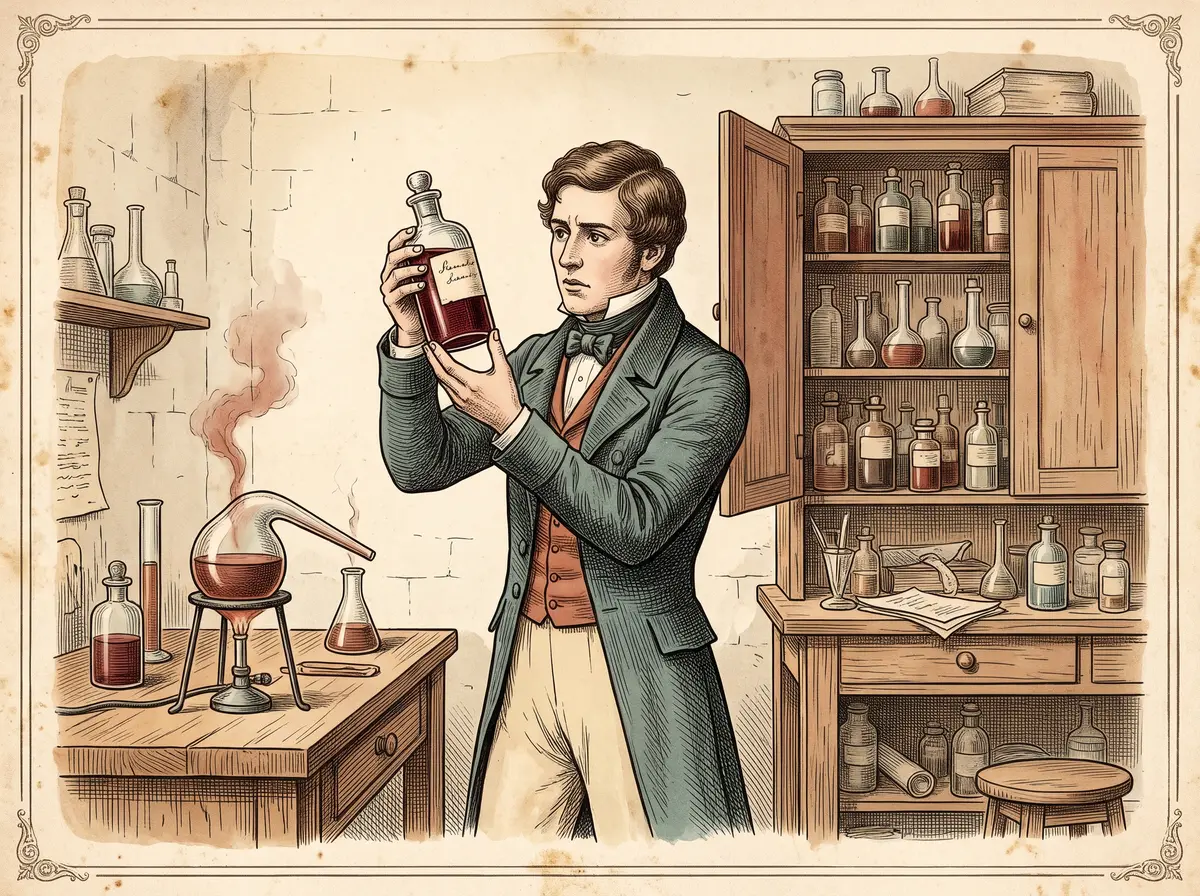
In 1826, news reached the young German chemist Justus von Liebig that a pharmacist's assistant in the south of France had discovered a new element: a heavy, dark red liquid with a stench so bad it was named for it. Liebig had a bottle of exactly that liquid on a shelf in his laboratory at Giessen. He had made it himself months earlier. The label on it said "iodine chloride."
By the Curiosities Desk · · 5 min read · Filed under Chemistry · Today’s round
What happened: The Element Bromine
In 1825, Liebig was only 22 and very new to his job. The Grand Duke of Hesse had installed him as a professor at the University of Giessen in May 1824, two weeks after his 21st birthday, and his lab occupied a former guardhouse with no running water. Like many chemists of the time, he took on analyses of mineral waters and the leftover brines from salt making. Later accounts say the liquid he was examining came from a salt works, and several place it at the salt springs of Bad Kreuznach, in the Rhineland.
When he treated that brine with chlorine, he got a reddish-brown liquid. It looked a lot like a compound already known to chemists, iodine chloride, made by combining the elements iodine and chlorine. Liebig noticed that it didn’t behave quite like iodine chloride in every way. But rather than run more tests, he settled on an explanation, wrote “iodine chloride” on the bottle, and moved on. In the words of one early 20th-century biographer, the bottle then sat on his shelf “for several months.”
Meanwhile, in Montpellier, Antoine-Jérôme Balard was doing something similar for a different reason. Balard, born in 1802, worked as a laboratory assistant at the city’s school of pharmacy and was studying iodine in seaweed and the salt marshes along the Mediterranean coast. When he passed chlorine through the bitter “mother liquor” left after salt crystallized out of seawater, a yellow-orange layer formed. He extracted it, distilled it, and collected a few drops of a deep red liquid.
Balard also first suspected a compound of chlorine and iodine. The difference is that he kept testing. He couldn’t find any iodine in it. He couldn’t break it apart into anything simpler. By the standards of the day, that meant it was an element. His former professor, Joseph Anglada, suggested the name “muride,” from the Latin muria, meaning brine. Balard sent his findings to the French Academy of Sciences, which appointed a commission to check the work. Its report, delivered on August 14, 1826, confirmed the discovery, and the element got a new name: brome, from the Greek bromos, “stench.” Balard’s full memoir appeared that year in the Annales de Chimie et de Physique.
As the Dictionary of Scientific Biography puts it, the discovery of a new element “by a young and obscure provincial pharmacist caused a sensation in Paris.”
Liebig wasn’t the only one left holding a bottle. In the autumn of 1825, Carl Löwig, a student at Heidelberg who grew up in Bad Kreuznach, brought his professor, Leopold Gmelin, a red, foul-smelling liquid he had pulled out of his hometown’s spring water. Gmelin recognized something new and asked him to make more. Exams and holidays got in the way, and Balard published first. Löwig later wrote a whole book on bromine, published in 1829.
Why it was strange: The Element Bromine
Liebig had done the hard part. He had isolated the substance, seen it with his own eyes, and even noticed that something about it was off. What he skipped was the boring part: the follow-up experiment that would have told him his label was wrong.
That’s what turns this from a near miss into a lesson. Balard and Liebig started from the same wrong guess. Balard treated it as a question to test, and Liebig treated it as an answer. When Liebig repeated Balard’s procedure, he wrote that it was “really so simple” and that he “did not come upon a single fact” that contradicted Balard’s conclusions.
As the story is usually told, Liebig put the mislabeled bottle in a special cupboard he called his “cupboard of mistakes,” as a reminder to himself. The cupboard appears in many retellings, though it is hard to trace to Liebig’s own writing, so treat it as a well-loved part of the legend. What’s better documented is the moral he drew. Accounts written in the decades after his death say he cited the episode as an example of an explanation not grounded in experiment, and resolved never again to take anything for granted.
He wasn’t the last great scientist to see something new and file it under a familiar name. See Science’s Most Embarrassing Mistakes for more.
What scientists learned: The Element Bromine
Bromine turned out to be a missing piece in a pattern. Chemists already knew chlorine, a greenish gas, and iodine, a dark solid that turns into violet vapor. Bromine, a liquid, sat neatly between them. Its atomic weight falls roughly halfway between theirs, and its chemistry looked like a blend of the two. That trio became one of the clearest early examples of chemical families, groups of elements that behave alike. Today they are called the halogens, from Greek words meaning “salt makers,” because they combine with metals to form salts like table salt.
Patterns like that eventually helped Dmitri Mendeleev organize the periodic table, as told in The Blank Squares That Predicted Three Undiscovered Elements.
Bromine also helps explain why Liebig’s guess was so tempting. Iodine chloride and bromine are both reddish-brown, both corrosive, both pungent. Looks alone could not tell them apart. Only experiments could.
How it reaches us today: The Element Bromine
Liebig recovered nicely. His Giessen laboratory became one of the most influential teaching labs in history, training students to do chemistry hands-on and to check their results. He went on to shape organic chemistry and agricultural chemistry.
Bromine found work too. Potassium bromide, which Balard had made in his first experiments, became a widely used sedative and anti-seizure medicine in the late 1800s. It was so associated with calm that “bromide” became slang for a dull person or a tired cliché, a usage popularized by the humorist Gelett Burgess in 1906. Today bromine compounds are used in flame retardants, water treatment, and medicines. The element itself was first produced in quantity starting in 1858, from the salt deposits at Stassfurt, Germany.
The cousin that came before bromine had its own messy debut, in The Seaweed Ash That Ate Its Own Vats — and Gave Up a New Element.
Fun fact: The Element Bromine
Bromine is one of only two elements that are liquid at room temperature. The other is mercury.
Sources: The Element Bromine
- Antoine-Jérôme Balard, “Mémoire sur une substance particulière contenue dans l’eau de la mer,” Annales de Chimie et de Physique 32 (1826): 337–384. Bibliographic record: Lynge & Søn rare books.
- Leo E. Klopfer, “The Discovery of Bromine,” History of Science Cases for High Schools, Harvard University (1960), with translated excerpts from Balard, Liebig, and the Academy’s commission.
- Siegfried Schindler, “Justus von Liebig,” Chemistry 5, no. 2 (2023): 1046–1059.
- Peter van der Krogt, “35. Bromine,” Elementymology & Elements Multidict (Balard, Löwig, Gmelin, and the naming of the element).
- “Liebig,” Biographies of Scientific Men (Wikisource), on the “liquid chloride of iodine” bottle.