Accidental Discoveries · Physics
The Cheap Cigar That Made an Invisible Quantum Discovery Appear
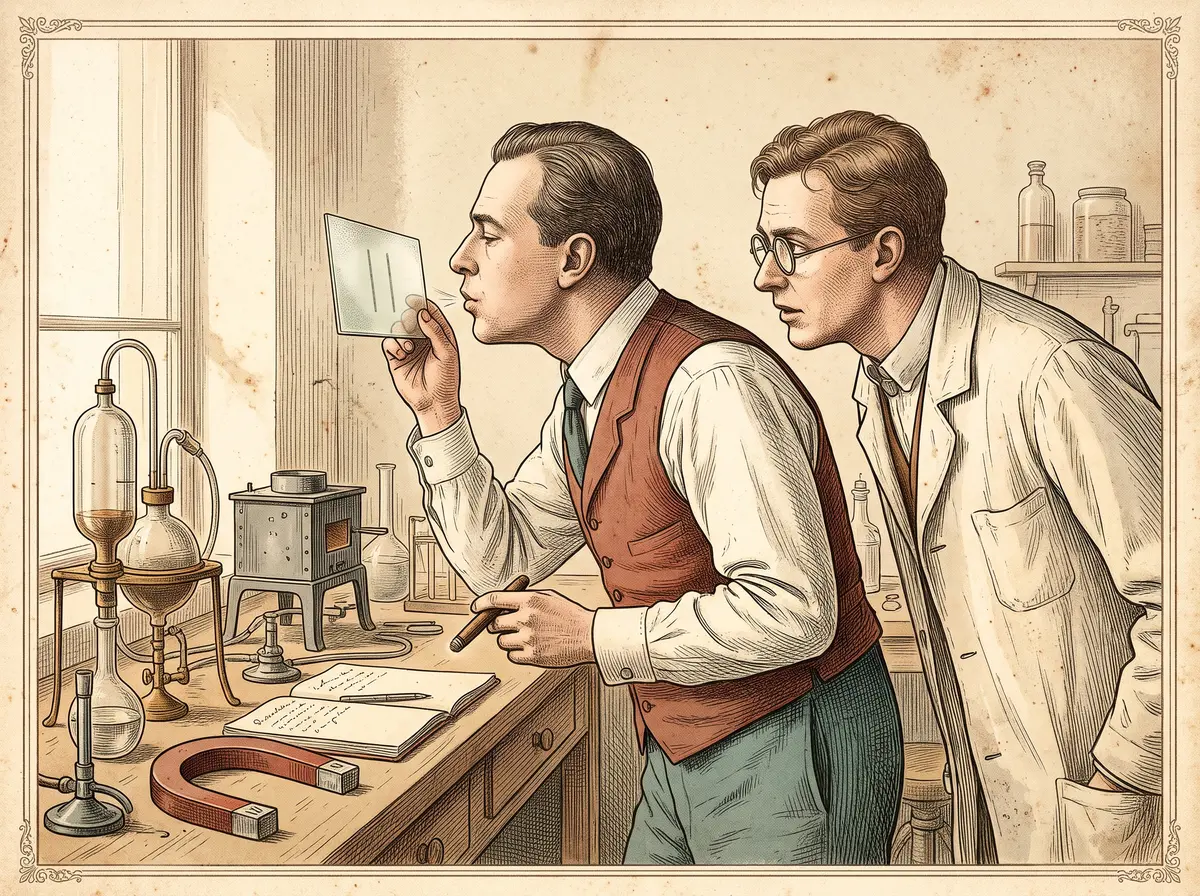
In Frankfurt in 1922, Walther Gerlach unbolted a small glass plate from a vacuum chamber, squinted at it, and saw nothing. He handed it to his colleague Otto Stern. As Stern leaned in close, a faint line slowly darkened into view on the blank glass, as if someone were developing a photograph. The developer, Stern later explained, was his breath, which smelled of the cheap cigars he smoked because his salary was too low for good ones.
By the Curiosities Desk · · 5 min read · Filed under Physics · Today’s round
What happened: The Stern-Gerlach Experiment
The experiment that Otto Stern and Walther Gerlach ran in 1921 and 1922 was built to settle an argument about atoms. Niels Bohr’s new model of the atom made a strange prediction: a tiny atomic magnet placed in a magnetic field should not be able to point in any direction it likes. It should only be allowed a few fixed directions. Physicists called this “space quantization,” and many did not believe it was real. Peter Debye dismissed the idea as “a timetable for the electrons.” Max Born, Stern’s colleague in Frankfurt, at first tried to talk him out of testing it.
Stern, a physical chemist who had worked with Albert Einstein, thought of a test. Heat silver in an oven to about 1,000 degrees Celsius until it boils off as vapor. Let the silver atoms stream out through two slits, each 0.03 millimeters wide, to form a thin beam. Fire that beam through a magnet shaped so the field is much stronger on one side than the other. Then let the atoms land on a glass plate.
If the atoms’ magnets pointed every which way, as everyday physics expected, the beam should simply smear out into a broad blur. If Bohr was right, it should split cleanly in two.
The work was miserable. The apparatus usually ran only a few hours before something broke. Germany’s postwar inflation was eating the lab’s money, and Born raised funds by giving public lectures. Even when the beam worked, the silver it left behind was roughly one atom thick, too thin to see.
That is where the cigar comes in. According to the account later written up by the physicists Bretislav Friedrich and Dudley Herschbach, Gerlach could find no trace of the beam on one plate and passed it to Stern. Stern’s sulfur-laden breath turned the invisible silver into silver sulfide, which is jet black, and the beam’s track appeared. In a later recollection told in his own voice, Stern put it simply: “My salary was too low to afford good cigars, so I smoked bad cigars.”
Even so, the first results were fuzzy. In early 1922 the two men met in Göttingen and nearly gave up. Then a railroad strike stranded Gerlach on his way home, giving him time to rethink. Back in Frankfurt, he improved the alignment and tried again. This time the trace on the plate was not a smear. It was two separate lines, split by about 0.2 millimeters. Stern received a telegram: “Bohr is right after all.” On a postcard to Bohr in early February 1922, showing the split pattern, Gerlach wrote, in translation, “Attached [is] the experimental proof of directional quantization.”
Why it was strange: The Stern-Gerlach Experiment
Because the atoms did something no everyday magnet can do. Toss a box of compass needles into a magnetic field and they will point in every direction in between. Silver atoms only came out “up” or “down.” Nothing landed in the middle.
Stranger still, the result was right for the wrong reason. Stern and Gerlach thought they had confirmed Bohr’s idea about the orbit of the silver atom’s outer electron. But that electron, it later turned out, has no orbital magnetism at all in silver’s ground state. The split came from something no one had imagined yet.
And it was only visible thanks to a bad habit. One of the cleanest results in early quantum physics was, at a crucial moment, developed by tobacco smoke. Another physics surprise that showed up on a plate nobody expected to read: The Spotted X-Ray Film That Traced the First Atomic Bomb — Through a Cardboard Box.
What scientists learned: The Stern-Gerlach Experiment
In 1925, two young Dutch physicists, George Uhlenbeck and Samuel Goudsmit, proposed that the electron carries its own built-in magnetism, as if it were a tiny spinning top. They called it “spin.” It comes in exactly two settings, usually called up and down. By 1927, physicists realized that spin, not the electron’s orbit, was what had split the silver beam. Stern and Gerlach had seen spin three years before anyone had a name for it.
The deeper lesson was about measurement itself. In the quantum world, some properties do not take a continuous range of values. Ask an electron which way its magnet points, and it can only answer with one of a few allowed results. The experiment became a standard teaching example of that idea, and it still opens many quantum mechanics textbooks.
Stern went on to build a whole field of “molecular beam” experiments. He won the 1943 Nobel Prize in Physics for the molecular ray method and for measuring the magnetic moment of the proton. For more finds that turned up while researchers were after something else: The Physicist Who Tried to Bottle a Mountain Fog — and Caught Subatomic Particles Instead.
How it reaches us today: The Stern-Gerlach Experiment
Spin is behind a good deal of modern technology. Magnetic resonance imaging (MRI), the hospital scanner that maps the inside of the body, works by flipping the spins of atomic nuclei in a strong magnetic field and listening for the signal they give off. Atomic clocks, which keep GPS satellites accurate, rely on carefully controlled spin states in atoms. Many proposed quantum computers store information in spin.
The original beam-splitting trick lives on, too. Physicists still use magnets to sort atoms and particles by their spin, the same basic move Stern and Gerlach made with a furnace of silver. In February 2002, a plaque was mounted at the entrance to the Frankfurt building where they worked, showing the two men on either side of the split beam.
A result that showed up while someone was looking at a blank plate belongs with Found While Looking for Something Else.
Fun fact: The Stern-Gerlach Experiment
When Friedrich and Herschbach re-enacted the cigar story for that 2002 dedication, plain sulfurous breath did almost nothing to a silver film. Cigar smoke blackened it within seconds to minutes. Their conclusion: it was probably Stern’s smoke, not just his breath, that made the beam appear.
Sources: The Stern-Gerlach Experiment
- Bretislav Friedrich & Dudley Herschbach, “Stern and Gerlach: How a Bad Cigar Helped Reorient Atomic Physics,” Physics Today 56, no. 12 (2003): 53–59.
- W. Gerlach & O. Stern, “Der experimentelle Nachweis der Richtungsquantelung im Magnetfeld,” Zeitschrift für Physik 9 (1922): 349–352. English translation on arXiv.
- Niels Bohr Archive, “Postcard from Walter Gerlach to Niels Bohr” (1922).
- The Nobel Foundation, “The Nobel Prize in Physics 1943: Otto Stern”.