Accidental Discoveries · Physics
The Two Clocks That Fell Into Step While Huygens Was Stuck in His Room
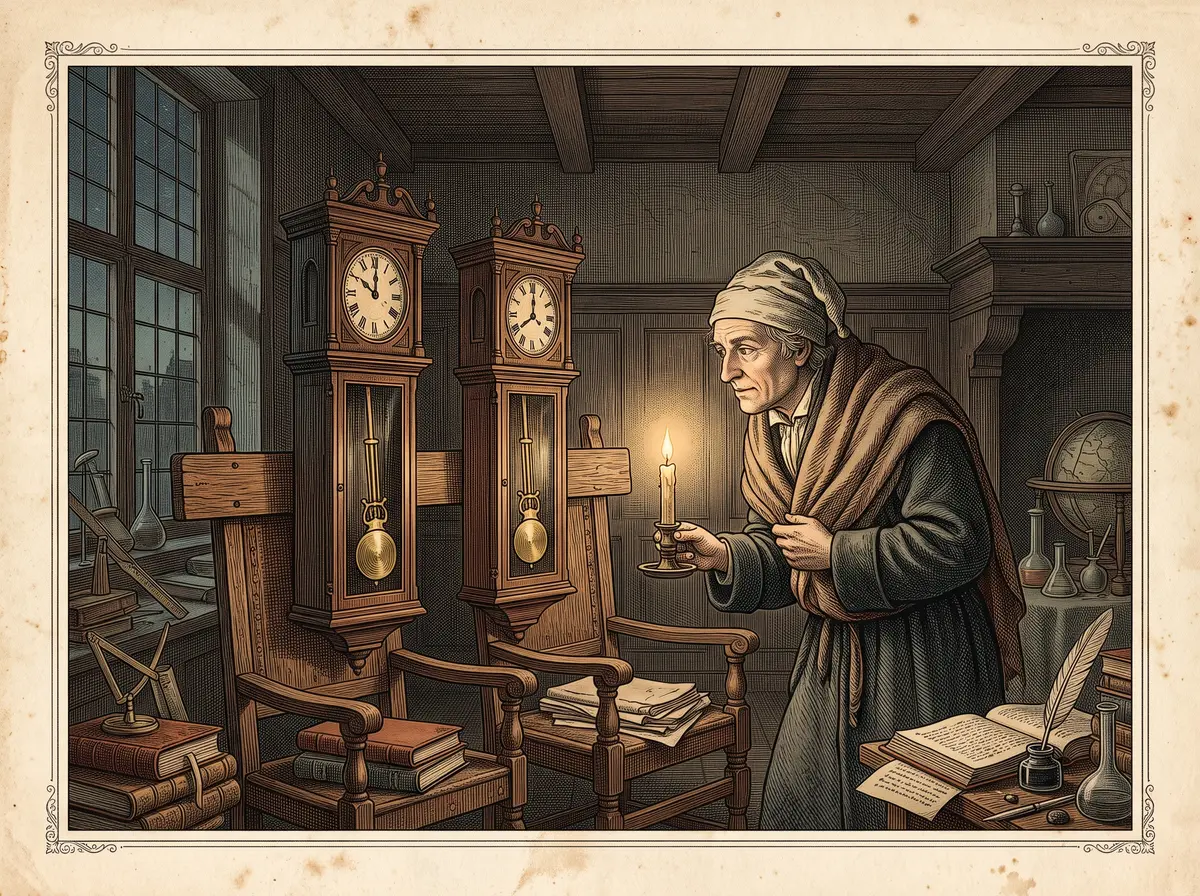
In February 1665, the Dutch scientist Christiaan Huygens was stuck indoors at home in The Hague with nothing much to look at but two of his own pendulum clocks, hung side by side from a board propped across two chairs. He knocked their pendulums out of rhythm. About half an hour later, they were swinging in perfect, mirror-image step again. He did it again. They did it again. Two machines that had no business knowing about each other appeared to be keeping each other company.
By the Curiosities Desk · · 5 min read · Filed under Physics · Today’s round
What happened: Huygens's Clock Synchronization
Huygens had patented the pendulum clock in 1657, and by the 1660s he was trying to make it do something much harder than tell time in a parlor: find a ship’s position at sea. Sailors could work out latitude from the Sun and stars, but longitude (how far east or west you are) required knowing the exact time back at your home port. A clock that kept perfect time on a rolling deck would solve one of the deadliest problems in navigation.
So Huygens’s new clocks were built for the ocean. Each sat in a case weighted with lead, roughly 100 pounds in all, to steady it against the waves. In 1664 a pair had already gone to sea on a voyage commanded by the English officer Robert Holmes, as part of trials Huygens ran with the Scottish nobleman Alexander Bruce.
Back home in early 1665, Huygens wrote to his father, Constantijn, on 26 February that he had been “forced to keep to my chambers for some days.” Later retellings, including the Georgia Tech team that studied his notes, say he was recovering from an illness. Whatever the reason, he had time to watch his clocks closely. They hung one or two feet apart from a single board resting on two chairs.
What he saw bothered him. The two pendulums always ended up swinging at exactly the same rate, but in opposite directions, approaching each other and then pulling apart, like a pair of dancers mirroring one another. Physicists now call this anti-phase synchronization: same rhythm, opposite timing. When Huygens deliberately mixed up their beats, they settled back into that pattern within about half an hour and stayed there.
He tested it like a good experimenter. He moved one clock to the far side of the room, about fifteen feet away. Now the two drifted apart by around five seconds in a day, the normal disagreement of two separate clocks. Bring them back close, and the agreement returned. He even put a board between them, and the effect held.
He wrote to the Liège mathematician René-François de Sluse, to his father, and to Sir Robert Moray of the Royal Society of London. The Society’s minutes recorded the news as “an odd kind of sympathy” between the clocks.
Why it was strange: Huygens's Clock Synchronization
A clock is supposed to be the most independent object in the house. Its entire job is to keep its own time, no matter what anything else is doing. Two good clocks should agree because each is accurate, not because they are quietly adjusting to each other.
Worse, for Huygens’s purposes, this was a bug. A sea clock that could be nudged by its neighbor might also be nudged by the ship. The “sympathy” was charming in a sickroom and worrying on a deck.
Huygens’s first guess was that the swinging pendulums stirred the air in some imperceptible way. Within about a week he changed his mind and blamed something more solid: tiny, almost invisible movements of the board and the chairs holding it. That second guess turned out to be the right idea. It’s the same quiet coupling that shook a famous footbridge in The Wobbly Bridge That Closed Two Days After Opening — Because People Walked on It.
What scientists learned: Huygens's Clock Synchronization
Huygens had stumbled on coupled oscillators: two rhythmic things linked by a shared connection, so that each one’s motion slightly pushes on the other. Every swing of a pendulum gives its support a tiny shove. The other clock feels that shove and is sped up or slowed down a hair. Over many swings, the two settle into a pattern where those shoves balance out.
Explaining it precisely took centuries. An English clockmaker, John Ellicott, reported in 1740 that clocks sharing a support could even stop each other. The Dutch mathematician Diederik Korteweg made the first formal attempt at the mathematics in 1906.
In 2002, a team at the Georgia Institute of Technology (Bennett, Schatz, Rockwood and Wiesenfeld) rebuilt the experiment with two small pendulum clocks on a wheeled platform. They found Huygens had been somewhat lucky. Anti-phase lock-step only happens if the two clocks already run at very nearly the same rate, and only if the coupling is just right. Too weak, and they drift apart. Too strong, and one clock can stop the other entirely. The hundred pounds of lead Huygens added for seaworthiness happened to put his setup in the sweet spot.
The story isn’t fully settled. In 2016, researchers hung two large pendulum clocks from a wooden structure and watched them synchronize in the same direction instead of opposite ones. Their models suggest the damping of the support (how quickly it soaks up vibration) can decide which pattern wins. If you want to see where sea clocks went next, read The Self-Taught Carpenter Who Solved the Deadliest Problem in Ocean Navigation.
How it reaches us today: Huygens's Clock Synchronization
Huygens’s pendulum clocks never solved longitude. John Harrison’s marine chronometers did that in the next century, using balance springs instead of swinging pendulums.
But the “odd kind of sympathy” became one of the founding examples of synchronization, a field of science that studies how separate rhythms lock together. The same basic idea helps engineers think about generators on a power grid that must stay in step, arrays of lasers, and tiny superconducting circuits. Biologists use related math for heart pacemaker cells firing together and fireflies that flash in unison. And physics teachers use it for a favorite classroom demo: a row of ticking metronomes on a board resting on soda cans, falling into step all on their own.
It started with a man stuck in his room who noticed his clocks were behaving more like friends than machines, and didn’t shrug it off. It’s a fitting entry in Found While Looking for Something Else.
Fun fact: Huygens's Clock Synchronization
When the 2016 team’s two big clocks synchronized, both ran slow by about 47 seconds an hour — falling into step made them worse at their actual job.
Sources: Huygens's Clock Synchronization
- Christiaan Huygens, Oeuvres complètes, Tome V: Correspondance 1664–1665 (letters of February–March 1665 to his father and to Robert Moray), via DBNL
- J. Peña Ramirez, L. A. Olvera, H. Nijmeijer and J. Alvarez, “The sympathy of two pendulum clocks: beyond Huygens’ observations”, Scientific Reports 6, 23580 (2016)
- Innovations Report / Georgia Institute of Technology, “The mystery of Huygens clocks explained” (2002), on Bennett, Schatz, Rockwood and Wiesenfeld, “Huygens’s clocks,” Proceedings of the Royal Society A 458 (2002)
- Physics World, “The secret of the synchronized pendulums”
- Idols of the Cave, “An Odd Kind of Sympathy” (translation and timeline of Huygens’s 1665 letters, with Royal Society minutes)