Everyday Objects · Engineering
The Department Store That Served Brandy at the Top of Its Moving Staircase
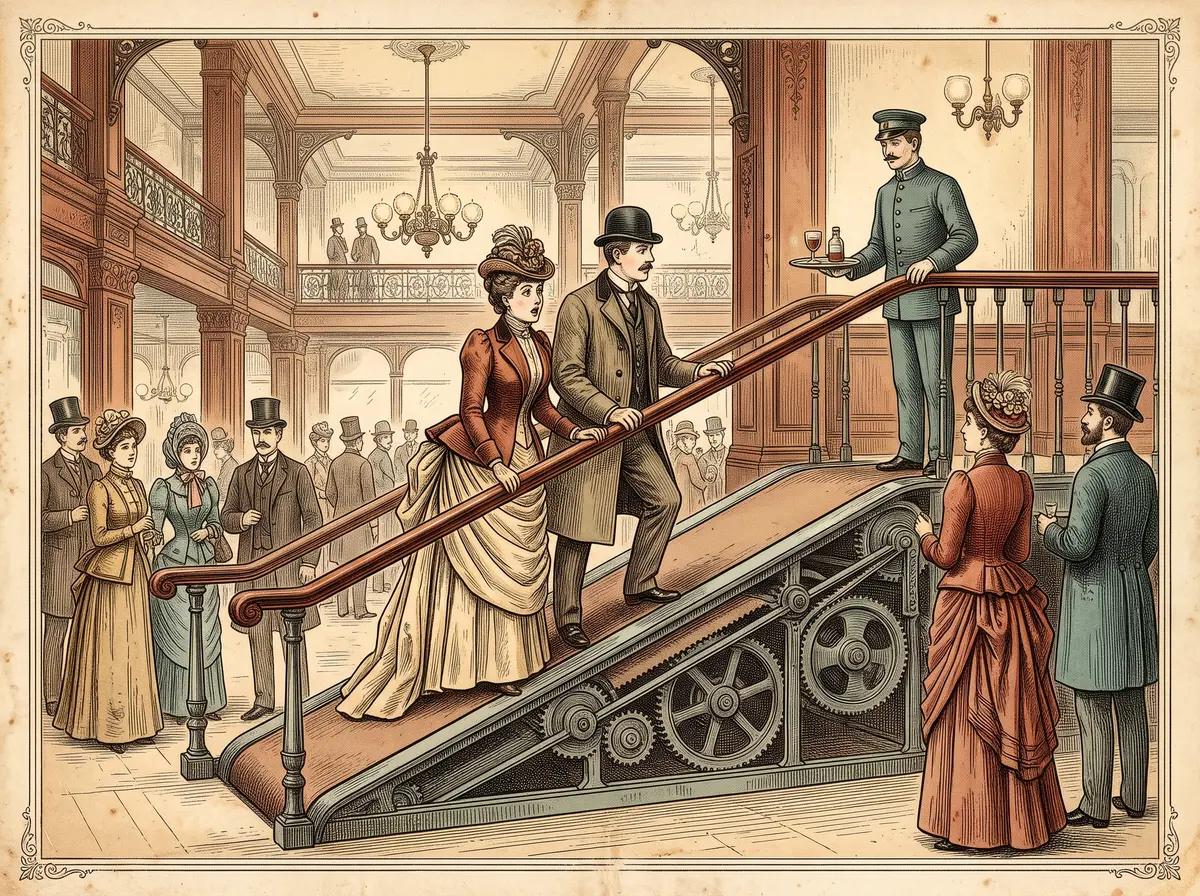
On November 16, 1898, shoppers at Harrods in London stepped onto a moving leather belt and rode it, gripping a mahogany handrail, up to the next floor. According to a story historians and guidebooks have repeated ever since, an attendant waited at the top with a small reward for anyone who made it: a glass of brandy for the shaken, and smelling salts for anyone who felt faint.
By the Curiosities Desk · · 5 min read · Filed under Engineering · Today’s round
What happened: The Escalator
The escalator story starts with a staircase that never existed. In 1859, a Massachusetts patent attorney named Nathan Ames patented “Revolving Stairs,” a loop of steps meant to carry people between floors. Nobody ever built one.
The first moving stairway that actually moved came from Jesse W. Reno, a mining engineer who had graduated from Lehigh University in 1883. On March 15, 1892, he received U.S. Patent No. 470,918 for an “Endless Conveyer or Elevator.” His patent describes an endless belt of hinged cast-iron sections running at a slope of about 25 degrees, at roughly 200 feet per minute, with handrails that moved at the same speed as the belt. At each end, a comb-like landing let riders step off without their feet being pulled under. Reno pitched the idea for a proposed New York subway, and the city turned him down.
So in 1896 he took it to the beach. Reno set up his “inclined elevator” at the Old Iron Pier on Coney Island, where it ran for two weeks as a novelty ride. It lifted riders a grand total of about seven feet. According to the Hagley Museum and Library and the National Inventors Hall of Fame, an estimated 75,000 people lined up to try it. A few months later, the same machine got a month-long trial at the Manhattan end of the Brooklyn Bridge, where it could do a real job: moving crowds.
Two years later the idea crossed the Atlantic. Harrods unveiled what is usually described as England’s first moving staircase on November 16, 1898. It was not a staircase at all but a sloped conveyor, a continuous belt said to be made of 224 linked pieces of leather, built by the French firm Piat. Riders stood on the incline and slid their hands along the rail.
That is where the brandy comes in. Historian Bill Lancaster, in The Department Store: A Social History, reports that shoppers who were unsettled by the ride were revived with free smelling salts and cognac. The detail has been repeated so often, in histories and London guidebooks, that it is hard to trace back to an 1898 eyewitness, so treat the exact drink order as a well-loved store legend rather than a recorded fact. What is clear is that for many people in 1898, letting the floor carry you upward was a new and slightly alarming experience.
Meanwhile, inventor Charles Seeberger was working on a design closer to the one we know, with flat steps instead of a smooth slope. He teamed up with the Otis Elevator Company, and their machine won first prize at the 1900 Paris Exposition. Seeberger also needed a name. He later said he built it from a Latin dictionary, joining “scala” (steps) with the prefix “e” and the suffix “tor.” He trademarked “Escalator” in 1900 and intended it to be said “ess-KAL-a-tor.” By 1906, he admitted, the public had settled on “ESS-ka-lay-tor” instead.
Why it was strange: The Escalator
We now step onto escalators without thinking, often while looking at a phone. But the first riders had no habits for this. A floor that moves upward sounds like a magic trick, and the earliest versions asked people to trust a belt of iron or leather to carry their whole body weight up a slope.
The worry wasn’t silly. When the London Underground opened its first escalators at Earl’s Court station on October 4, 1911, a Board of Trade report on the first week listed nine torn dresses, one pinched finger, and a passenger on crutches who fell. After a guard rail was added, no more accidents were reported in the following three weeks. Learning to ride took practice, and the machines had to learn too.
The Underground had its own reassurance strategy, and it’s the opposite of brandy. According to a popular story, the railway asked an engineer with an artificial leg, known as “Bumper” Harris, to ride up and down on opening day to show that anyone could do it safely. Even London transport historians say there is some doubt about whether that happened the way it’s told.
The early escalator sits comfortably with The Grocer Who Hired Fake Shoppers to Push His Invention Around the Store, another device that store owners first had to talk customers into trying.
What scientists learned: The Escalator
Reno’s patent already held most of the engineering ideas that make escalators work. A long loop of linked sections runs over gears, called sprockets, at the top and bottom, so the moving surface circles back underneath. A handrail moving at the same speed as the feet keeps a rider’s body steady; a stationary rail, like the one Harrods riders reportedly slid their hands along, pulls the hand back while the feet move forward.
The trickiest part is the handoff at the ends. Seeberger’s first flat-step design had smooth steps that slipped under a triangular divider, so riders had to step off sideways. Reno’s combs, teeth that let ridged steps slide underneath while the rider’s foot glides onto solid floor, turned out to be the better answer. The comb-and-groove landing is still standard.
Engineers also learned that escalators move far more people than elevators. An elevator carries a small group and then makes everyone wait. An escalator never stops, so it can empty a crowded train platform or a store’s ground floor in a steady stream.
How it reaches us today: The Escalator
Escalators shaped the modern department store, the subway, and the shopping mall, all of which depend on moving crowds between floors without lines. By its centenary in 2011, the London Underground alone ran 422 of them.
The name ended up on the move, too. Otis held on to “Escalator” as a trademark for decades, so competitors sold “Motorstairs” and “Moving Stairs.” In 1950, in Haughton Elevator Co. v. Seeberger, the U.S. Patent Office ruled that the public used “escalator” as the ordinary word for any moving stairway. Otis lost its exclusive claim, and the word became the common noun it is today.
Like many familiar machines with odd beginnings, it belongs with The Ordinary Object With the Strange Origin.
Fun fact: The Escalator
The machine that launched the escalator industry was a beach ride that lifted people about seven feet, roughly the height of a tall doorway, and some 75,000 people waited in line to try it.
Sources: The Escalator
- Jesse W. Reno, U.S. Patent No. 470,918, “Endless Conveyer or Elevator” (March 15, 1892) — primary source
- Hagley Museum and Library, “On March 15, 1892, the American inventor and engineer…” — Hagley Vault archive note on Reno’s inclined elevator
- National Inventors Hall of Fame, “Jesse Wilford Reno”
- Ian Visits, “100th Anniversary of the Escalator on London Underground” — includes the 1911 Board of Trade first-week report
- Wikipedia, “Escalator” — starting point; cites Bill Lancaster, The Department Store: A Social History (1995), for the Harrods smelling-salts-and-cognac account